Zeldin is Lying about your Healthcare


In his robocalls Zeldin uses a local physician to assure patients and constituents that he and the Republicans are not about to

  • deny insurance for pre-existing conditions
  • will not touch medicare
  • will not abolish social security

The physician, Dr. Vacirca, identifies himself and his practice twice in the robocall. He said Zeldin supports care for patients with pre-existing conditions and supports Social Security and Medicare, while [the democratic oponent] Gershon supports “socialist-style, government control” health care that will drive up taxes and bankrupt Medicare.

Jessica Waterbury, a patient of Dr. Vacirca, said she found Vacirca’s relationship with the Zeldin campaign “troubling.”

“Now that this information has come to light, I am more than dismayed, and do not want the money that paid for my treatment going to someone who is willing to take away protections for pre-existing conditions (like my cancer), and who voted against the individual market for health insurance,” Waterbury said.


Mitch McConnell disaggrees with Zeldin:

Republicans Will Take on Obamacare and Entitlements if They Win in Midterms, Mitch McConnell Says.  By

“…after indicating that he would like to cut spending on Social Security, Medicare and Medicaid, Senate Majority Leader Mitch McConnell told Reuters that if Republicans win the Senate this November, they will once again take up their fight to repeal the Affordable Care Act, also known as Obamacare.

McConnell … clarified his desires to cut spending on Medicare, Medicaid and Social Security programs,”

Nothing surprising about these devious maneuvers.  The Republican mojo has been clear for a while:

1st hand out a huge tax cut for the super rich that fund the Rep. party.

2nd complain about the deficit they created and blame it on Medicare, Medicaid, Obamacare and Social Security

3rd repeal Obamacare and cut all the social programs drastically

safe_image-1


Posted in ACA, Health Care, Medicaid, medicare, Seniors, Social security, Uncategorized, Zeldin | Tagged , | Leave a comment

Lee’s Extreme Voting Record

By David Friedman: Letter to the Editor in today’s Smithtown News on Lee’s extreme voting record:

Screen Shot 2018-10-20 at 12.00.22 AM

Screen Shot 2018-10-20 at 12.00.34 AM

Posted in Uncategorized, Zeldin | Tagged , , , | 1 Comment

Lee Zeldin’s ‘Concealed Carry Reciprocity Act’ Puts Your Kids at Risk

Currently, New York sets its own rules for who can carry a hidden, loaded handgun in public – as it should be. Lee Zeldin’s project, the Concealed Carry Reciprocity Act, would take our rights away so that states with weaker gun safety laws would override our current regulations. This is the NRA’s top legislative priority and Lee Zeldin co-sponsors the Concealed Carry Reciprocity Act. We need commonsense gun violence prevention laws, and not laws that make our communities less safe.


Posted in Guns, NRA, Trump, Uncategorized, Zeldin | Tagged , , | Leave a comment

The Blue Wave in CD-1

I have always wanted to know whether our efforts of canvassing and voter registration are actually paying off!

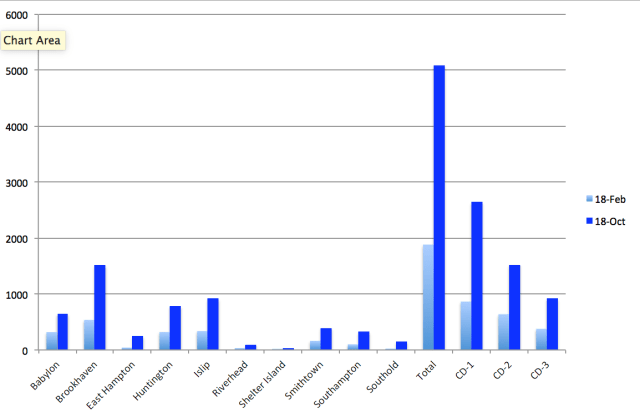
Now we have some data.  Suffolk County Board of Elections collects data on new voter registrations on a monthly basis.  I have compared data published in Feb 2018 with data published on October 1st 2018.  New Voter registrations are definitely up (Fig. 1).  And it turns out that they are heavily skewed towards Dem. party registration (see Fig. 2).  The numbers are actually about 2x higher than in comparable midterm election years from the past.  This bodes well for a “blue wave”.

Screen Shot 2018-10-06 at 6.25.57 PM

Fig. 1.  Data on new voter registrations for Feb 2018 (light blue) versus October 2018 (dark blue).


Screen Shot 2018-10-05 at 8.15.44 PM.png

Fig. 2.  New voter registrations are heavily skewed towards the Dem. party, data from October 2018.  Not shown are percentages of C, II, WP, U, etc.

These numbers have to be  considered in the context of  general population changes.  It turns out that the general population in Suffolk County has been shrinking steadily.  For the period of 2/2018 to 10/2018 the numbers are:

Date                 2/2018             10/2018

Suffolk             961,409             954,150             -0.76%

NY-CD1            472,989             470,344             -0.56%

NY-CD2            320,104             316,739             -1.05%

NY-CD3            168,316             167,067             -0.74%

This mirrors a similar decrease in the total population comparing 2015 to 2016 (-0.76%) and 2016 to 2017 (-0.6%).  There are still more births than deaths, and more international arrivals than domestic arrivals. Thus, the decrease in the population on eastern Long Island is most likely due to young people leaving Suffolk county, a well-recognised phenomenon.  Are these young people that are leaving Suffolk, mainly democrats?  Are they being replaced by newly registered people that are also mainly democrats?  If this were the case the overall percentages of people in the Dem party would not have changed much.  But the data show that the Dem party has been growing faster than any other party in NY CD-1.

Here are the numbers of total registered Dem and Rep voters in NY CD-1 from 2012 and from Oct 2018:

Date                 2012            10/2018

Dem                  132,683          144,211         +8.7%

Rep                   156,075           159,184        +1.99%

All voters         445,374           470,344        +5.61%

Comparing data for all political party registrations between 2012 and 2018, Dems are up +8.7%, Rep +1.99%, Con -2.13%, Indep +5.95%, Unaffiliated +5.32%, Working families -0.32%.

Sources:

Voter reg Oct 2018

https://www.elections.ny.gov/NYSBOE/enrollment/congress/congress_nov12.pdf

https://resistancesuffolk.blog/2018/02/08/new-registrations-favor-dems-in-cd-1/


Posted in Canvassing, long island, Uncategorized, Zeldin | Tagged , , , | 1 Comment

Lee Zeldin: We call BS when we see BS!

Screen Shot 2018-10-05 at 6.36.39 PM.png
By Marc Rauch
To the editor of the Long Island Advance:

NY-01 Representative Lee Zeldin has tried to portray himself as an environmentalist in a recent TV campaign ad, in press releases and in letters to constituents. However, a new report released last week by the Environmental Working Group Action Fund, a Washington, D.C. based group that seeks to protect people, communities and natural resources from the health and environmental consequences of toxic chemicals, suggests just the opposite.

EWG rated all 435 Members of the House on 17 recent House votes impacting toxic chemicals safeguards. Mr. Zeldin voted to weaken safeguards against these poisons, not to strengthen them, all 17 times. Mr. Zeldin’s “0” rating tied him with Claudia Tenney, an upstate Republican, for dead last in the 27-member New York House delegation. The full report can be found at https://www.ewgaction.org/protectyourhealth/billsummaries.html.

Adding this new report on toxic chemicals to Zeldin’s consistently rock-bottom across-the-board ratings from the national League of Conservation Voters, NY-01 voters should treat Zeldin’s claims to have their health and environmental concerns at heart with the deepest of skepticism.

Yours truly,

Marc Rauch
Bellport

Posted in Environment, EPA, Health Care, long island, Uncategorized, Zeldin | Tagged , , | 1 Comment

Gershon vs. Zeldin on Gun Legislation

Printed as a Letter to the Editor in The Independent, Oct. 3, 2018

More Guns?

Thank you for printing “Zeldin and Gershon Square Off,” so that voters know where each candidate stands on various topics. One important issue that was not covered in the article, however, is gun safety. Lee Zeldin co-sponsored and voted for the Concealed Carry Reciprocity Act, which would allow any person with a concealed carry permit from another state (with weaker gun laws that don’t require a background check or safety training, for example) to carry their weapon in New York.

Law enforcement is overwhelmingly opposed to this bill, since more guns on the streets means more lives at risk. In fact, an association representing 18,000 police departments across the country sent a letter to Congress asking them to reject this legislation, noting it would “hamper law enforcement efforts to prevent gun violence.”

Perry Gershon supports common sense gun measures, and that includes upholding New York’s strong gun laws, rather than undermining them.

Sincerely,

Carol Deistler

Posted in democrats, Guns, long island, perry gershon, school shootings, Uncategorized, Zeldin | Leave a comment

Open Letter to the United States Senate from Law Professors Around the Country

Screen Shot 2018-10-03 at 3.04.42 PM.png
Judicial temperament is one of the most important qualities of a judge. As the Congressional Research Service explains, to be a judge requires that an individual have
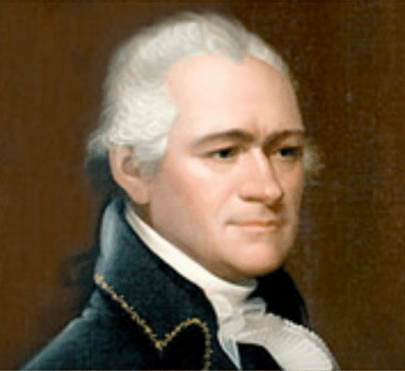
“a personality that is evenhanded, unbiased, impartial, courteous yet firm, and dedicated to a process, not a result.” (1) The concern for judicial temperament dates back to our founding; in Federalist Paper 78, entitled “Judges as Guardians of the Constitution,Alexander Hamilton expressed the need for “the integrity and moderation of the judiciary.”
We are law professors who teach, research, and write about the judicial institutions of this country. Many of us appear in state and federal court, and our work means that we will continue to do so, including before the United States Supreme Court. We regret that we feel compelled to write to you to provide our views that at the Senate hearings on Thursday, September 27, 2018, the Honorable Brett Kavanaugh displayed a lack of judicial temperament that would be disqualifying for any court, and certainly for elevation to the highest court of this land.
The question at issue was of course painful for anyone. But Judge Kavanaugh exhibited a lack of commitment to judicious inquiry. Instead of being open to the necessary search for accuracy, Judge Kavanaugh was repeatedly aggressive with questioners. Even in his prepared remarks, Judge Kavanaugh located the hearing as a partisan question, referring to it as “a calculated and orchestrated political hit,” rather than acknowledging the need for the Senate, faced with new information, to try to understand what had transpired. Instead of trying to sort out with reason and care the allegations that were raised, Judge Kavanaugh responded in an intemperate, inflammatory, and partial manner, as he interrupted and, at times, was discourteous to questioners.
As you know, under two statutes governing bias and recusal, judges must step aside if they are at risk of being perceived as or of being unfair. See 28 U.S.C. §§ 144, 455. As this Congress has put it, a judge or justice “shall disqualify himself in any proceeding in which his impartiality might reasonably be questioned.” 28 USC § 455.
These statutes are part of a myriad of legal commitments to the impartiality of the judiciary, which is the cornerstone of the courts.
We have differing views about the other qualifications of Judge Kavanaugh. But we are united, as professors of law and scholars of judicial institutions, in believing that Judge Kavanaugh did not display the impartiality and judicial temperament requisite to sit on the highest court of our land.
Signed, with institutional affiliation listed for identification purposes only,
523 Professors, 90 Schools, [and counting]
Note: We invite law professors to sign this open letter to the United States Senate. We will deliver the letter to the Senate on Thursday, October 4, 2018, at 12:00 noon EST. If you are a law professor and interested in signing this letter, please follow the instructions on the Google Document that is available here:
Posted in Judiciary, Trump, Uncategorized | Tagged , , , , | Leave a comment

Whither the Supreme Court?

Thursday, September 27th 2018 was a very bad day for the Supreme Court.  And at the epicenter of that day was a 45 minute rant by Judge Brett Kavanaugh, a nominee to the Supreme Court of the United States, furious that he was being questioned about a credible allegation of sexual misconduct simply and solely, he claimed, as the victim of a “political hit”.  “This whole two-week effort has been a calculated and orchestrated political hit, fueled with apparent pent-up anger about President Trump and the 2016 election,” he charged, his voice cracking with rage.  It was all about “revenge on behalf of the Clintons and millions of dollars in money from outside left-wing opposition groups.”

Never before has a nominee for the Supreme Court so openly and nakedly aligned himself with one political party and expressed such hatred for the other.  Over and over again Kavanaugh, in a diatribe that would have earned him a contempt citation in any court in the land, derided “the left” in general and the Democratic Senators questioning him in particular as the enemy, out to get him.  There’s been a lot of talk about Judge Kavanaugh’s “judicial temperament” or lack thereof as evidenced by this performance.   A basic requirement of a judicial temperament is a respect for facts and evidence.  So I wondered after hearing this extraordinary charge: does he have any evidence to back this up?  Does he really believe that the hearing he was so bitterly complaining about was really nothing more than revenge on behalf of the Clintons?  That he was being made the scapegoat for the result of the 2016 elections?  As somebody who voted for Hilary Clinton and felt she was the victim of a decades long campaign of vilification, and as someone who was plenty angry about the election of Donald Trump, I felt the charge was ridiculous.  He was there not because of the 2016 election or the mysteriously omniscient power of the Clintons, but because of who he was and very possibly what he had done.

Aside from the very plausible allegations about his possibly criminal behavior as a teenager, Kavanaugh was sitting in the hot seat not because of revenge on behalf of the Clintons or anger about the election of 2016 but because of a long and lamentable history of politicizing the Supreme Court, a history he was very much a recent addition to.  History both in the short term and in the long term.  If Judge Kavanaugh really wanted to come to the truth of the matter, the way a judge would, instead of whining about not being allowed to ascend triumphantly to a promised seat on the Supreme Court and cement a conservative majority for the foreseeable future, he could have brought up many things.  There was, for example, the strange case of Merrick Garland only two years before.  But if we ourselves really want to understand how and why the Supreme Court has come to such a lamentable pass, in danger of losing any shred of credibility as the “non-political” branch of our Constitutional system, we have to go back a lot further than Merrick Garland.

THE POLITICIZATION OF THE SUPREME COURT: THE DISTANT HISTORY

In 1937, at the height of his power and fresh from winning the greatest landslide Presidential election in history, Roosevelt proposed legislation to expand the number of Justices on the Supreme Court.  It would have allowed him to appoint an additional Justice to the Court for each Justice over the age of 70 currently on the Court up to a maximum of six.  Although it is true that there is nothing in the Constitution requiring there to be exactly nine Justices, Roosevelt’s motive for upending longstanding tradition and trying to “pack” the court was clearly and nakedly political.  He was tired of the “Four Horsemen”, as the four rigidly conservative Justices on the Court were termed, voting time after time to strike down New Deal legislation. He was unwilling to wait for death and retirement to change its composition.  The result of his attempted gambit was that not only was it denounced by many members of his own party, but he suffered a major reversal in his popularity (what today would be called his “approval rating”) and his party suffered major defeats in the elections of 1938.

What Roosevelt failed to accomplish by executive fiat in 1937 was effectively accomplished by 20 years of political dominance by the Democratic party from 1932-1952.  The “Four Horsemen” so despised by Roosevelt were gradually replaced by appointees with a very different outlook such as Robert Jackson, Felix Frankfurter, William O. Douglas, and Hugo Black.  The Supreme Court, it seemed, would remain the non-political branch of government, evolving slowly over time to reflect the application of Constitutional law to changing historical circumstances and mores, acting as a kind of flywheel in the American system of government.

With the election of a Republican president in 1952 it appeared that the drift of the Supreme Court away from reflexive support for business against labor would be slowed down.  Eisenhower’s first appointment was Earl Warren, the popular Republican governor of California.  The world of 1953, when Warren was appointed, was one of institutionalized segregation through a host of Jim Crow state laws that no Supreme Court dared strike down.  It was one where individuals arrested by the police were seldom informed that they had any rights and were often interrogated using brutal methods.  It was one where criminal defendants did not have a right to be represented by a lawyer; if they were too poor to afford one that was just too bad.  All that was about to change.  Brown v Board of Education started the process of dismantling institutionalized segregation, overturning the “separate but equal” doctrine that operated on the fictional assumption that the equal part of this flawed equation was in good faith.  Over half a century of historical experience provided abundant evidence that it was not, and the court overturned this doctrine.  However, the segregationist mindset was deeply embedded in America.  Eisenhower, normally thought of as a moderate man, free of prejudice, enraged by the crimes of the Nazis, invited Earl Warren to a White House dinner before the case was heard where he told Warren “These [southern whites] are not bad people. All they are concerned about is to see that their sweet little girls are not required to sit in school alongside some big overgrown Negroes.”  In spite of this Warren was able to overcome the resistance of a couple of holdouts on the Court and achieved a unanimous 9-0 decision to give Brown v Board of Education tremendous authority as a landmark decision.

The response was outrage amongst a significant segment of the American public.  During the deliberations about the decision several of the Justices worried aloud about its enforceability.  Their concerns were well founded.  There was active and at times violent resistance, resistance which finally forced a reluctant Eisenhower to call out the National Guard to enforce school desegregation.  Earl Warren became the most hated man in America in many quarters.  This hatred was only increased in the following decade when the Supreme Court handed down the Gideon decision, the Miranda decision, and the Engel decision which ruled that public or sponsored prayer in public schools was unconstitutional.  In 1964 I was part of a youth group a bus tour to see for the first time what the United States looked like outside the New York metropolitan area.  I remember on the way to Disneyland spotting billboards demanding “Impeach Earl Warren” in huge capital letters.  Out of curiosity a few of us Easterners ventured into a John Birch Society headquarters.  Below the maps showing the entire world with the exception of the United States in varying hues of red and pink, were books explaining at length and in great detail why it was necessary to get Earl Warren impeached to restore the true American values of the founders.  At the time I thought it all a bit of a joke: a sad, bitter little movement at the fringes of American society.  How wrong I was.

What I was seeing was the early stages of an aggressive movement to “take back” the Supreme Court.  This movement has taken various forms and employed various tactics over the years, but the purpose was always the same: to achieve a Supreme Court that would rule in conformity with the political philosophy of the passionate right.  In order to do this and avoid being perceived as nakedly political, the movement to take back the court has over the years employed terms such as “judicial activism”, “activist judges”, “legislating from the bench”, and “strict constructionist”.  These terms have done the movement yeoman service in obscuring its true objective, which is inherently political; that is, to achieve a certain outcome and then to construct for it a rationalization, no matter how tendentious.

In spite of its fierceness the movement to “take back” the court seemed to be foundering entering the 1970s.  The Brown decision was being grudgingly accepted, at least in most of the country.  In any case a private school movement had sprung up to circumvent it.  Police departments adjusted to the Miranda decision without the apocalyptic consequences predicted by its opponents.  The Gideon decision sparked little public outrage; it concerned indigents, not nice middle class people.  The school prayer decision did spark widespread outrage but dealt with too narrow a segment of American life to build a political movement on.  All this changed with Roe v Wade.  In spite of the fact that it was a 7-2 decision and that one of the dissenters was a Kennedy appointee, it was quickly perceived as a political godsend by the Republican Party, which in 1973 had already successfully fought and won using Nixon’s “Southern strategy”.  Within a very short time the Republican Party had mobilized both the Catholic Church and the Evangelical Church to march to its political tune.  Up until then the Catholic vote was predominantly Democratic; even more so after Kennedy’s victory in 1960.  Evangelicals largely stayed out of politics, or at least were not an identifiable voting bloc; this appeared consistent with a belief in keeping separate what should be rendered to Caesar and what to God.  By mobilizing the passionate doctrinal opposition of the Catholic and Evangelical Churches to abortion under all circumstances the Republican Party was able to manufacture in short order two large new voting blocs in its favor: “single issue” opponents of abortion.  Never mind that imposing the doctrinal beliefs of a particular religious group or groups on the American body politic is specifically antithetical to the Constitution.  It didn’t matter.  Republicans had a winning issue.  Every national election it collected millions of votes in its favor on the basis of this issue with little blowback. There was no similar conversion to the Democratic side this issue; those taking the “pro-choice” side were for the most part already Democrats; if they weren’t they weren’t single-issue voters either.

From 1973 to the present the Republican Party has stoked outrage at the legalization of abortion.  It has fully embraced the doctrine of the religious right that life begins at conception.  The corollary to this is that abortion is equivalent to murder, with all the legal consequences that entails.  So it is that we have seen a series of increasingly absurd laws whose ostensible purpose is to “protect” the unborn, but whose real purpose is to enshrine into law this religious doctrine.  The most recent example of this is a Texas law that health care facilities must provide for the burial or cremation of fetal remains, including not only abortions but also miscarriages.  Fortunately in 2018 this law was struck down by a Federal District Court but no doubt will be appealed to the Supreme Court in a coming term.  In addition to this legal strategy, the Republican Party has used good old-fashioned propaganda, encouraging comparisons of abortion to the Holocaust, comparisons which I for one find not only ludicrous but offensive.

When Justice Lewis Powell resigned in 1987, at the beginning of Reagan’s second term, Republicans saw their chance to finally take control of the court and shape it to their political objectives.  The year before, the moderate conservative Chief Justice Burger resigned.  To replace him Reagan promoted the most conservative Justice on the Court, and one of the two Justices who had voted against Roe, William Rehnquist. to Chief Justice.  To take Rehnquist’s Associate Justice seat he appointed Anthony Scalia, to the right even of Rehnquist and far more of an ideologue.  Powell, appointed by Nixon, had been a swing Justice, voting unpredictably according to his interpretation of how the Constitution applied to the case at hand.  In theory that would seem to be what those opposed to “judicial activism” wanted.  In practice it was anything but.  Reagan chose to appoint Robert Bork, an icon of the ultra-conservatives in the Republican Party, the man who invented “originalism”, the doctrine under which Scalia operated, holding that cases brought in 1987 had to be decided using only the most literal reading, the “original intention” of the writers in the Constitution, who lived in the very different world of 1787.  Aside from the fact that this theory was a novelty, outside the mainstream of American jurisprudence, it seemed suspiciously prone to producing a result very much in conformity with the political objectives of the Republican Party.  On top of this, during his confirmation hearing Bork expressed views that were clearly outside the mainstream of American law.  He had opposed the one man, one vote decision of the Warren Court.  He wrote an article opposing the 1964 Civil Rights law forcing businesses to serve people of all races.  He opposed the Griswold decision which struck down a Connecticut state law banning contraceptives for married couples, which incidentally first established as a matter of law a Constitutional right to privacy which underpins the Roe decision, and which is now possibly in jeopardy given the success of the current Republican effort to change the direction of the court.  Bork’s nomination was defeated 58-42, the largest in history.  At a press conference after the defeat, the ranking Republican member of the Judiciary Committee, Strom Thurmond, said ”I would recommend they not send someone as controversial.”  In response Reagan very sensibly nominated a far less ideological judge, Anthony Kennedy, the Justice who would be replaced by Brett Kavanaugh should Kavanaugh’s nomination be confirmed.

The reaction by the Republican Party, especially its hard right, to the rejection of Bork was one of great bitterness. Instead of replacing a moderate conservative with a reliable ideologue, they had only replaced one moderate conservative with another.  William Safire, a columnist generally aligned with the Republican right coined the verb “Borking” to describe the perceived unfair rejection of a nominee for political reasons.  In his tirade to the Senators last Thursday Brett Kavanaugh used this term, claiming that the objections of “several of the Democratic members of this committee” to his nomination was a “Borking”.  So little is this term understood or in common use outside of the hard right that I read one transcription of Kavanaugh’s opening speech that read “working” in place of “Borking”.  In spite of the partisan bitterness this embodied by this term, the Republicans themselves are hardly without blame for the Robert Bork fiasco.  Democrats, who were in the majority, warned Reagan not to nominate him, and that should he do so they would fight it with everything they had.  There was good reason for this.  Bork had long coveted the position and was promised it by Nixon, who had a soft spot for him as a result of his compliance in the “Saturday Night Massacre” of 1973.  Unfortunately for Bork, Nixon was forced to resign before another Supreme Court appointment became available.  This alone should have been disqualifying.  In addition his nomination was passionately opposed by all civil rights groups, who had not forgotten Bork’s equally impassioned denunciation of the 1964 Civil Rights Act.  Benjamin Hooks, the Executive Director of the NAACP stated: “We will fight it all the way—until hell freezes over, and then we’ll skate across on the ice.”  In spite of this a Republican triumphalism that was to become an increasing factor in future years carried the day and Bork was nominated by Reagan much to the temporary delight of the Republican hard right.

Bork’s nomination was defeated in Committee 9-5.  In spite of this, Bork insisted that his nomination be brought to the full Senate floor, where it was also defeated.  In retrospect it is clear that if it was true that Bork’s highly charged political beliefs were responsible for his defeat, it was also true that his degree of open partisanship was highly atypical of judges who had been nominated to the Supreme Court throughout most of its history.  However you view it, his nomination was a disaster for the Court, and for the “Advise and Consent” role of the Senate.  The ideological battle lines were clearly drawn and it was open warfare.  The Republican Party felt it had been cheated from achieving its long-term objective of filling the Court with Justices who could be relied on to rule in accordance with its political goals.  It was an avoidable long step down the road of politicizing the Court.

THE POLITICIZATION OF THE SUPREME COURT: RECENT HISTORY

After the appointment of Anthony Scalia the next bite at the apple came in 1990 with the resignation of Justice Brennan, one of the most liberal Justices on the Court.  To replace him George H.W. Bush selected a little known but highly respected Republican Judge from New Hampshire, David Souter.  As an Associate Justice on the Supreme Court of New Hampshire Souter was noted for his tough sentencing.  Souter was on friendly terms with a number of very conservative figures in New Hampshire, and John Sununu, Bush’s chief of staff and former Governor of New Hampshire, pushed for his nomination, assuring hard-right movement conservatives such as Paul Weyrich, co-founder of the Heritage Foundation, the American Legislative Exchange Council (ALEC), and coiner of the term “the Moral Majority”, that Souter would be a “home run” for the right. Most important for Republicans still smarting from the rejection of Bork he had almost nothing in the way of a judicial record on the federal level.  He was the perfect “stealth nominee”.

On the surface he certainly seemed ideal nominee to further the long standing goal of “taking back” the Court.  Bookish to the point of reclusiveness, Souter owned no computer, no fax machine, no cell phone, no TV, and did not attend movies.  He owned a vast library and read extensively.  He took notes using a fountain pen on a yellow legal pad.  He seemed a man out of an earlier era, maybe even an earlier century; he was described by a friend as “a creature of the seventeenth century.”  Although clearly no ideologue his professed judicial approach was a “rational minimalism” that argued that precedent — i.e. earlier court decisions principally — should be overturned only when it was clear that there were demonstrable flaws in logic or naked prejudice.  Likewise, he was a strong believer in the conservative shibboleth that judges should not “legislate from the bench”, that the Court should interfere only with the greatest deference in the work of the political branches.  He was “a strict constructionist.”  In short, Souter seemed the perfect embodiment of the professed judicial ideal of the right: uninfluenced by the changing morals and mores of the times, and an enemy of “judicial activism”.  In spite of the opposition of the left led by the NAACP and NOW – Molly Yard, the president of NOW, testified at Souter’s confirmation hearing that Souter would “end freedom for women in this country.” – Souter’s nomination sailed through and he was confirmed by the Democratic-majority full Senate 90-9, all nine “No” votes coming from liberal Democrats.

Souter’s first two years on the Court seemed to bear out Sununu’s prediction of a “home run” for the right.  He consistently voted with Scalia.  In the spring of 1991 the elderly Thurgood Marshall resigned.  In 1954 Marshall had argued for the plaintiff (i.e., in favor of) before the Court in the Brown v Board of Education.  An Associate Justice for 23 years he was widely viewed as the keeper of the flame on Constitutional issues arising from civil rights legislation.  Politically it would have been difficult to replace him with a white nominee.  So H.W. Bush nominated Clarence Thomas, whom he had considered at the time of the Souter nomination and had rejected on the grounds of insufficient judicial experience.  To explain his choice Bush put forth the palpable falsehood that Thomas was the finest African-American judicial mind available, now having 16 months on the federal bench under his belt.  As far as his judicial philosophy Thomas was strongly influenced by the work of Ayn Rand and Thomas Sowell, both of whom wrote from an extreme libertarian perspective, from the viewpoint that government efforts at social reform are inherently wrong and counter-productive, and that only through individual action can disadvantages of birth be overcome.

Replacing Marshall with Thomas looked like another “home run” for the right.  The goal of overturning Roe v Wade, as well as generating a host of decisions friendly to business and hostile to social reform seemed tantalizingly close.  And then the Thomas confirmation hearing blew up in a way very similar to the Kavanaugh hearing today.  Anita Hill came forward with highly credible allegations of sexual misconduct while she served under Thomas at both the Department of Education and the EEOC.  Like Kavanaugh today Thomas angrily denied the allegations, claiming he was a victim of a media circus and a “high tech lynching,” a curious defense for a jurist who consistently argued against any special treatment on the basis of race.  Anita Hill was harshly questioned by the Republicans on the Committee led by Arlen Specter, weakly defended by the majority Democrats led by Joe Biden and vilified in the conservative press as a nymphomaniac and a liar (the description of her as “a little bit nutty and a little bit slutty” is from the book The Real Anita Hill by David Brock, then a right wing political operative, which came out the following year).  The Judiciary Committee split 7-7, sending Thomas’s nomination to the floor with no recommendation for or against.  Thomas was ultimately confirmed 52-48, the smallest margin in over a century.  He ultimately became along with Scalia the most reliably conservative Justice.  The distance between him and Thurgood Marshall, whom he replaced, could hardly be wider.

With Thomas on the Court it looked like all systems were go for the overturning of Roe in the 1991-1992 court term.  And the case of Planned Parenthood v Casey, brought that term to test the Constitutionality of laws enacted by the State of Pennsylvania to make abortion difficult or impossible in many cases, looked promising for fulfilling that goal.  Upholding the Pennsylvania laws meant making Roe all but a dead letter.  Of the nine justices on the Court, eight were appointed by Republicans, and the only Democratic-appointed justice, Byron White, had, along with Rehnquist, been one of the two dissenters in the original Roe decision.  Ken Starr argued on behalf of the Bush administration that Roe was wrongly decided.  However trouble was on the way for the Republicans.  Sandra Day O’Conner, appointed by Reagan, had little sympathy for the push to revert back to the pre-Roe days of illegal back alley abortions.  Two more, Blackmun and Stevens were out; Blackmun because he was the original author of Roe, Stevens because he had voted specifically to uphold Roe in previous decisions.  That left Kennedy and Souter along with Rehnquist, White, Scalia, and Thomas to overturn.  However Souter unexpectedly sided with O’Conner, Blackmun, and Stevens to strike down the Pennsylvania laws.  That still appeared to leave a five vote majority to uphold the restrictive laws.  However in the days following the conference between the Justices to decide the case, Kennedy changed his mind and joined with O’Conner and Souter in a plurality decision to make only minor changes in Roe v Wade, and in fact going beyond Roe in formulating a new “undue burden” standard upon any state laws restricting the availability of abortions.  In short, it was a stinging defeat for the “pro-life” political movement to again outlaw abortion and return to the days when annually the hundreds of thousands of women with an unwanted pregnancy were faced with choices ranging from dismal to appalling.

With the election of Bill Clinton in 1992 it looked like the hopes of the political movement to take back the court were dashed for the foreseeable future.  With the appointment of Ruth Bader Ginsburg to replace Byron White they took a step backwards, and the appointment of Stephan Breyer to replace Blackmun gave the now liberal majority greater longevity.  In the late 90s David Souter increasingly sided with this majority.  As a result he became probably the most hated man in America in rightwing circles.  The cry of “No more Souters” became a watchword for the movement to take back the court.  The next Republican president would vet Supreme Court nominees for their political beliefs like never before.

As the 90’s wore on Republicans began to question why Republican-appointed Justices seemed to drift to the left while no Democratic-appointed Justice ever drifted in the opposite direction.  Kennedy, O’Conner, Stevens, and most egregiously Souter were cited as prime examples of this.  Often the tone of Republicans towards these Justices carried a strong whiff of betrayal.  Varying explanations were proposed for the drift.  Perhaps the most widely accepted explanation was that the drift reflected movement in public opinion, such as changing attitudes towards homosexuality.  Critics from the right however, including Justices Scalia and Thomas, rejected this explanation in favor of something more insidious: as reflective of the leftward march of the intellectual elite, including news reporters, legal commentators such as Jeffrey Toobin, and law school professors.  While this explanation is very satisfying to the Republican base, which tends to attribute most of the ills of society to a purported left-wing elite, it is highly implausible given a little consideration.  Justice Stevens, probably the most brilliant jurist on the Court he sat on was fiercely independent.  A biography of him is titled “John Paul Stevens: an Independent Life.”  When asked in 2007 if he still considered himself a Republican, his reply was “”That’s the kind of issue I shouldn’t comment on, either in private or in public.”  It’s nothing short of absurd to presume that the deep, complex and nuanced thinker that Stevens was would fall under the influence of the passing intellectual trends of his times.  Even less would Souter, a man uniquely divorced from the ephemeral world around him, a man who did not watch TV, go to movies, or read popular magazines.  Souter hated Washington DC and its social gatherings; he disdained intellectual fashions.  A rival and ignored explanation for the supposed leftward drift of these Republican-appointed Justices is that they didn’t drift left but appeared to do so viewed from an ideological platform drifting further and further right. It’s entirely possible that the Republican centrist of 1976 appeared as the thoroughgoing liberal of 2009 from the viewpoint of movement conservatism.  Or maybe it’s simply that Justices such as Stevens, Souter, O’Conner, and Kennedy, not committed to any particular judicial ideology, much less a political one, actually did “call balls and strikes as they seem ‘em” to repeat the favorite formula regularly trotted out at the confirmation hearings of recent Supreme Court nominees.

Increasingly in the 80’s and 90’s and on into the 21st Century the Supreme Court became an important issue in Presidential campaigns.  Republican candidates would regularly denounce “activist judges” supposedly “legislating from the bench”, overriding the two political branches.  They would promise to appoint “strict constructionists”.  The problem is that it was awfully hard to see any daylight between “strict constructionism” and the ideological goals of the Republican party, particularly on hot-button issues such as campaign finance reform, gun control, and abortion.  This tendency culminated in the election of 2016, in which Donald Trump made the composition of the Supreme Court a central campaign issue, thus winning over voters of the religious right who might otherwise hesitate to support a candidate caught on tape bragging about the impunity with which he was able to commit sexual assault.  What’s clear is that making the composition of the Supreme Court a campaign issue in Presidential elections contributes radically to the further politicization of the Court and threatens its independence from the other branches.

With the election of 2000 the Republicans not only looked to get their chance to take back the court but in fact got to decide the result of the election itself with Republican-appointed Justices.  In a highly controversial 5-4 decision the four Justices most identified with movement conservatism, joined by O’Conner, decided to stop the Florida recount and award the election of 2000 to Bush.  Aside from the fact that some have argued that both O’Conner and Rehnquist should have recused themselves because both expressed a wish to retire during a Republican administration, the decision seemed at odds with the legal theories long espoused by Scalia, Thomas, and Rehnquist.  This led to suspicions that there was a partisan undercurrent to the Bush v Gore decision.  Jeffrey Toobin has written that so upset was Souter by what he considered the crudely partisan nature of the decision that he seriously considered leaving the Court, feeling that he could no longer serve with the Justices behind the decision. There is no question that the decision damaged the Court, diminishing further its position in the eyes of the American public as a non-partisan arbiter of Constitutional questions.

The chance to change the direction of the court came in the second term of George W Bush.  The elderly Rehnquist had died in 2005 and was replaced by the reliably conservative and much younger John Roberts as the Chief Justice.  Although that meant extending the longevity of a conservative Chief Justice, it did not significantly alter the direction of the Court. The moment of truth arrived when the moderate O’Conner announced her retirement the next year.  With the cry of “no more Souters” ringing in his ears, Bush chose to replace her with Samuel Alito, a member of the Federalist Society, an organization dedicated to the promotion of ideological conservative judicial theory, notably Originalism, and increasingly the de facto gatekeeper of lawyers aspiring to federal judgeships under Republican administrations.  As a federal district judge in Pennsylvania, Alito had gone further than the other judges on that court in the Planned Parenthood vs Casey decision, unlike them ruling a wife must obtain spousal consent from her husband before obtaining an abortion, ignoring the argument that forcing spousal consent could lead to spousal abuse and domestic violence.

Although with Kennedy still on the court the movement did not have the votes to overturn Roe, they did have the votes along with Kennedy to embark on a series of decisions handing Republicans political victories important to the Republican base.  One of the first of these was the Heller decision, which, in a radical departure from all previous case law on the Second Amendment, held that the Second Amendment contained an individual right to own any firearm “in common use” in spite the “well-regulated militia” clause.  To explain this stunning reversal using originalist theory Scalia evolved a complicated argument that paradoxically relies less on the text of the Second Amendment than on a historical analysis of the “natural right” of self-defense.  In a blistering dissent Stevens pointed out this contradiction to Scalia’s purported adherence to the text of the Amendment and the intentions of its writers.  He pointed out that nowhere in the text of the Second Amendment is an individual right enunciated, that the phrase “to keep and bear arms” along with the militia preamble clearly points at an application to state militias only, and that Scalia’s decision implied the Framers intended to restrict the regulation of firearms by elected officials, a proposition Stevens found absurd.  In any case Scalia’s decision seemed to contradict the stated horror of movement conservatives of “judicial activism” and “legislating from the bench”.  This seeming inconsistency bothered movement conservatives not a jot however.  They were all too happy to ignore the inconsistency to achieve a political goal coveted by the NRA and its constituency for decades.  Given the background of gun control as a major political issue, it was hard to escape the conclusion that the Heller decision was politically tinged.

In 2013 the Court heard Shelby County vs Holder.  Shelby County in Alabama had sued Eric Holder, the Attorney General of the United States.  It claimed as unconstitutional provisions in the Voting Rights Act (VRA) of 1965, which forced it, along with other counties and states in the United States with a history of racial discrimination in voting rights, to obtain “preclearance” from the federal government before making any changes to their voting laws.  The Supreme Court had explicitly upheld preclearance as Constitutional in decisions from 1973, 1980, and 1999.  In addition Congress had specifically re-authorized the section of the law under dispute in 2006 for an additional 25 years.   In addition two lower federal courts had already ruled on Shelby, holding that both preclearance itself, and the coverage formula dating from 1975 used in its enforcement to determine which counties showed a pattern of discrimination, passed constitutional muster.  In spite of all this the Court struck down this key provision of the VRA, ruling 5-4 in an opinion written by Chief Justice Roberts that the “40 year-old facts “ of the coverage formula had “no logical relationship to the present day”.  The opinion further ruled that a state or county cannot be subject to preclearance simply because of past discrimination.  In effect this rendered the heart of the VRA a dead letter except in the unlikely event that Congress legislates a new coverage formula.  In his opinion Roberts conceded that the VRA had been tremendously successful “at redressing racial discrimination and integrating the voting process”.   But, somewhat fatuously, Roberts claimed that if the coverage formula had been updated in 2006 when the VRA was renewed, it would not find the “pervasive”, “rampant”, “flagrant” and “widespread” discrimination that Congress observed when the VRA was originally enacted in 1965.  In dissent Ruth Bader Ginsburg noted dryly that “throwing out preclearance when it has worked and is continuing to work to stop discriminatory changes is like throwing away your umbrella in a rainstorm because you are not getting wet.”

Within hours of the decision being handed down Texas and Mississippi officials pledged to enforce recently enacted state Voter ID laws that had not been precleared.  Since the ruling a host of other Voter ID laws have been enacted, as well as laws ending practices increasing minority turnout such as same-day registration, early voting, Sunday voting and pre-registration for teens about to turn 18.  Three years after the ruling 868 polling places had been closed down, primarily in minority communities.  Furthermore an investigation by ProPublica in 2017 revealed that Roberts had used erroneous data in evaluating whether or not patterns of racial discrimination still existed.  The data Roberts used lumped Hispanics in with Whites, thereby depressing the apparent White turnout bringing it more in line with the Black turnout, leading to a false conclusion of progress.  The real story behind Shelby was its validation into law of the strategic decision by the Republican Party to suppress voter turnout amongst the poor and minorities through aggressive Voter ID laws and rollbacks in accessibility to the polls.  The Shelby decision must be viewed in the context of the highly partisan drive by the Republican Party to enhance its political power through voter suppression.  In spite of the baroque reasoning of Robert’s opinion it’s difficult to escape the conclusion that the Roberts Court was “legislating from the bench”, overturning legislation enacted by the political branches for what looked like, to the untrained eye, nakedly partisan reasons.  It, the Heller decision and other decisions by the Roberts Court have rendered the phrase “judicial activism” as used by Republicans in political campaigns meaningless.  Or rather it seemed to mean judicial decisions that ran counter to the political interests of the Republican Party.

Throughout the Obama Administration the atmosphere on Capitol Hill grew ever more bitterly partisan.  Exhibit A was Mitch McConnell’s statement two years into the Obama Administration that his overriding goal was to make Obama a one-term President.  After the Republicans gained seats in the Senate in 2010 a number of vacant judicial seats remained unfilled because the Republicans put up procedural hurdles.  After the 2012 election, in which the Democrats did better, the minority Republicans still continued to use tactics to hold up Obama nominations to the bench, including the traditional “blue slip” rule allowing a single Senator to blackball a nomination of a Judge to a court covering his state.  (This rule was quietly dropped in 2017 when the Republicans held the majority and the Presidency, and it was no longer convenient for them).  Finally losing patience and in frustration, Harry Reid, the Democratic majority leader, in a move many even on the Democratic side considered unwise at the time, unleashed the “nuclear option” which eliminated the filibuster on judicial nominations except the Supreme Court.  This politicized the judicial nominations even further; no longer would a nominee have to attract some bi-partisan support.  Instead judicial nominations could be rammed through by the majority on a purely partisan basis.  A predictable effect of this was that centrist nominees or nominees tied to no political agenda would become increasingly rare because of their prospects for promotion to higher judicial posts were dim. If one party held both the Presidency and the Senate, why would it not select judges guaranteed to push forward its own political agenda?  Although the short-term provocation for Reid’s decision was understandable, in the long term it was another big step down the road to politicizing the Courts.

Worse lay ahead.  On Feb 13, 2016 Anthony Scalia unexpectedly died.  A month later, on March 16, Obama nominated Merrick Garland to the Supreme Court.  Garland was at the time Chief Judge of the U.S. Court of Appeals for the District of Columbia, a powerful post on a court often considered an incubator of Supreme Court nominees.  A number of Democrats on the left expressed displeasure with his nomination, arguing that instead of a white male centrist with a law and order reputation, Obama should have nominated a black woman or at least someone less pro-business and further to the left.  Many Republicans such as Orrin Hatch had in the recent past expressed admiration for Garland.  In 2010 when Obama had a vacancy to fill, Hatch announced that he would help insure Garland’s confirmation on a bi-partisan basis if Obama nominated him, characterizing Garland as a “consensus” candidate. In 1997 Garland had been confirmed to his D.C. Court of Appeals post by the Republican controlled Senate by a vote of 77-23.  Garland had more federal judicial experience than any Supreme Court nominee in history and was the oldest Supreme Court nominee since 1971.

None of this really mattered though, because within hours of Scalia’s death Mitch McConnell announced that he would not consider any nomination by Obama, and that the nomination should only be made by next president, a statement contradicted by later statements made by several Republican Senators who declared that should Hillary Clinton be elected, the lame duck session of the Senate would act to confirm Garland on the expectation that a Clinton nominee would be “worse”.   After Garland was nominated Republican Senators, acting on McConnell’s orders, refused to even meet with Garland.  McConnell’s reasoning that “the American people should have a say in the court’s direction” was clearly specious and without any Constitutional basis, although it fit perfectly with the decades-long Republican strategy of cultivating one-issue “Supreme Court voters”.  Although appointments in a President’s lame duck year are rare they were not unprecedented.  What was unprecedented was to entirely ignore a Presidential nomination to the Supreme Court, as if no vacancy existed.  As the spring and summer of 2016 drifted by, protests of Garland’s treatment mounted and not just from Democrats.  Scores of law professors, historians, and political scientists of varying political stripes urged the Senate to at least have a process for Garland as a duly appointed nominee with impeccable qualifications.  But wielding the raw power of the Senate majority, McConnell refused to budge.  After 273 days of inaction the Garland nomination officially lapsed with the end of the 114th Congress.  McConnell was doubly successful in his tactic; denying the seat to a Democratic President, and motivating “Supreme Court voters” to vote Republican in 2016, particularly the one-issue right-to-life constituency Republicans had nurtured over decades, and hungering for the long-awaited triumph of overturning Roe v Wade.  That the Republican nominee turned out to be Donald Trump did not matter.  What mattered was Trump’s promise to nominate only judges from a pre-vetted public list provided by the Federalist Society.  McConnell’s achievement of what he considered the crowning moment of his political career came at the cost of permanently damaging the Supreme Court as an institution trusted for its independence by the American public, and of incidentally damaging the remaining shreds of comity in the Senate as well.  It made the claim of the Supreme Court to be the non-political branch of the American system of government appear naïve and foolish.  Those nominated to it would be selected above all not for their qualifications or intellect, much less for their independence, but for their loyalty to a political movement.  The open proclamation by Trump that if elected he would nominate only judges pre-selected by the Federalist Society stripped away even the fig leaf of judicial independence.  Once inaugurated, instead of Merrick Garland Trump selected Neil Gorsuch, notable particularly for his hostility to Church – State separation, and a reliable vote not much different than Scalia in outcome if not in temperament.  Although Gorsuch certainly possesses the resume to sit on the Court it is difficult not to view the seat he sits on as “the stolen seat.”  When the Democrats attempted to block his nomination using the filibuster rule, which had remained in place for Supreme Court nominations after Reid removed it for lower court judicial nominations, McConnell simply invoked the “nuclear option” for the Supreme Court as well and rammed the nomination through.

Which brings us to the present day, and the Kavanaugh nomination to replace Kennedy.  Full disclosure: I believe the allegations of Dr Blasey Ford.  I believe them for a number of reasons including but not limited to: her authenticity as a witness and her “100%” certainty that her assailant was Kavanaugh, the differences in motivation: i.e., Dr Blasey Ford had nothing to gain by coming forward with her allegation while Judge Kavanaugh had a lot to lose by not strenuously denying it, the evasions and apparent whoopers in Judge Kavanaugh’s testimony particularly on the subjects of his drinking habits and the meaning of phrases he wrote into his high school yearbook, the corroborating accounts by multiple persons who knew Judge Kavanaugh either in high school or college and observed heavy drinking or sexual misconduct, and the very real possibility that his strenuous denials were fueled by his lack of memory of the particular incident described by Dr Blasey Ford, both because of its insignificance to him at the time, and because of a memory lapse caused by excessive alcohol consumption.

Aside from the question of Judge Kavanaugh’s guilt or innocence however, what I found particularly insufferable was the sense of wounded righteousness coming from both Judge Kavanaugh himself and the Republicans on the Committee.  In his opening statement Judge Kavanaugh indignantly accused Chuck Schumer, the Democratic majority leader, of vowing to “oppose me with everything he’s got,” as if that was so very uncalled for and unfair.  This and similar comments from Democrats were cited with the kind of outrage usually reserved for accusations of criminal behavior regardless of whether they are false or true.  But as I hope the above history has demonstrated, strenuous opposition to his nomination by Democrats should not have come as a surprise to Kavanaugh.  Nor should its source have been particularly mysterious.  If he had thought about it for just a moment he would have found it very easy to understand.  The Supreme Court was no longer the non-partisan, independent body of 100, 50, or even 20 years ago.  The President who appointed him had made appointments to the Supreme Court a central issue of his political campaign, had published a list of the only nominees he would consider, and had likely won hundreds of thousands if not millions of votes from one-issue voters because of this.  Kavanaugh himself was hardly a non-partisan figure.  He had been a key figure in the impeachment of Bill Clinton, pushing so hard to be allowed to interrogate Bill Clinton with a battery of very explicit sexual questions that he had to be restrained by other members of Ken Starr’s staff.  As he himself declared in his opening statement, but with a very different and self-justifying meaning in mind, “As we all know in the United States political system of the early 2000s, what goes around comes around.”  And although he appeared not to understand it, it had indeed “come around” for him.  Given Judge Kavanaugh’s record, both during the Clinton impeachment and during his tenure in the Bush administration, when among other things he was in receipt of information illegally purloined from the computer of Judiciary Committee Democrats, it is not surprising that he was zealously opposed by Democrats, including the Minority Leader.  In fact if Schumer had not opposed him with “everything he’s got” he would have been guilty of political malpractice.  The very act of blaming only the Democrats for their opposition to him, strangely omitting any reference to his own highly partisan past, or to the treatment accorded Merrick Garland and its influence on 2016 political campaign, a campaign which culminated for him in his own elevation to a Supreme Court seat he was tearfully claiming as rightfully his, only confirmed the worst fears of those very same Democrats: that he is “constitutionally” partisan and incapable of judging things from any side but his own.

While Judge Kavanaugh was blasting the Democrats for their statements opposing his confirmation, a dark money political group, the Judicial Crisis Network, founded in 2004 with the specific purpose of advancing a right-wing legal agenda by running “issue ads” to influence judicial appointments, was busy spending millions of dollars running ads targeting vulnerable Democratic Senators in Indiana, North Dakota, and West Virginia, accusing them of “taking marching orders” from liberals, and pressuring them to vote in favor of his confirmation.  Kavanaugh’s tirade against the political opposition to his nomination omitted any mention of this of course.  But the fact remains: on his behalf millions of dollars were being spent by such right-wing pressure groups, which existed for the sole purpose of exerting political pressure to pack the judiciary with nominees who could be counted on to advance a right-wing political agenda.  Even the name “Judicial Crisis Network”, which is hardly less descriptive of the aims of this dark money advocacy organization than its original name of “Judicial Confirmation Network”, gives the game away.  The underlying assumption being that an independent judiciary with no allegiance to a particular right-wing agenda constitutes a “crisis”.  Kavanaugh’s performance, with his claim to find the political opposition from Democrats to his confirmation most shocking was at best highly disingenuous; at worst it was thoroughly dishonest.  After his unprecedentedly partisan tirade, his confirmation to the Court would be another long step to its total politicization.

 

Posted in Courts, Judiciary, Uncategorized | Tagged , , | Leave a comment

Kavanaugh’s 1982 Calendar: damning!

Screen Shot 2018-09-28 at 3.43.28 PM
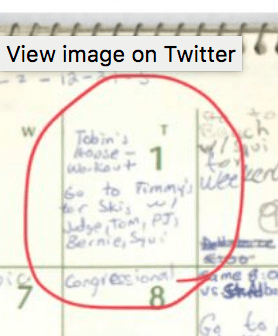
“go to Timmy’s for [Brew]skis (beer) with Judge, Tom, PJ, Bernie, Squi”
Screen Shot 2018-09-28 at 3.43.16 PM

(Provided by Brett Kavanaugh to the Senate Judiciary Committee)

During Thursday’s dramatic questioning of Supreme Court nominee Brett Kavanaugh, he was quizzed repeatedly about the calendars he provided to bolster his case that he didn’t assault Christine Blasey Ford while a high school student in 1982.

Ford alleges that she attended a party at someone’s home that summer, where, she alleges, Kavanaugh and his friend Mark Judge pushed her into a bedroom and locked the door and where Kavanaugh then began to try to remove her clothes. Among the others at the party, Ford alleged, was another friend of Kavanaugh’s named P.J. Smyth. Kavanaugh denies the allegation and told Fox News’ Marth MacCallum that while he might have met Ford, he didn’t know her. Judge said in a statement that he doesn’t remember any such party. Smyth made a similar statement.

It was Kavanaugh’s hope that providing those calendars would show that he attended no such gathering. He insisted, in his testimony Thursday, that any party of the sort must have been on a weekend (since he and his friends had jobs) and that the calendars showed that essentially all of the weekends were booked with other activities. (His friend Mark Judge, in a memoir about his past drinking problem, wrote that this wasn’t a concern of his: He’d regularly show up at work hung over or drunk.)

Rachel Mitchell, hired by the Republican majority of the Senate Judiciary Committee to navigate the questioning of Kavanaugh and Ford, pointed to one particular calendar entry that got some attention after the calendars came out. It read:

Tobin’s House — Workout / Go to Timmy’s for Skis w/ Judge, Tom, PJ, Bernie, Squi

The reference to “skis” is apparently to “brewskis,” or beers. The entry was July 1, a Thursday. Mitchell asked him about it.

MITCHELL: The entry says, and I quote, go to ‘Timmy’s for skis with Judge, Tom, P.J. Bernie and … Squi?’

KAVANAUGH: Squi. It’s a nickname.

MITCHELL: To what does this refer, and to whom?

KAVANAUGH: [after explaining the “Tobin’s House” part] It looks like we went over to Timmy’s. You want to know their last names, too? I’m happy to do it.

MITCHELL:If you could just identify: Is ‘Judge’ Mark Judge?

KAVANAUGH: It is. It’s Tim Gaudette, Mark Judge, Tom Kaine, P.J. Smyth, Bernie McCarthy, Chris Garrett.

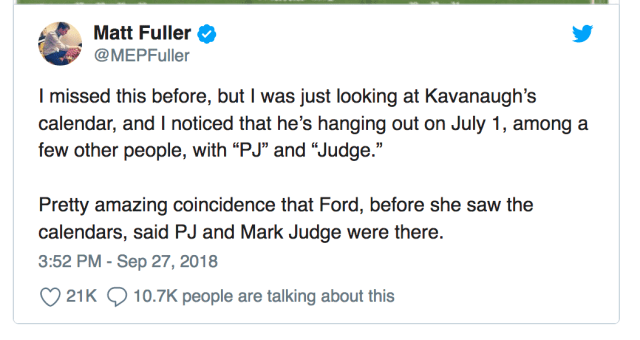
Notice two things here. First, that “Squi” was in attendance at the party — someone who, we learned thanks to Mitchell’s questioning of Ford, was going out with Ford over the course of that summer. Second, notice those two other attendees, one of whom Mitchell highlighted: Mark Judge and P.J. Smyth.

Mitchell’s questioning continued.

MITCHELL:Did you in your calendar routinely document social gatherings like house parties or gatherings of friends in your calendar?

KAVANAUGH: Yes, it certainly appears that way, that’s what I was doing in the summer of 1982. You can see that reflected on several of the– several of the entries.

MITCHELL: If a gathering like Dr. Ford has described had occurred, would you have documented that?

KAVANAUGH:Yes, because I documented everything, those kinds of events, even small get-togethers. August 7 is another good example where I documented a small get-together that summer. So yes.

During her testimony, Ford made clear that the event at which she says she was assaulted was a casual get-together before the others (who were older than her and had a later curfew) went to other, bigger parties. Kavanaugh says that the gathering at Timmy’s on July 1 was essentially that.

We noted Thursday, too, that the time frame of this July 1 party fits with Ford’s testimony. She says that six to eight weeks after the alleged assault, she saw Judge working at a store in the area. Judge’s book indicates that he was working at that store for several weeks in early to mid-August.

This is a central point to Ford’s allegation. Kavanaugh denies knowing her, denies being at a party with her. Here is an event in July where he was with several long-standing friends, two of whom were named by Ford and one of whom she’d been going out with.

But Mitchell’s next question completely fumbles the point.

MITCHELL:Have you reviewed every entry that is in these calendars of May, June, July and August of 1982.

KAVANAUGH:I have.

MITCHELL:Is there anything that could even remotely fit what we’re talking about in terms of Dr. Ford’s allegations?

KAVANAUGH: No.

That was it. Mitchell changed the subject.

There were all sorts of ways that Mitchell could have pressed the issue. How, for example, might Ford have been able to identify by name two of Kavanaugh’s close friends if she didn’t know him or had barely met him? Why isn’t it possible that this July 1 get-together was precisely the sort of event at which Ford alleges she was assaulted? That more than remotely fits the allegation? But she didn’t ask.

Mitchell had been stepping in for Republican senators during the day’s questioning, a tactic that helped the majority avoid the spectacle of men grilling a woman about an attack she says she experienced. There was no break in that pattern — until the July 1 question. After that series of questions, Mitchell didn’t speak again.

Update: On Friday morning, Sen. Sheldon Whitehouse (D-R.I.) outlined the points above. Sen. Charles Grassley (R-Iowa), the chairman of the committee, responded by noting that the calendar indicates that there were at least seven boys at the party, while Ford’s allegations only mentioned four.

Ford addressed the number of attendees during her testimony on Thursday, also responding to a question from Mitchell.

“I can’t guarantee that there weren’t a few other people there,” Ford said, “but they are not in my purview of my memory.”


Comment (D. Posnett):  It is interesting. to see what our congressman, Lee Zeldin, thinks of Brett Kavenaugh.  Thanks to David Friedman for this:

Screen Shot 2018-09-28 at 6.16.34 PM

Posted in Courts, Judiciary, SCOTUS, Trump, Uncategorized, Zeldin | Tagged , , , , | Leave a comment

Reaction Against Kavenaugh

Screen Shot 2018-09-24 at 1.50.06 PM
By Mara Gerstein:
I was 16 when Anita Hill testified before congress. I watched and was devastated — for reasons I understood and some I couldn’t yet articulate. I can now. It was the first time I realized that women’s lives are worth less then men’s. Ouch.
Even by 16, I had been masturbated in front of in public twice. I had been told that I must give good blow jobs, as I walked down Park Avenue in my Laura Ashley dress, wearing lip gloss and 1/2 inch heels for the first time, on my way to so-and-so’s Bar Mitzvah. I had been hit on (hard) by my high school drafting teacher. (thankfully nothing as terrible as what Blasey-Ford endured)
But these things change your life forever. Your sense of self, your understanding of your own value, your comfort in intimate relationships.
What these assholes tell us every time they excuse sexual abuse is that we shouldn’t negatively impact a man’s life just because he has negatively impacted a woman’s.
Blasey-Ford’s testimony, starting Wednesday or Thursday of this week, will lay this truth very bare. That a single boyhood indiscretion changes a woman’s life forever. That Kavanaugh’s attack almost ruined Blasey-Ford’s life, and that it deeply shaped her life choices. How she spent her college years (hiding with a girlfriend in a dorm room), the subject of her life’s work (trauma and its relationship to depression and anxiety), where she chose to live (as far way from the attack as possible)…
I urge everyone to watch the Senate hearings this week and to make your voice heard in whatever way you can on this issue. March, call, tweet, and talk to everyone you know about it. VOTE. Get everyone you know to vote.
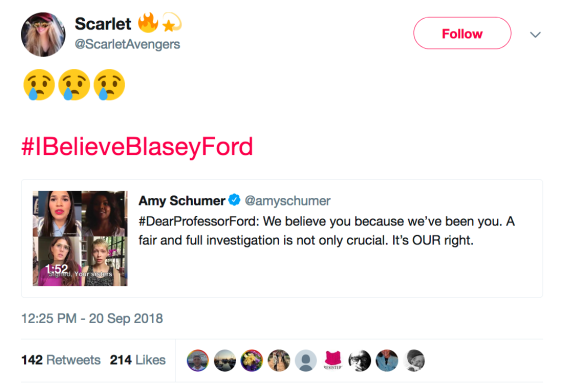
In the end, as with everything these days, it is up to the people of this country to say that they will not stand for women’s lives being worth less then men’s anymore. That it’s time to #kickthebumsout, and get real about equality. It’s time. #timesup #metoo #Ibelieveanitahill #IbelieveBlaseyFord
Posted in Judiciary, Trump, Uncategorized, Zeldin | Tagged , , , , , , , | 2 Comments

Zeldin Puts Our Community At Risk by Undermining NY Gun Laws

Printed as Letter to the Editor in The East Hampton Star, September 20, 2018

Gun Laws

To the Editor:

Lee Zeldin receives an A rating from the National Rifle Association, and to give him his due, he has certainly earned it. In December 2015, Zeldin was part of a G.O.P. effort to block debate about legislation that would prevent people on the “no fly list” for suspicion of terrorism from buying guns. In 2017 he voted for H.R. 1181, which would allow veterans deemed mentally incompetent to continue to own firearms, and in that same year he co-sponsored H.R. 38, the Concealed Carry Reciprocity bill.

The C.C.R. Act would override the sensible gun laws that New York legislators have worked hard to put in place and allow any person with a concealed-carry permit from another state (with weaker gun laws that don’t require a background check or safety training, for example) to carry their weapon in New York.

Law enforcement is overwhelmingly opposed to this bill for the simple reason that more guns on the streets means more danger for police officers, as well as for civilians. Even Zeldin’s fellow Long Island Republican, Peter King, voted against C.C.R. Why is Zeldin for it? Could it be because doing the N.R.A.’s bidding helps fill his campaign coffers? I would ask him, but since he no longer holds town hall meetings with his constituents, I can’t.

Perry Gershon, running against Lee Zeldin in November, supports requiring background checks at the national level when buying a gun, among other common-sense measures. A vote for Perry Gershon on Nov. 6 is a vote for responsible gun laws.

Sincerely,

CAROL DEISTLER

Posted in Guns, perry gershon, Peter King, Uncategorized, Zeldin | 2 Comments

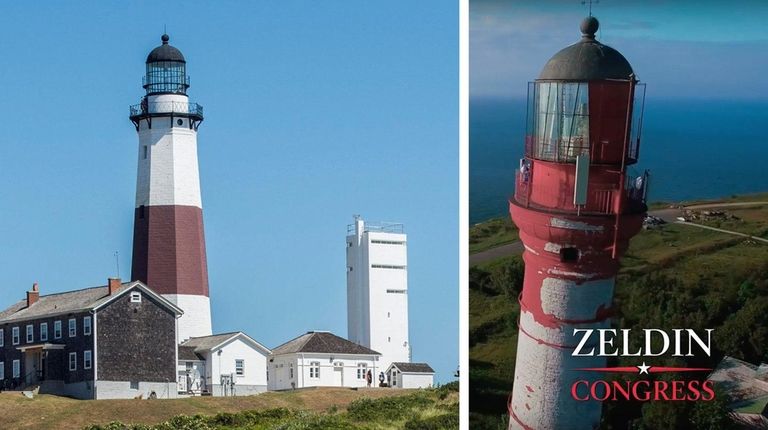
Zeldin features Estonian lighthouse in Ad about Long Island


The Montauk Lighthouse as seen in 2015 next

The Montauk Lighthouse as seen in 2015 next to an image of the Pakri Lighthouse in Estonia shown in Lee Zeldin’s online ad for re-election. Photo Credit: Gordon M. Grant; Zeldin for Congress via YouTube.


“Zeldin features Estonian lighthouse in Ad about Long Island”

Republican congressman is emphasizing protection of local environment
September 20, 2018

Rep. Lee Zeldin seemed to have a good time visiting the historic Montauk Lighthouse in his Long Island congressional district in 2016 – but he should have paid closer attention.

His latest campaign commercial features some beautiful footage of a lighthouse that vaguely resembles the Montauk icon, but is actually the Pakri Lighthouse, 4,000 miles away in Estonia.

Zeldin’s campaign has posted two versions of the ad online, a 30-second cut and a 15-second cut that has more than 2,500 views on Youtube.

Zeldin campaign spokesman Chris Boyle told City & State that the ad currently airing on TV has been fixed, and sent a version of the ad with the correct lighthouse. But as of Thursday afternoon, only the ad with the Estonian lighthouse was available on Zeldin’s Youtube page.


Editorial note:

Zeldin likes to claim that he is the “only Long Islander in this race”….   Maybe he is the “only Estonian in this race.”  He needs a lesson on the Lighthouses of Suffolk County.  Want to teach that lesson, Perry?


Response from Perry Gershon:

Lee, I think you should study Long Island geography…

While Lee Zeldin is busy dodging the voters, avoiding candidate forums until two weeks before the election, and calling me names, he should really come to better grips with our local geography.

I live in the Town of East Hampton, full-time. I built my home in 1999 and proudly have been a taxpayer since. Our most famous town landmark is the Montauk Lighthouse. It is historic and known not just here but internationally. So I was puzzled to see Lee’s first TV commercial featuring a photo of a lighthouse in Estonia, Northern Europe, as Lee discusses drilling off Long Island’s coast.

Before you start talking about my Long Island residence, perhaps it would be better to study our local landmarks and learn the difference between Montauk and Estonia. And by the way, if you oppose offshore drilling, why wouldn’t you sign the Congressional letter to Interior Secretary Zinke opposing drilling along the East Coast? Your signature’s absence was notable for a representative from New York.

Posted in Uncategorized, Zeldin | Tagged , , | 1 Comment

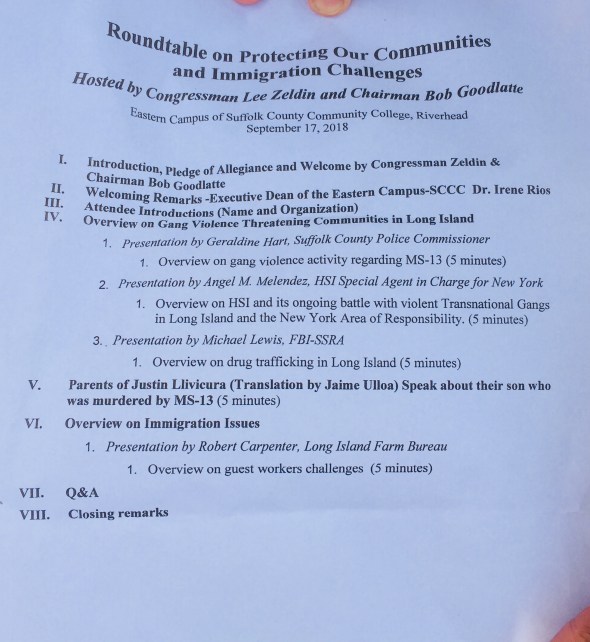
“Roundtable” on Gangs and Immigration

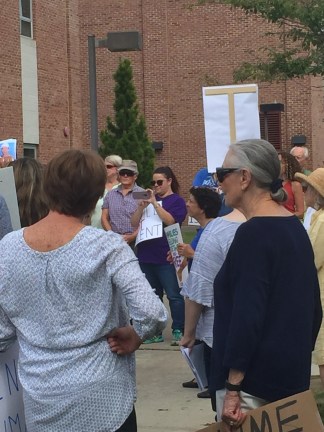
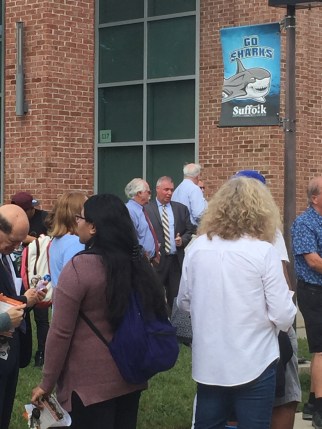
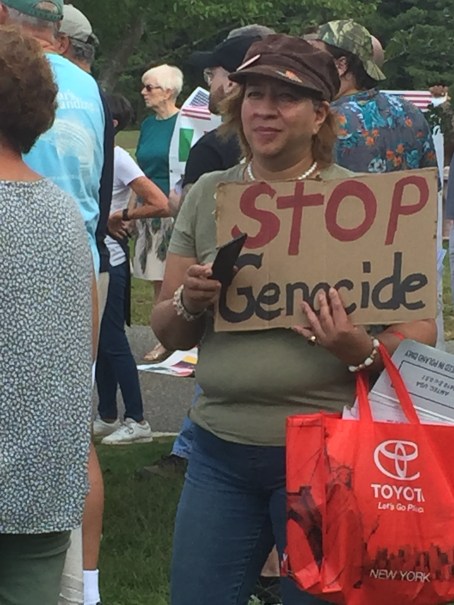
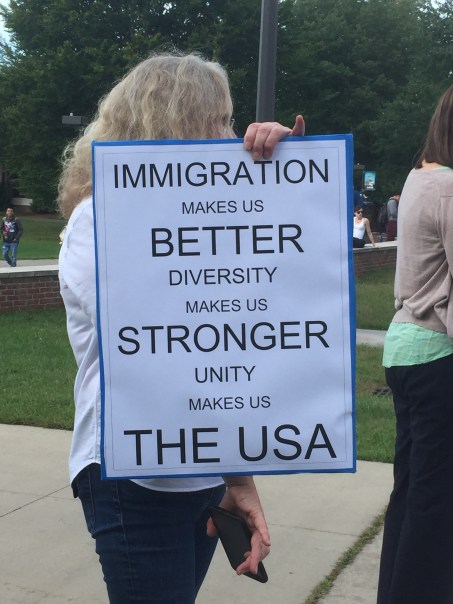
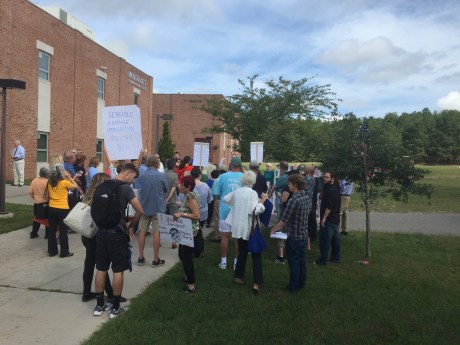
Lee Zeldin and Bob Goodlatte held a “roundtable” on the topic of gangs and immigration at Suffolk County College of Riverhead.  With little notice and no invites to relevant local leaders or concerned citizen’s groups, those that did show up (about 60 people) were shut out of the meeting!   A roundtable usually implies that all concerned are invited to participate.  Not in Zeldin’s world.  Like his mentor, he doesn’t like dissent.

I have a copy of the printed agenda of the meeting (see below) and pictures of the protestors outside the building that we were not allowed to enter.  Students on campus were interested in all the commotion and we got to register some of them to vote!

IMG_8975

The press was present – I am sure we will hear more about this.  It sounds like another Photo-op for ZELDIN.  Not a serious effort to help improve anyone’s life.  Here is a press report:  http://www.fios1news.com/longisland/local-suffolk-roundtable-on-immigration-gang-violence-met-with-protests#.W6Bt0VJRfOS

IMG_8976

IMG_8970

IMG_8969  IMG_8967

IMG_8964

IMG_8960

IMG_8959

IMG_8958


Error
This video doesn’t exist
Posted in immigration/deportation, Uncategorized, Zeldin | Tagged , , , , | Leave a comment

Trump Mouths off About “Windmills”

Submitted by Judith Hope:

In an Aug. 30 rally in Evansville, Indiana, President Donald Trump made three unsubstantiated claims about wind turbines, which he calls “windmills”:

  • Trump suggested that a single turbine can be responsible for “thousands” of bird deaths. Birds are killed by turbines, but the real death toll from a single turbine is orders of magnitude lower than this. A 2013 study estimated an average of just over five bird deaths per turbine per year.
  • He repeatedly referred to “problems” when the wind doesn’t blow. It’s true that lack of wind prevents turbines from generating energy, but these pauses do not create problems that power grid operators can’t handle.
  • Trump also stated that living near turbines is noisy, enough to make someone “go crazy after a couple of years.” Studies indicate that people living near turbines are rarely exposed to average sound levels beyond 45 decibels, which is akin to the hum of a refrigerator. There is no direct evidence that the sound is detrimental to physical or mental health, although it may be annoying to some people.

Here is the full source:  https://www.factcheck.org/2018/09/trump-again-overblows-risks-of-wind-power/


Editorial remark (D. Posnett):

I can remember visiting the wind turbines off of Block Island in a chartered party boat in October 2017.   I remember,

  • they are huge when you are right next to them
  • they are completely silent – I just heard the waves, the wind and the people talking on the boat
  • there were private fishing boats at the base of some turbines, because that is where the fish were
Error
This video doesn’t exist


Posted in Environment, Trump, Uncategorized, wind energy, Zeldin | Tagged , , , | 2 Comments

Don’t Make Me Laugh

33531801294_4966befdc3_n


By Perry Gershon:

Lee Zeldin wants you to think he’s an environmentalist. He’s spending big bucks blasting that absurd idea across Long Island television.

Don’t make me laugh.

In his four years in Congress, Lee has voted against the environment over and over again. He’s taken tens of thousands of dollars from the oil and gas industry to prop up his campaign.

It’s no wonder Lee opposed protecting the environment on 21 out of 22 votes.

Lee opposed seven bills on air quality protections.

He opposed protections for clean water 19 different times.

He opposed protecting wildlife eight times.

And he continues to stand by a president who insists climate change is a Chinese hoax.

Get the idea? Lee Zeldin is no friend of the environment, of clear air and water, or protecting our planet for future generations.

Long Island voters have a clear choice in November.

I promise to work tirelessly to protect the environment – whether that be our clear air, clean water, clean energy production, or protecting wildlife.

Lee’s record is clear, and that’s just another reason why he has to go.

Donate $5 right now. Let’s show Zeldin we won’t stand for his hypocrisy on the environment.


Posts on R&R (since July 2018) related to Zeldin’s environmental record:

Zeldin’s Environmental Voting Record Goes from Bad to Worse

Lee Zeldin wants to Drill in the Ironwood Forest National Monument By Marc Rauch: Latest update: Zeldin’s Environmental Voting Record Goes from Bad to Worse in 2018 In the first 3 years of Lee Zeldin’s congressional term (2015-2017), he earned … Continue reading

Posted in climate change, Environment, EPA, Executive Order, GOP, National Parks & Monuments, Trump, Uncategorized, water quality, Zeldin | Tagged , , | 2 Comments | Edit

Zeldin’s War on the Environment

By Perry Gershon:  (Source: https://www.facebook.com/pg/perry4congress/posts/?ref=page_internal) Lee Zeldin continues to support the Trump Administration’s destruction of our environmental protections. The new “plan” for coal represents one more example of the total disregard for the serious health effects of air pollution. The … Continue reading

Posted in Air Pollution, Environment, Trump, Uncategorized, water quality, Zeldin | Tagged , , , | 2 Comments | Edit

Is Lee Zeldin Really “Good On The Environment”?

A slickly produced mailer from Lee Zeldin appeared in my mailbox this week. It touted our Congressman’s supposed record in “safeguarding our environment.” Mr. Zeldin has been very adept in pulling the wool over voters’ eyes about his actual environmental … Continue reading

Posted in Uncategorized | Leave a comment | Edit

Zeldin Boasting about Environment Record?

Recently Congressman Lee Zeldin (R, NY-1), co-chair of the Long Island Sound Caucus and founding member of the “Congressional Estuary Caucus”, was joined by EPA Regional Administrator Pete Lopez, New York State Department of Environmental Conservation Regional Director Carrie Meek … Continue reading

Posted in climate change, Environment, EPA, Paris Climate Accord, Uncategorized, Zeldin | 4 Comments | Edit

More Bad Zeldin Environmental Votes

By Marc Rauch and Chelsea Estevez Since our last update in late August, fourteen bills impacting the environment have come before the House of Representatives. Lee Zeldin took the anti-environment position on 12 out of 14 of these recent bills. … Continue reading

Posted in climate change, Environment, EPA, Paris Climate Accord, Trump, Uncategorized, Zeldin | Tagged , , , , , | Leave a comment | Edit

Complete Lee Zeldin Environmental Voting Record

A great resource!   D Posnett Marc Rauch·Friday, June 23, 2017 Complete Lee Zeldin Environmental Voting Record (Last Updated 6/29/17) Introduction Linked here https://docs.google.com/spreadsheets/d/19e5j3Z3xupufWNReLsO-P69eL316sJDLBbf8EZDFklg/edit?usp=sharing is an easy-to-use Excel spreadsheet summarizing Lee Zeldin’s complete environmental voting record in Congress. Purpose This spreadsheet … Continue reading

Posted in Air Pollution, climate change, Environment, EPA, National Parks & Monuments, Offshore Drilling, Uncategorized, Zeldin | Tagged , , , , | 2 Comments | Edit

Lee Zeldin’s Duplicity on Environmental Issues

Marc Rauch, from Bellport, New York. had the following letter in the March 2, 2017 edition of the Long Island Advance: I was taken aback by Rep. Lee Zeldin’s “official positions” on protection of the environment, as reported last week … Continue reading

Posted in Environment, Uncategorized, Zeldin | Tagged , , , | 1 Comment | Edit

Zeldin & Environment?

My letter to editor of LI Advance was published this week- 2/16/2017 Voting to loosen standards on oil and gas industries Where is Congressman Zeldin on the environment? Two weeks ago I visited Congressman Zeldin’s office to talk with a … Continue reading

Posted in Environment, Uncategorized | Tagged , | 5 Comments | Edit

Flip the House — Defeat Zeldin!

By Jacquelyn Gavron & Amy Turner, July 19, 2018 New York’s First Congressional District (NY-1), historically a swing district, is represented by Lee Zeldin (R). He was initially elected with Tea Party support and is an unwavering Trump loyalist with … Continue reading

Posted in ACA, AHCA, economy, Environment, Guns, Health Care, Politics, Tax Reform, Uncategorized, Women, Zeldin | 3 Comments | Edit

Moral Obligation to send Zeldin packing

Published in the East Hampton Star –  the July 10, 2018 To the Editor: Offered less than 10 days into our district’s 133-day congressional race, The Star’s advice to local Democrats (“First District Dilemma”) is not only premature, but also … Continue reading

Posted in perry gershon, Uncategorized, Zeldin | Tagged , , , , | Leave a comment | Edit
Posted in Environment, Uncategorized, Zeldin | Tagged , | 2 Comments

New York’s Suffolk County Economy: Not so Hot?

Representative Lee Zeldin likes to claim that he has contributed to a “booming” economy resulting in jobs in his district (the eastern part of Suffolk county).

Lets examine this for a minute.

First, jobs

umemployment graph

This is the graph of unemployment since the housing crisis (the last major recession) in 2008.  While unemployment came down from 10% to just under 5% under Obama, it went to just under 4% under Trump.  5/6 of the recovery (83%), as measured by reduced unemployment, occurred during the Obama years and 1/6  (17%) of the recovery occurred under Trump.

Similar numbers apply to Suffolk county.  But what is the job growth in Suffolk county,  compared to the rest of the state of New York?  Well, it is nothing to brag about.  For instance, job growth between Dec 2016 and Dec 2017 on Long Island (Nassau & Suffolk) was 12,500 jobs representing 0.9% job growth.  Compared to the rest of the state or to NY City those are measly results: For NY State there were 156,800 new jobs representing 1.6% job growth over the same time period.  And if you assess job growth for the period of Dec 2014 through Dec 2017 (the period that Zeldin has been in office), it is 0.934 %.  By comparison job growth during the prior 4 years (when Tim Bishop was in office), was 1.425% (Suffolk county total employment numbers).

If job growth had been average on Long Island (equal to the NY State average), we would have had 22,220 new jobs between Dec 2016 and Dec 2017, not 12,500.  The shortfall: 22,220 minus 12,500 = 9,720 jobs are in fact jobs we could have had, if we had just “average” job growth.  Those are 9,720 jobs we lost.

Second, taxes.

Voters are not stupid. The republican tax cuts benefited primarily businesses and the super rich.  The average person in Suffolk county might see a difference in either direction by a few hundred dollars for their federal taxes. The big issue, however, is SALT (State and Local Tax) deductions.  These are now no longer fully deductible.  And we won’t see the effects until 2019.  Here is a simple calculation.  If my NY State taxes are 10,000 and my local taxes (realestate/school taxes) about 15,000, for a total of 25,000 SALT deductions, I can still deduct 10,000, according to the new Republican tax plan, so I will have to pay taxes on the remaining 15,000.  At a tax rate of 30% that is about $5000 additional taxes.  Our taxes in Suffolk county will therefore rise substantially, specially in communities in Western Suffolk where real estate taxes are high.  Zeldin tried to weasel out of this, but in the end he supported the Rep. tax bill and did not fight for his constituents. Amazing that he is now listing the new tax law as one of his achievements!  Thanks Lee!

Third: Wages

According to the U.S. Bureau of Labor Statistics’ most recent data, average weekly wages in Suffolk and Nassau are close to the national average of $1,109 per week: Suffolk $1,217, Nassau $1,242.  But importantly wages have been stagnant and not growing. Slow wage growth indicates that the U.S. economy has not yet fully recovered.

This graph shows lagging employee pay since 2010 while corporate profits are soaring!

Screen Shot 2018-09-06 at 3.39.46 PM

From: “Paychecks Lag as Profits Soar, and Prices Erode Wage Gains” NY Times.

Wage stagnation in Suffolk county is real.  For instance average weekly wages grew by 0.4% between the 2nd quarter of 2016 and 2017.  That compares to 2.3% growth in New York State and 3.2% growth nationally.  Suffolk county was ranked 315th in a national survey of comparable counties. This does not compare well with other NY State counties:

Monroe, N.Y. 92
Bronx, N.Y. 114
Kings, N.Y. 148
Oneida, N.Y. 156
Dutchess, N.Y. 168
Erie, N.Y. 189
Orange, N.Y. 189
Westchester, N.Y. 196
New York, N.Y. 215
Queens, N.Y. 215
Richmond, N.Y. 215
Broome, N.Y. 231
Onondaga, N.Y. 247
Saratoga, N.Y. 282
Albany, N.Y. 310
Suffolk, N.Y. 315
Rockland, N.Y. 336
Nassau, N.Y. 339

Fourth: the stock market

It is astounding that Republicans, like Lee Zeldin, are claiming credit for a soaring stock market.  They will mention the tax give-away to businesses (thus increasing profits), the abolition of regulations and hard-nosed trade wars with allies and others.  A bull run based on borrowed money and a soaring national deficit seems dangerous.  Add the inflation expected from the trade war.  Accordingly, the Warren Buffett Indicator predicts a stock market crash in 2018!  Perhaps Zeldin and company, should also be credited with the crash, when it happens?

The party of “fiscal hawks” has become a joke.  They can not claim to be fiscally conservative or responsible.  The national debt now equals $176,000 for each tax payer in the US.  Watch the dizzying numbers here! We all know what comes next: sanctimonious statements from Rep. lawmakers about how we need to cut Medicare, Medicaid, Social Security! Oy vey.


Relevant addenda:

1) my friend writes:

It is infuriating that Trump’s only accomplishment was to inherit a strong economy from Obama.

Cynical Republicans then gave a huge tax cut to the wealthy and a little one to the middle class. All conventional economic theory says that that will provide some fiscal stimulus for the economy through at least 2018, but at the cost of ballooning deficits and the inevitable Republican calls to cut Medicare and Social Security. Why are such simple economic ideas so hard to convey to the public?

2) An interesting piece in the NYT demonstrates how essential wages are.  Jobs per se, paying so little that you can not survive on them, will not solve the problem of poverty.

Posted in economics, economy, Employment, Labor, long island, Trump, Uncategorized, Zeldin | 2 Comments

Dangerous Men

Bleached Staghorn Coral

4117345237_d91f9d5e35_b

By James Ewing (Watermill, NY)

“The GOP Republican party is the most dangerous organization in human history…dedicated, with such commitment, to the destruction of organized human life on earth.”—Noam Chomsky, scholar, MIT.
What are these most dangerous men doing?
Oceans cover about 70% of earth’s surface and support all the planet’s living systems. They regulate weather, temperature, the food web, absorb atmospheric CO2 while producing half of the world’s oxygen. The ocean’s coral reefs maintain its resilience and viability.
In 2016 and 2017, greenhouse gas induced heating and acidification killed about half the corals on Australia’s Great Barrier Reef as well as many others around the world.
“So, you take out coral reefs and a third to a quarter of all species gets wiped out…that is ecological chaos, ecological collapse”, says John Vernon, world’s foremost expert on coral reefs. “We’ve got a mass extinction event looming,..more than an alarm bell,” says Veron. “It’s an air raid siren.”
And what are dangerous men doing? Driving our precious estate over a cliff and stepping on the gas.
The GOP party, White House and cabinet officials have essentially denied or ignored the existence of global warming. In 2008 the “No Climate Tax” pledge, signed by GOP’s Americans for Prosperity, declares economic growth shall always override environmental sustainability.
Dangerous men withdrew the nation from the Paris Climate accord which bound the globe together in efforts to halt global warming. GOP leadership were united in their praise.
Fossil fuels account for about 80 % of total climate warming emissions. What do dangerous men do?
Trump’s GOP republican party seeks to overhaul the Clean Power Plan which cut greenhouse gas emissions from power plants yielding controls to less restrictive individual states and fast track emissions permitting processes by industry insiders. They repeal the Clean Air and Water Acts; ease restrictions on releasing mercury, arsenic, lead, and carbon monoxide into our air; weaken fuel economy standards; cancel restrictions on super-polluting “glider trucks”; oppose California’s electric car mandate; abandon methane limits on new oil and gas wells; revoke prohibitions on hydrofluorocarbons; expand oil production infrastructure, opening public lands to resource development; weaken the Well Control Rule and allow drilling in 25 of the 26 regions of the entire U.S. Outer Continental Shelf while immunizing extractive industries from compensatory damages; slash funding for renewable energy and efficiency research; remove scientists from advisory positions at the EPA…
“Coral (die-off) is driven by carbon dioxide, unless you stop pumping carbon dioxide into the atmosphere, it’ll go on. There’s no way around it, there’s no alternative… We can’t—as humans—can’t exist independently of the welfare of the planet.”—John Vernon. But is this what dangerous men are thinking? Really? Really?

Posted in climate change, Environment, GOP, Paris Climate Accord, sustainable energy, Trump, Uncategorized, water quality, Zeldin | Tagged , , , , , | 1 Comment

Zeldin’s Environmental Voting Record Goes from Bad to Worse

39555196514_33abe1f2fb_bLee Zeldin wants to Drill in the Ironwood Forest National Monument

By Marc Rauch:
Latest update:
Zeldin’s Environmental Voting Record Goes from Bad to Worse in 2018
In the first 3 years of Lee Zeldin’s congressional term (2015-2017), he earned a 10% scorecard rating from the League of Conservation Voters (LCV). This means that he voted against the environment 90% of the time.
So far in 2018, LCV has scored 22 House votes related to the environment. Zeldin has voted against the environment 21 out of 22 times, or 95% of the time.
Since our last update on July 5, 2018, Zeldin has voted:
— to undermine fisheries management tools that are essential to prevent overfishing
— to prevent implementation of vital safeguards that protect communities from exposure to toxins in the fish they eat
— to prevent EPA from implementing its standards to reduce methane pollution in the oil and gas industry
— to prevent Congress from considering the economic costs of climate change
— to undermine the EPA’s ability to protect the 64,000 square mile Chesapeake Bay watershed
— to block federal funding for the New Mexico Meadow Jumping Mouse under the Endangered Species Act
— to support Republican Congressman Steve Scalise’s House Resolution declaring that a carbon tax to fight climate change would harm the U.S. economy
— to prevent the EPA from using funds for an environmental justice grants program
— to deeply cut funding for the EPA and cut $65 million from the budget for the Land & Water Conservation Fund (LWCF)
— to cut funding for the Department of the Interior’s Inspector General’s Office
— to open the Ironwood Forest National Monument to mining and drilling
On the “bright” side, to the extent that there is one, Zeldin in his only pro-environment vote so far this year voted against a bill that would allow LWCF funding to be redirected to park maintenance.
Details can be found here:
Posted in climate change, Environment, EPA, Executive Order, GOP, National Parks & Monuments, Trump, Uncategorized, water quality, Zeldin | Tagged , , | 3 Comments

Go National or Local?

LTE published August 23rd in the East Hampton Star:

To the Editor:

The East Hampton Star editorial about a “First District Dilemma for Democratic Voters” (July 5, 2018) asks whether one should give money and work for political causes nationally or locally. The question itself goes against the grain of my experience.

There is no dilemma. Giving money to national campaign groups is a good shortcut to supporting national efforts to get money to elections where the money will make the most difference. That doesn’t preclude giving to local candidates.

For people with the time and interest to investigate, and work on, local issues and candidates, the rewards are great. As a canvasser for many political campaigns for six decades, I can testify to its effectiveness and the satisfaction it brings. It’s like investing in companies. You are more likely to succeed, and take pleasure in succeeding, if you understand the product and the prospective buyer. Nothing replaces face-to-face contact.

A successful local political effort is enormously satisfying. You see results in the people you talk to and in the election results. In New York Congressional District 1, my wife, Alice, and I have been supporting Perry Gershon. We were pleased when he won the primary, and ecstatic when his issues-oriented campaign attracted the support after the election of all four of the non-winning candidates.

JOHN TEPPER MARLIN, PH.D.


I would like to add that recent  political races have yielded impressive Democratic gains (since early 2017) that were often quite unexpected.  One has to wonder what might have happened had folks abandoned their local candidates!

Read more here: Republicans Lost Support in Every Special Election Since Trump Became President

The Dem “swing” average at +16 points in elections held in 2017.

In NY CD-1 the R>D diferential was about 16 points in 2016 for the congressional race.  To win, all that is needed is an 8 point Dem swing.  That is absolutely feasible in the current environment and given the history of the elections in this district.  It is also comparable to what has happened in all the special elections. In other words, no “First District Dilemma for Democratic Voters.”

Flipping the house: an interactive map!

David Posnett


Posted in Trump, Uncategorized, Zeldin | Tagged , | Leave a comment

#StopKavanaugh

Sunday Aug. 26th there were rallies across the country including 2 in NY City:

https://www.facebook.com/search/top/?q=kavanaugh%20protests%20new%20york

Screen Shot 2018-08-27 at 1.24.46 PM.png

Cory Booker summarizes this mess eloquently:

Donald Trump’s personal lawyer has sworn under oath that Trump directed him to commit federal crimes.1

The Judiciary Committee should stop the Supreme Court hearings that are scheduled for early September and deal with the urgent matter of a president being credibly implicated in a criminal conspiracy.

The Senate must reject any Supreme Court nominee from an alleged criminal co-conspirator—especially when that nominee may rule to protect Trump from any accountability.

Let’s look at the facts. Several of the people closest to Donald Trump, including his former personal lawyer (Michael Cohen), former campaign chairman (Paul Manafort), former national security adviser (Michael Flynn), and others, have either been convicted of or have pleaded guilty to a range of federal offenses—including campaign finance violations allegedly at the direction of candidate Trump.2

Meanwhile, Brett Kavanaugh, Trump’s Supreme Court nominee, has argued that a sitting president cannot be criminally indicted or even a subject of a criminal investigation while in office. The consequences of his confirmation could be enormous: Kavanaugh could become Trump’s shield against accountability.3

We must let Special Counsel Robert Mueller complete his investigation before proceeding with any Supreme Court confirmation hearings.

No American citizen under criminal investigation is able to choose their own judge. The president shouldn’t be an exception.

Thank you.   Senator Cory Booker

Sources:

1. “Cohen attorney: If these hush payments are crimes, Trump is guilty,” Politico, August 21, 2018
https://act.moveon.org/go/48600?t=5&akid=214985%2E17413353%2EzHwnWK

2. “Cohen, Manafort and more: Trump associates and others accused or convicted of crimes,” USA Today, August 22, 2018
https://act.moveon.org/go/48601?t=7&akid=214985%2E17413353%2EzHwnWK

3. “Kavanaugh in memo argued against indicting sitting president,” The Associated Press, August 10, 2018
https://act.moveon.org/go/48660?t=9&akid=214985%2E17413353%2EzHwnWK

Sign this petition if you agree

BTW, in case you are wondering, Lee Zeldin supports the Kavanaugh nomination.

Rep. Lee Zeldin (R-Shirley): “ I strongly believe that regardless of whether a judicial court nominee is chosen by a Republican president or a Democrat president, or whether the nominee is conservative, moderate, or liberal in his or her beliefs, it is most important that the individual would not be an activist on the bench or allow their personal beliefs  to overcome the required objectivity to strictly interpret the law and our Constitution.”

What a hypocrite.  Remember them blocking Obama’s nominee: Merrick Garland.

Posted in Judiciary, Trump, Uncategorized, Zeldin | Tagged , , , | Leave a comment