
Tom Price Bought Drug Stocks. Then He Pushed Pharma’s Agenda in Australia.

Before he was named Trump’s health secretary, Price took a congressional trip to Australia and pressed officials to extend protections for drug companies in an international trade agreement.

In the spring before the 2016 presidential election, the Obama administration’s 12-nation trade agreement known as the Trans-Pacific Partnership, or TPP, was still alive. Negotiators worked on details as Congress considered whether to ratify the pact.

The Australian government was getting in the way of one change demanded by U.S. pharmaceutical companies. Makers of cutting-edge biological drugs wanted to have data from their clinical trials protected from competitors for 12 years, as they are under U.S. law — not the roughly five years permitted under the TPP. Australian officials insisted that an extension would deprive consumers of cheaper alternatives for too long.

On April 5, 2016, a bipartisan group of U.S. lawmakers arrived in Canberra, Australia’s capital, for meetings with government officials on a broad range of subjects. Among those on the routine congressional trip was Rep. Tom Price, a Georgia Republican who would go on to become President Trump’s secretary of health and human services. Three weeks before the trip, Price had purchased up to $90,000 worth of pharmaceutical stocks — trades that would come under scrutiny after his nomination to Trump’s cabinet.

In Canberra, Price and another Republican, Rep. John Kline of Minnesota, pressured senior Australian trade officials to modify their position on the 12-year extension, according to a congressional aide who was on the trip. The Australians explained that they had no intention of changing their laws or rules in ways that could increase drug prices. Price and Kline continued pushing, according to the aide, asking for a side letter or other written guidance that the period would be extended in Australia even if it weren’t spelled out in the TPP itself.

Price’s lobbying abroad, which has not previously been reported, is another example of how his work in Congress could have benefitted his investment portfolio. He traded hundreds of thousands of dollars’ worth of shares in health-related companies while taking action on legislation and regulations affecting the industry. ProPublica previously reported that Price’s stock trades are said to be under investigation by federal prosecutors.

Price, who did not respond to an interview request for this story, has said he did nothing wrong, that his broker generally chose stocks without his knowledge and that all of his trades were publicly disclosed.

Price’s financial disclosures submitted to the House Office of the Clerk show that on March 17, 2016, he purchased shares worth between $1,000 and $15,000 each in Eli Lilly, Amgen, Bristol-Meyers Squibb, McKesson, Pfizer and Biogen. All six companies had an interest in biological drugs, which are grown from live cells and are known for short as biologics. Eli Lilly, for example, is behind Portrazza, the first biologic approved to treat a common type of lung cancer. Amgen makes a top-seller for rheumatoid arthritis and psoriasis. Biogen developed a biologic for people suffering multiple sclerosis relapses.

Kline, who has since retired from Congress, said he could not recall if he or anyone else raised the biologics issue. His financial disclosures do not show direct holdings in pharmaceutical companies.

Australia has played another role in Price’s financial activities. In 2015 the congressman bought about $10,000 worth of shares in Innate Immunotherapeutics, a small biologics firm with an office in Sydney. After the congressional trip, which also made a stop in Sydney, Price purchased a larger stake in the company, about $84,000 worth, in two private placements, the first of which was announced in June. Price was invited to purchase the shares at a discounted rate.

It’s not known if Price had any contact with the firm while in Sydney. Price didn’t respond to questions about when and where he discussed the discounted offering with company officials. The company’s officials also did not respond.

Traveling congressional delegations typically meet with a variety of local officials, and at the time of the visit to Australia it wasn’t unusual for Republican lawmakers to side with the pharmaceutical industry on the trade deal’s protections for biologics. Price’s advocacy stands out because he pushed the cause directly with foreign officials, while at the same time owning stakes in companies that could have benefited.

An itinerary for the trip reviewed by ProPublica mentions TPP in relation to one of the meetings, but does not list the biologics provision. A former Australian trade official, who asked not to be named and attended one of the meetings, confirmed that the 12-year lockup was addressed, but said he could not recall which Congress members were pushing it.

Others on the trip, organized by the House’s Education and the Workforce Committee, were Robert Scott, D-Va., Ruben Hinojosa, D-Texas, Erik Paulsen, R-Minn. and Dan Benishek, R-Mich. Those members who responded to requests for comment said they could not recall whether the provision was discussed.

The data collected during clinical trials of drugs can save competitors time in developing the cheaper alternatives to biologics known as biosimilars. Keeping the data proprietary longer extends the original drugmaker’s monopoly. While some big brand-name pharmaceutical companies also make biosimilars, they and their trade association — the Pharmaceutical Research and Manufacturers of America — advocated strongly for longer exclusivity.

In the end, the debate over the provision became moot. Trump scrapped the TPP days after taking office. Price divested his drug stocks upon taking the cabinet post. His investment in Innate Immunotherapeutics yielded a profit of at least $150,000.
Posted in FDA, Trump, USDA | Tagged , , , | Leave a comment

President Trump’s Paris decision will live in infamy

Slamming the global environment

BY  FRED KRUPP

NEW YORK DAILY NEWS

Thursday, June 1, 2017, 3:30 PM

President Trump’s reckless decision to leave the Paris climate agreement will live in infamy.

This is a retreat from America’s role as world leader — one that ignores overwhelming scientific evidence and the advice of more than 1,000 business leaders who urged him stand up for our clean energy economy.

It will hurt the U.S. far more than it hurts the rest of the world. And that’s saying a lot, because the global damage will indeed be considerable.

The most obvious consequence, for people everywhere, will be a slowdown in the fight to reduce the pollution that causes climate change — at the very moment we need to step up. That will mean more deaths from heat waves, extreme weather and disease; a deepening refugee crisis as populations shift in reaction to weather and agricultural changes, and an increase in the price we must pay to solve this problem.

Such pollution already take a toll on public health. The President’s retreat in the face of climate change means Americans must now continue to breathe dirty emissions from power plants and cars.

What will we say to our children and grandchildren when they ask: “Why did you do so little to avert a crisis you could have prevented?”

Trump’s misguided decision will also fuel resentment toward the United States and make things more difficult for American business.

Businesses want to locate where their markets are. By pulling out of the Paris climate accord, Trump sends them a clear signal that clean energy companies should look elsewhere.

We’ll be hobbled in the global race for clean energy businesses and jobs, potentially the most important economic prize of the 21st century. China and Europe are already vying for the leadership role on clean energy that the president just ceded. That’s why so many investors and CEOs were urging the president to stay in. Fortunately, the Paris Agreement is strong enough to withstand this blow. Other world leaders have made it clear they will move ahead on their Paris commitments with our without the U.S.

The European Union and China are reportedly preparing to announce new joint climate actions as I write. By pulling out of the deal, we are isolating ourselves diplomatically and economically while siding with the only two outlier nations — Syria and Nicaragua — that refused to sign the climate pact.

It did not have to be this way.

For decades, the world struggled to come together to face the threat of climate change. Nations argued over who was responsible and who should contribute to the solution. Developing nations pointed the finger at the advanced economies that had already emitted so much. Those countries, in turn, demanded that the fastest-growing developing countries also do their part.

Finally, in 2015, virtually every country in the world — big and small, rich and poor — came together in an unprecedented show of global unity and made a deal that allowed each country to make its own plan, but also held them accountable for reducing pollution.

This historic breakthrough brought tremendous international credit to the country that helped pull the world together: the United States.

Now that Trump has turned his back on all of that, his decision to shirk U.S. leadership responsibilities will hover over diplomatic discussions, trade negotiations and major business deals. We will be the only major nation dodging our duties, something other countries won’t forget.

Our President has made a reckless, unforced error.

This is the latest in a series of administration decisions that move us backward on climate, public health and the environment.

The President wants to slash the U.S. Environmental Protection Administration’s budget by almost one-third, and his EPA chief — who advocated for withdrawal from Paris — is busy dismantling the environmental standards that keep our air and water clean and safe.

Trump’s announcement must not, and will not, be the last word on whether America leads or retreats on climate change.

Companies such as Citigroup are already saying the private sector should be able to participate in the Paris climate deal. Many of them have emissions reductions targets similar to the Paris commitments made by nations.

Businesses, engineers, entrepreneurs, scientists — indeed, all of us — must continue to pursue practical solutions to reduce the pollution that is driving climate change at such a dangerous pace.

If there can be a silver lining to this day, it will be that Trump’s retreat from the Paris climate accord becomes a galvanizing moment for the majority of Americans who support clean energy and climate action.

As these women and men stand up for their children and adopt clean energy in their own lives, they will join the myriad cities, states, companies, and nations around the world who are leading the way to a cleaner, healthier future even as the president tries to go backward.

Krupp is president of the Environmental Defense Fund.


Posted in climate change, Environment, Paris Climate Accord, Trump | Tagged , | Leave a comment

What Does the US Have in Common with Nicaragua and Syria?

Apparently, President Trump has made his decision to withdraw from the Paris climate accord, according to reports from journalists with direct knowledge of the decision. Details on how the withdrawal will be executed are being worked out by a small team including EPA Administrator Scott Pruitt.  It looks like this gang is deciding on whether to initiate a full, formal withdrawal — which could take 3 years — or exit the underlying United Nations climate change treaty, which would be faster but more extreme.

Pulling out of Paris is the biggest thing Trump could do to unravel Obama’s climate legacy.  It sends a combative signal to the rest of the world that America doesn’t prioritize climate change.  This tactic threatens to unravel the ambition of the entire deal and if the entire deal unravels, throws the world into unpredictable national decisions with respect to the global environment.  It is nothing more than a decision that shirks any semblance of leadership.

How did we get here?  A letter from 22 Republican Senators (including Mitch McConnell) that called for a clean exit had reinforced Trump’s instincts to withdraw, and the president has indicated to his advisors over the past week that he was going to pull out.

Now, the answer to my question:  The only other two countries that aren’t supporting the Paris accord are Nicaragua and Syria. 
Is this really how to MAKE AMERICA GREAT AGAIN?
Posted in climate change, Environment, EPA, Paris Climate Accord, Trump | 2 Comments

Poll: Public Views the ACA More Favorably Than Congress’ Plan to Replace It, Though Republicans Favor the Replacement

Kaiser Family Foundation

Majority Says the Senate Either Should Make Major Changes or Not Pass The House Bill At All, While About a Third Want the Senate to Pass It As Is or With Only Minor Changes

Public Grows More Pessimistic About How Repeal Will Affect Them Personally

Most (55%) of the public holds an unfavorable view of the Congressional plan that would repeal and replace the Affordable Care Act, and the same share (55%) want the Senate either to make major changes to the House-passed bill or not pass it all, finds the latest Kaiser Health Tracking Poll.

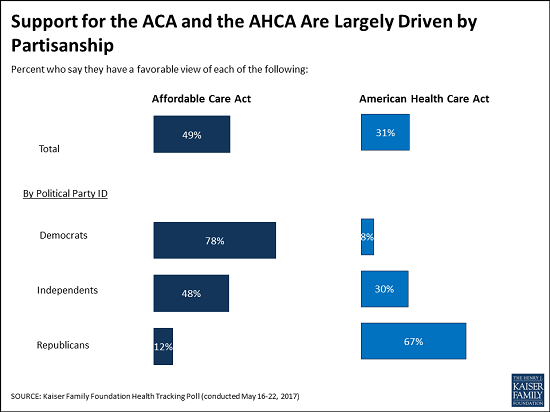
Three in 10 (31%) of the public hold favorable views of the American Health Care Act, which narrowly passed the House on May 4 and is now under consideration in the Senate. In comparison, about half (49%) of the public hold a favorable views of the Affordable Care Act.

There are large partisan divisions on these questions, with far more Republicans holding favorable views of the replacement plan (67%) than of the ACA (12%).  The opposite is true for Democrats, and among independents, more also hold favorable views of the ACA (48%) than of the replacement bill (30%).

tuesday poll.pngIn spite of these views, a majority of the public (74%) believe it is” likely” that the president and Congress will repeal and replace the ACA. At the same time, relatively few say the Senate should adapt the American Health Care Act as passed by the House (8%) or with only minor changes (24%). Most want the Senate either to make major changes (26%) or not pass it at all (29%).

Public Growing More Pessimistic About How Repeal Would Affect Them Personally

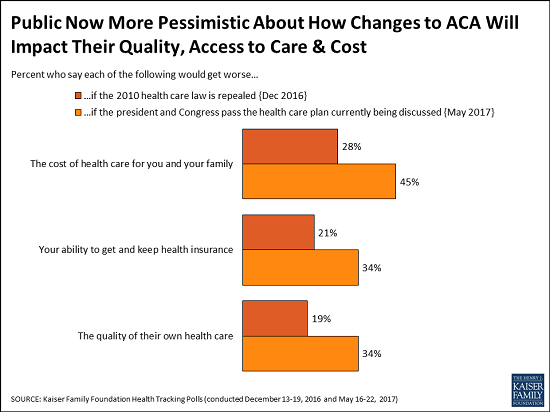
The poll also finds the public more pessimistic about the replacement bill now than they were in December after the elections but before Congress put forward specific legislation. Nearly half (45%) of the public now says the replacement bill would result in higher health care costs for their family, compared to about a quarter (28%) who said so in December. In addition, a third now expect their ability to get and keep health insurance and the quality of their health care to get worse under the pending bill, compared to about one in five that said so in December.

poll_2Tues.pngOther findings include:

  • A majority of the public (63%) continue to say that President Trump and Republicans in Congress are responsible for any problems with the Affordable Care Act moving forward, more than twice the share who say President Obama and Democrats in Congress are responsible. Those considering Republicans responsible includes most Democrats (77%) and independents (63%), and half (49%) of Republicans.
  • Few (14%) believe that the House-passed bill fulfills all or most of President Trump’s promises on health care, while three quarters (76%) say it fulfills none (35%) or some (40%) of them. Among Republicans, twice as many say it fulfills none or some of the President’s promises (59%) as say it fulfills all or most of them (30%).

The poll also includes additional questions on Medicaid, which will be released separately later this week.

Read the PollDesigned and analyzed by public opinion researchers at the Kaiser Family Foundation, the poll was conducted from May 16 – 22 among a nationally representative random digit dial telephone sample of 1,205 adults. Interviews were conducted in English and Spanish by landline (421) and cell phone (784). The margin of sampling error is plus or minus 3 percentage points for the full sample. For results based on subgroups, the margin of sampling error may be higher.

Filling the need for trusted information on national health issues, the Kaiser Family Foundation is a nonprofit organization based in Menlo Park, California.

Posted in ACA, AHCA, Congress, Health Care | Leave a comment

The Last Nuremberg Prosecutor Alive

At 97, Ben Ferencz is the last Nuremberg prosecutor alive and he has a far-reaching message for today’s world (click to watch 60 Minutes with Leslie Stahl).

  • Twenty-two SS officers responsible for the deaths of 1M+ people would never have been brought to justice were it not for Ben Ferencz.
  • The officers were part of units called Einsatzgruppen, or action groups. Their job was to follow the German army as it invaded the Soviet Union in 1941 and kill Communists, Gypsies and Jews.
  • Ferencz believes “war makes murderers out of otherwise decent people” and has spent his life working to deter war and war crimes.  

Ben Ferencz

CBS NewsIt is not often you get the chance to meet a man who holds a place in history like Ben Ferencz.  He’s 97 years old, barely 5 feet tall, and he served as prosecutor of what’s been called the biggest murder trial ever. The courtroom was Nuremberg; the crime, genocide; the defendants, a group of German SS officers accused of committing the largest number of Nazi killings outside the concentration camps — more than a million men, women, and children shot down in their own towns and villages in cold blood.

Ferencz is the last Nuremberg prosecutor alive today. But he isn’t content just to be part of 20th century history — he believes he has something important to offer the world right now.

“If it’s naive to want peace instead of war, let ’em make sure they say I’m naive. Because I want peace instead of war.”

Lesley Stahl: You know, you– have seen the ugliest side of humanity.

Benjamin Ferencz: Yes.

Lesley Stahl: You’ve really seen evil. And look at you. You’re the sunniest man I’ve ever met. The most optimistic 27-year-old Ben Ferencz became the chief prosecutor of 22 Einsatzgruppen commanders at Nuremberg.

Benjamin Ferencz: You oughta get some more friends.

Watching Ben Ferencz during his daily swim, his gym workout and his morning push-up regimen is to realize he isn’t just the sunniest man we’ve ever met — he may also be the fittest. And that’s just the beginning.

This is Ferencz making his opening statement in the Nuremberg courtroom 70 years ago.

Ben Ferencz in court: The charges we have brought accuse the defendants of having committed crimes against humanity.

The Nuremberg trials after World War II were historic — the first international war crimes tribunals ever held. Hitler’s top lieutenants were prosecuted first. Then a series of subsequent trials were mounted against other Nazi leaders, including 22 SS officers responsible for killing more than a million people — not in concentration camps — but in towns and villages across Eastern Europe. They would never have been brought to justice were it not for Ben Ferencz.

Lesley Stahl: You look so young.

Benjamin Ferencz: I was so young.  I was 27 years old.

Lesley Stahl: Had you prosecuted trials before?

Benjamin Ferencz: Never in my life. I don’t—

Lesley Stahl: Come on.

Benjamin Ferencz: –recall if I’d ever been in a courtroom actually.

Ferencz had immigrated to the U.S. as a baby, the son of poor Jewish parents from a small town in Romania. He grew up in a tough New York City neighborhood where his father found work as a janitor.

Benjamin Ferencz: When I was taken to school at the age of seven, I couldn’t speak English– spoke Yiddish at home. And I was very small. And so they wouldn’t let me in.

Lesley Stahl: So you didn’t speak English ’til you were eight?

Benjamin Ferencz: That’s correct.

Lesley Stahl: Could you read?

Benjamin Ferencz: No, on the contrary. The silent movies always had writing on it. And I would ask my father, “Wazukas,” in Yiddish, “What does it say? What does it say?” He couldn’t read it, either.

But Ferencz learned quickly. He became the first in his family to go to college, then got a scholarship to Harvard Law School. But during his first semester, the Japanese bombed Pearl Harbor, and he, like many classmates, raced to enlist. He wanted to be a pilot, but the Army Air Corps wouldn’t take him.

Benjamin Ferencz:  They said, “No, you’re too short. Your legs won’t reach the pedals.” The Marines, they just looked at me and said, “Forget it, kid.”

So he finished at Harvard then enlisted as a private in the Army. Part of an artillery battalion, he landed on the beach at Normandy and fought in the Battle of the Bulge. Toward the end of the war, because of his legal training, he was transferred to a brand new unit in General Patton’s Third Army, created to investigate war crimes.  As U.S. forces liberated concentration camps, his job was to rush in and gather evidence. Ferencz told us he is still haunted by the things he saw. And the stories he heard in those camps.

Benjamin Ferencz: A father who, his son told me the story. The father had died just as we were entering the camp. And the father had routinely saved a piece of his bread for his son, and he kept it under his arm at… He kept it under his arm at night so the other inmates wouldn’t steal it, you know.  So you see these human stories which are not — they’re not real.  They’re not real.  But they were real.

Ferencz came home, married his childhood sweetheart and vowed never to set foot in Germany again.  But that didn’t last long. General Telford Taylor, in charge of the Nuremberg trials, asked him to direct a team of researchers in Berlin, one of whom found a cache of top-secret documents in the ruins of the German foreign ministry.

Benjamin Ferencz: He gave me a bunch of binders, four binders. And these were daily reports from the Eastern Front– which unit entered which town, how many people they killed. It was classified, so many Jews, so many gypsies, so many others–

Ferencz had stumbled upon reports sent back to headquarters by secret SS units called Einsatzgruppen, or action groups. Their job had been to follow the German army as it invaded the Soviet Union in 1941, and kill Communists, Gypsies and especially Jews.

Benjamin Ferencz: They were 3,000 SS officers trained for the purpose, and directed to kill without pity or remorse, every single Jewish man, woman, and child they could lay their hands on.

Lesley Stahl: So they went right in after the troops?

Benjamin Ferencz: That was their assignment, come in behind the troop, round up the Jews, kill ’em all.

Only one piece of film is known to exist of the Einsatzgruppen at work.  It isn’t easy viewing…

Benjamin Ferencz: Well, this is typical operation.  Well, see here, this– they rounded ’em up. They all have already tags on ’em. And they’re chasing them.

Lesley Stahl: They’re making them run to their own death?

Benjamin Ferencz: Yes. Yes. There’s the rabbi coming along there. Just put ’em in the ditch. Shoot ’em there. You know, kick ’em in.

Lesley Stahl: Oh, my God. Oh, my God.

This footage came to light years later. At the time, Ferencz just had the documents, and he started adding up the numbers.

Benjamin Ferencz: When I reached over a million people murdered that way, over a million people, that’s more people than you’ve ever seen in your life, I took a sample. I got on the next plane, flew from Berlin down to Nuremberg, and I said to Taylor, “General, we’ve gotta put on a new trial.”

But the trials were already underway, and prosecution staff was stretched thin. Taylor told Ferencz adding another trial was impossible.

Benjamin Ferencz: And I start screaming. I said, “Look. I’ve got here mass murder, mass murder on an unparalleled scale.”  And he said, “Can you do this in addition to your other work?” And I said, “Sure.” He said, “OK. So you do it.”

And that’s how 27-year-old Ben Ferencz became the chief prosecutor of 22 Einsatzgruppen commanders at trial number 9 at Nuremberg.

Judge: How do you plead to this indictment, guilty or not guilty?

Defendant: Nicht schuldig.

Benjamin Ferencz: Standard routine, nichtschuldig.  Not guilty.

Judge: Guilty or not guilty?

Defendant: Nicht schuldig.

Lesley Stahl: They all say not guilty.

Benjamin Ferencz: Same thing, not guilty.

But Ferencz knew they were guilty and could prove it. Without calling a single witness, he entered into evidence the defendants’ own reports of what they’d done. Exhibit 111: “In the last 10 weeks, we have liquidated around 55,000 Jews.”  Exhibit 179, from Kiev in 1941: “The city’s Jews were ordered to present themselves… about 34,000 reported, including women and children. After they had been made to give up their clothing and valuables, all of them were killed, which took several days.” Exhibit 84, from Einsatzgruppen D in March of 1942: Total number executed so far: 91,678. Einsatzgruppen D was the unit of Ferencz’s lead defendant Otto Ohlendorf. He didn’t deny the killings — he had the gall to claim they were done in self-defense.

Benjamin Ferencz: He was not ashamed of that. He was proud of that. He was carrying out his government’s instructions.

Lesley Stahl: How did you not hit him?

Benjamin Ferencz: There was only one time I wanted to– really. One of these– my defendants said– He gets up, and he says, “[GERMAN],” which is, “What? The Jews were shot? I hear it here for the first time.”  Boy, I felt if I’d had a bayonet I woulda jumped over the thing, and put a bayonet right through one ear, and let it come out the other. You know? You know?

Lesley Stahl: Yeah.

Benjamin Ferencz: That son of a bitch.

Lesley Stahl: And you had his name down on a piece of—

Benjamin Ferencz: And I’ve got– I’ve got his reports of how many he killed. You know? Innocent lamb.

Lesley Stahl: Did you look at the defendants’ faces?

Benjamin Ferencz: Defendants’ face were blank, all the time. Defendants– absolutely blank. They could– like, they’re waiting for a bus.

Lesley Stahl: What was going on inside of you?

Benjamin Ferencz: Of me?

Lesley Stahl: Yeah.

Benjamin Ferencz: I’m still churning.

Lesley Stahl: To this minute?

Benjamin Ferencz: I’m still churning.

All 22 defendants were found guilty, and four of them, including Ohlendorf, were hanged. Ferencz says his goal from the beginning was to affirm the rule of law and deter similar crimes from ever being committed again.

Lesley Stahl: Did you meet a lot of people who perpetrated war crimes who would otherwise in your opinion have been just a normal, upstanding citizen?

“War makes murderers out of otherwise decent people. All wars, and all decent people.”

Benjamin Ferencz: Of course, is my answer. These men would never have been murderers had it not been for the war. These were people who could quote Goethe, who loved Wagner, who were polite–

Lesley Stahl: What turns a man into a savage beast like that?

Benjamin Ferencz: He’s not a savage. He’s an intelligent, patriotic human being.

Lesley Stahl: He’s a savage when he does the murder though.

Benjamin Ferencz: No. He’s a patriotic human being acting in the interest of his country, in his mind.

Lesley Stahl: You don’t think they turn into savages even for the act?

Benjamin Ferencz: Do you think the man who dropped the nuclear bomb on Hiroshima was a savage? Now I will tell you something very profound, which I have learned after many years. War makes murderers out of otherwise decent people. All wars, and all decent people.

So Ferencz has spent the rest of his life trying to deter war and war crimes by establishing an international court – like Nuremburg. He scored a victory when the international criminal court in The Hague was created in 1998.  He delivered the closing argument in the court’s first case.

“If they tell me they want war instead of peace, I don’t say they’re naive, I say they’re stupid.”

Lesley Stahl: Now, you’ve been at this for 50 years, if not more. We’ve had genocide since then.

Benjamin Ferencz: Yes.

Lesley Stahl: In Cambodia—

Benjamin Ferencz: Going on right this minute, yes.

Lesley Stahl: Going on right this minute in Sudan.

Benjamin Ferencz: Yes.

Lesley Stahl: We’ve had Rwanda, we’ve had Bosnia. You’re not getting very far.

Benjamin Ferencz: Well, don’t say that. People get discouraged. They should remember, from me, it takes courage not to be discouraged.

Lesley Stahl: Did anybody ever say that you’re naive?

Benjamin Ferencz: Of course. Some people say I’m crazy.

Lesley Stahl: Are you naive here?

Benjamin Ferencz: Well, if it’s naive to want peace instead of war, let ’em make sure they say I’m naive. Because I want peace instead of war. If they tell me they want war instead of peace, I don’t say they’re naive, I say they’re stupid. Stupid to an incredible degree to send young people out to kill other young people they don’t even know, who never did anybody any harm, never harmed them. That is the current system. I am naive? That’s insane.

Ferencz is legendary in the world of international law, and he’s still at it. He never stops pushing his message and he’s donating his life savings to a Genocide Prevention Initiative at the Holocaust Museum. He says he’s grateful for the life he’s lived in this country, and it’s his turn to give back.

Lesley Stahl: You are such an idealist.

Benjamin Ferencz: I don’t think I’m an idealist.  I’m a realist. And I see the progress.  The progress has been remarkable. Look at the emancipation of woman in my lifetime. You’re sitting here as a female. Look what’s happened to the same-sex marriages. To tell somebody a man can become a woman, a woman can become a man, and a man can marry a man, they would have said, “You’re crazy.” But it’s a reality today. So the world is changing. And you shouldn’t– you know– be despairing because it’s never happened before. Nothing new ever happened before.

Lesley Stahl: Ben—

Benjamin Ferencz: We’re on a roll.

Lesley Stahl: I can’t—

Benjamin Ferencz: We’re marching forward.

Lesley Stahl: Ben? I’m sitting here listening to you. And you’re very wise. And you’re full of energy and passion.  And I can’t believe you’re 97 years old.

Benjamin Ferencz: Well, I’m still a young man.

Lesley Stahl: Clearly, clearly.

Benjamin Ferencz: And I’m still in there fighting.  And you know what keeps me going? I know I’m right.

Produced by Shari Finkelstein and Nieves Zuberbühler.

© 2017 CBS Interactive Inc. All Rights Reserved.

Lesley Stahl

One of America’s most recognized and experienced broadcast journalists, Lesley Stahl has been a 60 Minutes correspondent since 1991.


Posted in Religion & tolerance, Uncategorized, war | Tagged , , , , , | 2 Comments

Who said it: Donald Trump or Frank Underwood? Take the Guardian Quiz.

The new season of House of Cards is here.  But first, the question is:

Has the Underwood White House Been Trumped?


https://www.theguardian.com/tv-and-radio/2017/may/29/who-said-it-donald-trump-or-frank-underwood?utm_source=esp&utm_medium=Email&utm_campaign=GU+Today+USA+-+Collections+2017&utm_term=228237&subid=21930353&CMP=GT_US_collection

Posted in Trump | Tagged , , | 1 Comment

We All Have Pre-existing Conditions

Photo

Lisa Solod, photographed in 2013, was turned away by four insurers because she was on thyroid replacement, an asthma inhaler, and hormone replacement. Credit Greg Kahn for The New York Times

The Republican health care plan recently passed by the House would hollow out one of the most popular provisions of the Affordable Care Act: a prohibition on charging higher prices to people with pre-existing medical conditions. States, under the plan, could waive that rule, provided they offer publicly funded alternatives for coverage.

The Republican plan raises questions, including about cost: Many experts believe the more than $100 billion earmarked for alternative programs, such as “high-risk pools,” would be inadequate. According to the Congressional Budget Office, many patients with pre-existing conditions would be priced out of the market.

But the Republican proposal also raises a more basic issue: Who will decide what constitutes a pre-existing condition?

Before the Affordable Care Act, profit-taking insurers had lowered the bar for what was considered a pre-existing condition to include nearly every malady, making it difficult for many healthy patients to get affordable insurance.

I have interviewed many such people. Renée Martin was thrown into an unaffordable high-risk pool because of an abnormal Pap smear. Lisa Solod got turned away by four insurers because she was on thyroid replacement, an asthma inhaler and hormones — a not uncommon trifecta for women in their 50s. Wanda Wickizer was priced out of having insurance because she had taken Lexapro for depression. Jesse Albert found that he and his family were uninsurable because he had once had a benign skin cancer and a bout of hepatitis C, even though his immune system had cleared the virus.

Turning away people with just a hint of illness is a reasonable business strategy. But as so often occurs in the profit-oriented health system, what is best for business is not necessarily good for patients.

When the House Committee on Energy and Commerce studied insurance denials and exclusions for pre-existing conditions by the four largest for-profit insurers in 2010, it found plentiful evidence that “each company had business plans that relied on using pre-existing conditions to limit the amount of money paid for medical claims.” In documents reviewed by the committee, one company listed “improved pre-existing exclusion processes” as an opportunity to increase growth.

The committee report found that the insurance companies turned down one out of every seven applicants with pre-existing conditions. Such denials had jumped by nearly 50 percent between 2007 and 2009, as the apparently successful financial strategy gained sway.

In the pre-Affordable Care Act era, states that ran high-risk pools generally specified pre-existing conditions that automatically qualified patients for admittance — generally serious diseases like AIDS, diabetes or epilepsy. The determination was based on health, but patients who could show they had been turned down by insurers were also generally eligible. Insurers, with different motivations, draw very different boundaries. In interviews with Dr. Hall before the A.C.A., some Kansans said that merely having hay fever or being fat were enough to be placed in the pools.

Indeed, if insurers make the call about who to exclude, almost anyone who needs insurance would seem vulnerable. I’m by all measures really healthy but I, too, once had an abnormal Pap smear, have taken Lexapro for short periods of my adult life and very occasionally use an asthma inhaler before I exercise in winter. Since an orthopedist removed the cartilage in my right knee after a soccer injury in college (an operation that has since been deemed useless or harmful), odds are that I will someday need a knee replacement. Dr. Hall told me that surgery alone could throw me into a high-risk pool, by many insurers’ standards.

And what of the much-vaunted benefits of cancer screening? With the possibility of a poorly financed high-risk pool looming, a rational person might avoid a colonoscopy. A polyp removal might prevent cancer but could mean paying higher insurance rates, because patients who get polyps are at risk for developing more polyps, which can be precursors to cancer.

We all have — or will have — some kind of a problem in our medical history.

Today, Mr. Albert, 52, is not happy with the price of his family’s high-deductible Obamacare policy: $2,000 a month. Even so, he said: “The A.C.A. was a lifesaver for us. Everyone in my family has something that could be defined as a pre-existing condition. It’s expensive but I don’t have to worry about being excluded from insurance or about bankruptcy anymore.”

Posted in ACA, AHCA, American Health Care Act, GOP, Pre-existing Conditions, trumpcare, Uncategorized, Zeldin | Tagged , , , , | 1 Comment

A Tale of Two Tax Triggers

Tax Policy Center — May 17,2017

Richard C. Auxier


Oklahoma is running a nearly $1 billion budget deficit. The District of Columbia (DC) is enjoying a surplus. Yet both might kill scheduled tax cuts. And, for different reasons, both show tax cut schedules are only as good as their schedulers.

According to the Center on Budget and Policy Priorities, nine states plus DC have used  “triggers” since 2002 to spread tax cuts over several years—eight are ongoing. A trigger is like a phased-in tax cut except the reduction only occurs if and when the state reaches some fiscal benchmark, such as future revenue growth.

Triggers can help states provide fiscally responsible tax relief—if designed well. They can also make it easy for lawmakers to pass large tax cuts that imperil future budgets—if executed poorly.

Oklahoma is a model of poor design and execution. Its glaring flaw: tying the tax cuts to estimated revenuerather than actual revenue. As my then-colleague Norton Francis wrote in a prescient January 2015 post, “It’s clear that lawmakers wanted the tax cut regardless of the budget implications.”

Oklahoma passed a two-step tax cut in April 2014. It scheduled a reduction in the state’s top income tax rate from 5.25 percent to 5 percent in January 2016 if the December 2014 revenue estimate for fiscal year (FY) 2016 was higher than the February 2013 estimate for FY 2014. Not only was it convoluted and impossible for voters to understand, but it was designed to effectively guarantee the rate cut under a misleading banner of fiscal responsibility.

By December 2014, oil prices and production were collapsing and the state’s economy was struggling. Oklahoma was already estimating a $300 million budget hole for fiscal 2016. But remember the trigger was not tied to the actual budget conditions, and the FY 2016 revenue estimate was still slightly higher than the FY 2014 estimate. Thus, even though the state could not afford $100 million in tax cuts, the trigger was pulled.

With a slowing economy and falling revenue, the state has faced deficits approaching $1 billion every year since 2015. The budget cuts enacted in response were so severe that 20 percent of Oklahoma school districts moved to a four-day week. Still, the legislature would not even consider bills to stop the triggers in 2015 or 2016.

But Oklahoma’s fiscal hole is now so deep that lawmakers have killed the second trigger before it could go off. If they had not changed the law, the income tax rate would have been cut to 4.85 percent in 2018 if next year’s total estimated revenue growth was greater than the estimated cost of the tax cut. Lawmakers didn’t want to risk it.

DC’s story is very different. In 2014, the District passed major tax reform. (Disclosure: I worked for the tax revision commission that developed the reforms.) The reform package was a deal, with tax changes that benefited low-income residents (EITC expansion), middle-income residents (higher standard deduction), high-income residents (increasing the estate tax threshold), and businesses (lowering the corporate income tax rate). However, the DC Council didn’t adopt all of the commission’s suggested revenue raisers, so some of the cuts were tied to triggers in future years. But unlike Oklahoma, DC’s triggers were based on actualbudgets—specifically, they went into effect when realized revenue was greater than budgeted revenue. The triggered cuts were set to begin in January 2016, and take effect over three to five years. However, DC’s revenue was so strong that all remaining cuts were pulled in February.

That windfall triggered a debate. Two DC councilmembers want to delay cuts in corporate and estate taxes, and progressive groups are lobbying to spend the excess revenue on affordable housing, transit, and to protect against possible federal budget cuts. However, business groups argue the business cuts were part of the original deal and the cuts are needed to sustain recent economic success. Further, the council chair stated, “any effort to repeal them is, in effect, raising taxes.”

You can think DC should go ahead with its tax cuts (and I do) and still appreciate the debate. In stark contrast to Oklahoma, DC set a responsible schedule for its cuts and checked the math as its fiscal situation changed. That’s what lawmakers are supposed to do, especially at a time of weak state revenue growth and unpredictable federal policies. It’s called a trigger for a reason; you can take your finger off it.

Posted in budget, Tax Reform, Trump | 1 Comment

“Assume A Can Opener” — Trump’s Can Opener Budget

The Tax Policy Center

By Howard Gleckman

You know the old joke: An economist and a seaman are stranded on a desert island with only canned food to eat. But they have no way to open the containers. “What do we do,” asks the sailor. “Assume a can opener,” replies the economist.

That, in a nutshell, describes President Trump’s 2018 budget request. On its face, it claims to accomplish five major goals: It would significantly cut taxes, boost spending on the military and border control, slash spending for regulation and safety net programs for the poor, protect most of Medicare and Social Security, and balance the budget in 10 years.

But it all only hangs together thanks to that hypothetical kitchen device, a big dose of supply side economics, and a black box the size of an aircraft hanger. The President’s budget will balance in a decade only if the economy grows far faster than nearly all economists think it can. And that implausibly rapid growth, the White House argues, will happen largely thanks to huge tax cuts that it never describes in more than a few bullet points. The result: The government will collect $2.7 trillion more over the next decade than under current law. Combined with $3.5 trillion in spending cuts, the budget will be balanced.

The fiscal plan projects that economic growth will ramp up rapidly from 2.3 percent this year to a sustained 3.0 percent rate by 2021. That’s vastly higher than the Congressional Budget Office forecast, which projects 1.6 percent growth for the next few years, rising to an average of 1.9 percent from 2021 to 2027. The Federal Reserve projects roughly 1.8 percent growth over the period.

The administration, though, is banking on powerful supply-side effects of what the President says will be historic tax cuts: As soon as fiscal year 2021, the budget asserts, his fiscal policy will generate more tax revenue than current law. By 2027, the Trump tax plan will produce revenue equal to 18.4 percent of the economy, the same as CBO’s current law projection. But because the economy will be so much bigger, Trump’s fiscal plan will generate $600 billion in additional revenue.

There are two problems with this rosy scenario, to borrow an old phrase. The first is that it very likely overstates the effect of any tax cuts on economic growth. The second is that it vastly overstates the positive effects of a Trump-like tax cut on growth. Indeed, if the President’s proposal looks anything like what he offered during the campaign, its medium-term effects on the economy would be modest at best, and its long-term effects would be negative.

To take the first problem first, while tax policy can affect the economy on the margins, the biggest drivers are labor force growth and productivity. Trump can’t do much to boost the number of US workers short of, say, raising the age of Social Security eligibility or opening the borders to immigrants (neither idea is in his budget). And productivity growth is largely a result of new technology and businesses processes, which are notoriously hard to predict and mostly immune from tax policy.

Without an explosion of workers or new tech, it is hard to see how Trump could get the economy growing at a sustainable rate of 3 percent even with the best of policy choices. But Trump’s tax policy, at least as he has described it so far, falls far short of ideal.

The budget promises that the president’s unspecified tax cuts would increase revenues by $2.7 trillion over 10 years. But last October, the Tax Policy Center, in partnership with the Wharton School at the University of Pennsylvania, estimated that Trump’s last campaign plan would reduce federal revenue by $6.2 trillion over the same period.

Are these the same proposals? It is impossible to know since most specifics are either undecided or hidden in that black box. Trump’s one-page outline in April described some changes to his campaign plan, but it is roughly the same proposal and its revenue effects are likely to be similar.

The budget document itself includes a revenue estimate for exactly one significant tax policy change—a   proposal to make it harder for some immigrants to claim the Earned Income Tax Credit and the Child Tax Credit. Beyond that, it merely restates that one-page summary but without specific revenue estimates.

The lack of detail? Another can opener, according to Budget Director Mick Mulvaney. He told reporters yesterday, “We do assume in this budget that that plan is deficit-neutral, just because it was, in all honesty, the most efficient way to look at it.”

But wait, you may be saying, isn’t Trump offsetting his tax plan with spending cuts? The problem is the president can’t use the same spending reductions to pay for new military and border security initiatives, finance big tax cuts, and balance the budget.  At least he can’t without the help of that handy can-opener.


Posted in budget, Tax Reform, Trump | Leave a comment

Tax Break Under the AHCA — The Middle Class Gets on Average $300

New CBO AHCA Score Confirms What We Already Knew

Tax Policy Center

by Mark J. Mazur

Meet the new estimate of the American Health Care Act (AHCA).  It looks a lot like the old one.

On May 24, the Congressional Budget Office (CBO) released its estimate of the revised AHCA, which the House of Representatives passed on May 7.  The revised AHCA allows states to opt out of ACA requirements establishing essential health benefits and permits states establishing high-risk pools to allow insurers to set premiums based on health status.  The modified bill sets aside $8 billion to help subsidize these pools.

Like its predecessor, the revised AHCA has four distinct major components.

  1. One would cut taxes paid by high-income individuals (lower taxes on capital gains, divided, and interest income for households with annual income over $250,000) and by companies in specific industries: health insurance, medical devices, prescription drugs, and indoor tanning salons.
  2. The second is a grab bag of tax reductions, such as loosened rules for flexible spending accounts and health savings accounts, repeal of the tax on individuals who can afford but don’t buy adequate health coverage, and a further delay of the excise tax on high-cost health plans (the so-called “Cadillac Tax”).
  3. The third restructures the tax credits that subsidize health care coverage, moving from existing income-related tax credits for purchasing health insurance on the ACA Marketplaces to age-related tax credits to purchase health insurance.
  4. And the fourth cuts Medicaid spending reducing coverage and essentially paying for the tax cuts.

The chart below shows the tax changes (the first two major components mentioned) go almost entirely to the highest earning households, while providing little or no benefit to the bottom 80 percent of the income distribution.  In fact, TPC estimates that a $37,000 average annual tax cut will go to the 1 percent of the population with the highest earnings (annual income of over $772,000).  The top 0.1 percent of the income distribution would receive an annual tax cut of over $200,000 (annual income over $3.9 million).  (Note that this chart shows the estimates for 2022, but incorporates the tax law changes for 2023 as the AHCA phases in some of the tax changes).

The bottom line: CBO estimates confirm the AHCA is largely a tax bill paired up with Medicaid cuts to offset the costs. And, as in the earlier version of the bill, almost all the benefits go to the highest income households in the country.

Posted in AHCA, American Health Care Act, Health Care, Tax Reform, trumpcare | 1 Comment

Statement of ABA President Re: The budget proposal released by the White House


WASHINGTON, May 23, 2017 — Steep budget cuts proposed today by the White House would severely undermine the fairness of the legal system and deny access to justice for some of society’s most vulnerable individuals. These include children, veterans, the elderly, people with disabilities, people in poverty, families suffering after natural disasters, survivors of domestic violence and victims of other crimes. America must not compromise on the principles that justice is accessible to all and all are equal under the law.

Among the more egregious cuts to the Constitution’s promise of a fair legal process are:

Legal Services Corporation: This program provides funding for civil legal aid to those who cannot afford it, serving people in every congressional district. The Legal Services Corporation promotes fair and efficient operation of our nation’s courts, giving low-income people representation in custody disputes, wrongful evictions, denial of benefits cases and other matters. What makes the cuts more outrageous is that more than 30 cost-benefit analyses all show that Legal Services Corporation delivers far more in benefits than it costs. Equal access to justice is the cornerstone of our American justice system and without the LSC, courthouse doors all over the country would slam closed for millions of Americans.

Public Service Loan Forgiveness: The Public Service Loan Forgiveness program encourages people to work in lower-paying but critically needed jobs that serve the public good. Without loan forgiveness, fewer people would be able to dedicate their lives to public service as prosecutors, public defenders, legal aid lawyers and other justice-related fields, especially in underserved rural areas. While these and other programs affecting access to justice have been targeted for harsh reductions, many other parts of the proposed budget would also do severe damage to the most vulnerable people in our society by cutting access to food assistance, medical care, housing and the other necessities of life.

As the budget process moves forward, the American Bar Association urges Congress to reinstate adequate funding for these important and valuable programs. In order to “establish justice,” as our Constitution calls on us to do, these programs must be preserved.

Posted in budget, Trump | 3 Comments

Take The KHF AHCA Quiz

http://kaiserf.am/2s8pLAT

Posted in AHCA, American Health Care Act, Uncategorized | Tagged , , , | 1 Comment

Trump’s Brain Function?

“there is no collusion between certainly myself and my campaign, but I can always speak for myself — and the Russians, zero.”

Experts in neurolinguistics and cognitive assessment, as well as psychologists and psychiatrists, weigh in: a decade of deterioration of his speech.

Fascinating article:

It was the kind of utterance that makes professional transcribers question their career choice:

“ … there is no collusion between certainly myself and my campaign, but I can always speak for myself — and the Russians, zero.”

When President Trump offered that response to a question at a press conference last week, it was the latest example of his tortured syntax, mid-thought changes of subject, and apparent trouble formulating complete sentences, let alone a coherent paragraph, in an unscripted speech. He was not always so linguistically challenged.

STAT reviewed decades of Trump’s on-air interviews and compared them to Q&A sessions since his inauguration. The differences are striking and unmistakable.

Research has shown that changes in speaking style can result from cognitive decline. STAT, therefore, asked experts in neurolinguistics and cognitive assessment, as well as psychologists and psychiatrists, to compare Trump’s speech from decades ago to that in 2017; they all agreed there had been a deterioration, and some said it could reflect changes in the health of Trump’s brain.

In interviews Trump gave in the 1980s and 1990s (with Tom Brokaw, David Letterman, Oprah Winfrey, Charlie Rose, and others), he spoke articulately, used sophisticated vocabulary, inserted dependent clauses into his sentences without losing his train of thought, and strung together sentences into a polished paragraph, which — and this is no mean feat — would have scanned just fine in print. This was so even when reporters asked tough questions about, for instance, his divorce, his brush with bankruptcy, and why he doesn’t build housing for working-class Americans.

In an interview from 1987, Donald Trump talks about poverty and homelessness in the US.  Trump fluently peppered his answers with words and phrases such as “subsided,” “inclination,” “discredited,” “sparring session,” and “a certain innate intelligence.” He tossed off well-turned sentences such as, “It could have been a contentious route,” and, “These are the only casinos in the United States that are so rated.” He even offered thoughtful, articulate aphorisms: “If you get into what’s missing, you don’t appreciate what you have,” and, “Adversity is a very funny thing.”

Now, Trump’s vocabulary is simpler. He repeats himself over and over, and lurches from one subject to an unrelated one, as in this answer during an interview with the Associated Press last month:

“People want the border wall. My base definitely wants the border wall, my base really wants it — you’ve been to many of the rallies. OK, the thing they want more than anything is the wall. My base, which is a big base; I think my base is 45 percent. You know, it’s funny. The Democrats, they have a big advantage in the Electoral College. Big, big, big advantage. … The Electoral College is very difficult for a Republican to win, and I will tell you, the people want to see it. They want to see the wall.”

For decades, studies have found that deterioration in the fluency, complexity, and vocabulary level of spontaneous speech can indicate slipping brain function due to normal aging or neurodegenerative disease. STAT and the experts, therefore, considered only unscripted utterances, not planned speeches and statements, since only the former tap the neural networks that offer a window into brain function.

The experts noted clear changes from Trump’s unscripted answers 30 years ago to those in 2017, in some cases stark enough to raise questions about his brain health. They noted, however, that the same sort of linguistic decline can also reflect stress, frustration, anger, or just plain fatigue.

Ben Michaelis, a psychologist in New York City, performed cognitive assessments at the behest of the New York Supreme Court and criminal courts and taught the technique at a hospital and university. “There are clearly some changes in Trump as a speaker” since the 1980s, said Michaelis, who does not support Trump, including a “clear reduction in linguistic sophistication over time,” with “simpler word choices and sentence structure. … In fairness to Trump, he’s 70, so some decline in his cognitive functioning over time would be expected.”

Some sentences, or partial sentences, would, if written, make a second-grade teacher despair. “We’ll do some questions, unless you have enough questions,” Trump told a February press conference. And last week, he told NBC’s Lester Holt, “When I did this now I said, I probably, maybe will confuse people, maybe I’ll expand that, you know, lengthen the time because it should be over with, in my opinion, should have been over with a long time ago.”

In an interview conducted earlier this month, President Trump explains the timing of James Comey’s firing. Via YouTube

Other sentences are missing words. Again, from the AP: “If they don’t treat fairly, I am terminating NAFTA,” and, “I don’t support or unsupport” — leaving out a “me” in the first and an “it” (or more specific noun) in the second. Other sentences simply don’t track: “From the time I took office til now, you know, it’s a very exact thing. It’s not like generalities.”

There are numerous contrasting examples from decades ago, including this — with sophisticated grammar and syntax, and a coherent paragraph-length chain of thought — from a 1992 Charlie Rose interview: “Ross Perot, he made some monumental mistakes. Had he not dropped out of the election, had he not made the gaffes about the watch dogs and the guard dogs, if he didn’t have three or four bad days — and they were real bad days — he could have conceivably won this crazy election.”

The change in linguistic facility could be strategic; maybe Trump thinks his supporters like to hear him speak simply and with more passion than proper syntax. “He may be using it as a strategy to appeal to certain types of people,” said Michaelis. But linguistic decline is also obvious in two interviews with David Letterman, in 1988 and 2013, presumably with much the same kind of audience. In the first, Trump threw around words such as “aesthetically” and “precarious,” and used long, complex sentences. In the second, he used simpler speech patterns, few polysyllabic words, and noticeably more fillers such as “uh” and “I mean.”

Donald Trump shares his take on Ross Perot’s 1992 presidential campaign. Via YouTube

The reason linguistic and cognitive decline often go hand in hand, studies show, is that fluency reflects the performance of the brain’s prefrontal cortex, the seat of higher-order cognitive functions such as working memory, judgment, understanding, and planning, as well as the temporal lobe, which searches for and retrieves the right words from memory. Neurologists therefore use tests of verbal fluency, and especially how it has changed over time, to assess cognitive status.

Those tests ask, for instance, how many words beginning with W a patient can list, and how many breeds of dogs he can name, rather than have patients speak spontaneously. The latter “is too hard to score,” said neuropsychologist Sterling Johnson, of the University of Wisconsin, who studies brain function in Alzheimer’s disease. “But everyday speech is definitely a way of measuring cognitive decline. If people are noticing [a change in Trump’s language agility], that’s meaningful.”

Although neither Johnson nor other experts STAT consulted said the apparent loss of linguistic fluency was unambiguous evidence of mental decline, most thought something was going on.

John Montgomery, a psychologist in New York City and adjunct professor at New York University, said “it’s hard to say definitively without rigorous testing” of Trump’s speaking patterns, “but I think it’s pretty safe to say that Trump has had significant cognitive decline over the years.”

No one observing Trump from afar, though, can tell whether that’s “an indication of dementia, of normal cognitive decline that many people experience as they age, or whether it’s due to other factors” such as stress and emotional upheaval, said Montgomery, who is not a Trump supporter.

Even a Trump supporter saw and heard striking differences between interviews from the 1980s and 1990s and those of 2017, however. “I can see what people are responding to,” said Dr. Robert Pyles, a psychiatrist in suburban Boston. He heard “a difference in tone and pace. … What I did not detect was any gaps in mentation or meaning. I don’t see any clear evidence of neurological or cognitive dysfunction.”

Johnson cautioned that language can deteriorate for other reasons. “His language difficulties could be due to the immense pressure he’s under, or to annoyance that things aren’t going right and that there are all these scandals,” he said. “It could also be due to a neurodegenerative disease or the normal cognitive decline that comes with aging.” Trump will be 71 next month.

Northwestern University psychology professor Dan McAdams, a critic of Trump who has inferred his psychological makeup from his public behavior, said any cognitive decline in the president might reflect normal aging and not dementia. “Research shows that virtually nobody is as sharp at age 70 as they were at age 40,” he said. “A wide range of cognitive functions, including verbal fluency, begin to decline long before we hit retirement age. So, no surprise here.”

Researchers have used neurolinguistics analysis of past presidents to detect, retrospectively, early Alzheimer’s disease. In a famous 2015 study, scientists at Arizona State University evaluated how Presidents Ronald Reagan and George H.W. Bush spoke at their news conferences. Reagan’s speech was riddled with indefinite nouns (something, anything), “low imageability” verbs (have, go, get), incomplete sentences, limited vocabulary, simple grammar, and fillers (well, basically, um, ah, so) — all characteristic of cognitive problems. That suggested Reagan’s brain was slipping just a few years into his 1981-1989 tenure; that decline continued. He was diagnosed with Alzheimer’s disease in 1994. Bush showed no linguistic deterioration; he remained mentally sharp throughout his 1989-1993 tenure and beyond.

Sharon Begley answered reader questions about this article on Facebook. Read the conversation here.


Posted in Trump, Uncategorized | Tagged , , , , | 1 Comment

I Spy with my Little Eye…

DAnYWzQXYAEoJxs-1Thanks to Photoshop and Twitter!

Posted in Uncategorized | Leave a comment

The Art of the Steal: Trump’s “deal” with the Saudis

Trump bowingIt looks like President “Art of the Deal” Trump got hornswoggled by the Saudis.  He agreed to sell them $110 billion of advanced weapons in return for – wait for it – nothing.  What a deal!  Or as our President himself might put it in one of his early A.M. Twitter rampages:  Sad!  Fail!
So what goodies are the Saudis getting?  133 M1A2 tanks, one of the most sophisticated tanks in the world.  48 CH-47F Chinook cargo helicopters, along with 112 Lycoming T55-GA-714A engines that the Chinooks use, and 58 AN/AAR-57 Common Missile Warning Systems.  This is the U.S. Army’s only heavy-lift cargo helicopter supporting combat and other critical operations.  The Terminal High Altitude Area Defense, or THAAD, one of the most advanced missile defense systems in the world, able to intercept short, medium, and intermediate range ballistic missiles.  The deal on this last item was greased when  Jared Kushner picked up the phone during a final pre-trip meeting with the Saudis and called Marillyn Hewson, CEO of Lockheed Martin (the company that makes the system), and straight-up asked her if she could give the Saudis a discount.  What a deal!  At least what a deal for Boeing, Lockheed Martin, Raytheon, and other defense contractors.

We’ve been down this road before.  Until the Shah was overthrown the U.S. sold Iran billions and billions of dollars of advanced weaponry.  What difference did it make that the Shah’s regime was repressive and autocratic – we had to go all in with Iran for “geopolitical” reasons, to counterbalance our adversary.  What could possibly go wrong?  Of course we wouldn’t make the same mistake again!  Except that Trump in the Middle East is like a goldfish swimming with the sharks.  Alliances in the Middle East never change (he seems to think).  No way any of our enemies could ever get their hands on some of those fabulous weapons (he seems to think).  The Saudis are our permanent really special friends (he seems to think).

Or are they?  It’s not difficult to find fault with Iran, but aside from our “permanent” alliance with them are the Saudis that much better?  The terrorists responsible for 9/11 did not come from Iran.  Osama bin Laden was not an Iranian.  ISIS itself hates Iran.  The closest thing to an establishment “radical Islam” is Wahhabism, which has been supported and spread throughout the globe as the state policy of Saudi Arabia for over 200 years.  A recent article by the British journalist Carlotta Gull details how with Saudi support the moderate brand of Islam in Kosovo is being supplanted by Wahhabism, creating a fertile recruiting ground for ISIS.

Our brilliant deal-making President didn’t even make a peep about the human rights catastrophe unfolding in Yemen, which is facing famine and already has over 50,000 casualties of the conflict between Iranian-backed Houthi rebels and the Saudi backed regime.  In fact Trump seemed quite pleased to reverse the U.S. policy of at least paying lip service to human rights, and pointedly omitted any mention of the numerous human rights violations of the Saudi regime including extreme discrimination against women, slavery, anti-Semitism, mistreatment and abuse of foreign workers, and overt repression of religious minorities.  Maybe Trump thinks some of this is not so bad…

Good job, Mr President!  In return for giving the Saudis exactly what they wanted from us and more, you’ve released them from any obligation to clean up their act and have received precisely nothing in return that commits them to help us in any way.  The Saudis must be celebrating “The Art of the Steal”.


Posted in foreign policy, Religion & tolerance, Trump, Uncategorized, war | Tagged , , , , | 1 Comment

Zeldin: AHCA Tax Credits but not for Vets

By Robert Wick, published as a letter to the Editor, East Hampton Star on May 25th, 2017

As a veteran myself, I’ve never particularly understood, why being a veteran makes one any more qualified to hold a public office than a non-veteran.  Be that as it may, Congressman Zeldin proudly advertises his veteran credentials.  So, I was very dismayed by his vote for the recent health bill passed by the House that threatens to strip tax credits from up to seven million veterans. The bill offers all of us tax credits that we can use to buy private insurance, but only if we are not eligible for other low-cost government health care options. So, here’s the catch for the estimated seven million veterans who qualify for VA health care benefits: If they elect not to take VA health care benefits, they would be ineligible for AHCA assistance.

Proponents of the AHCA conceded that the bill threatened veterans with the loss of health care coverage in this way, and so a provision had been inserted to exempt veterans.  However, in the final bill, it was removed because its inclusion would have required Senate approval by 60 votes, something they apparently didn’t want to risk, instead of a simple majority.  A bit of inside baseball – indeed; but the upshot for veterans is simple – the possible loss of tax credits for up to 7 million veterans, and yet Rep. Zeldin endorsed it.  Who is Rep. Zeldin serving with this kind of vote? Certainly, not our veterans.


Posted in AHCA, Health Care, Uncategorized, veterans, Zeldin | Tagged , , , | 1 Comment

Starving Our Children?

By Bruce Colbath, published as a letter to the editor “Backward we will go”  in the East Hampton Star May 25th, 2017.

We have already seen the amazing callousness that Mr. Trump and his Republican cronies have shown towards the American people in celebrating their punitive healthcare plan and their budget proposal. Sadly for us, they aren’t through. Another Trump proposal will cut $200 million from the Special Supplemental Nutrition Program for Women, Infants, and Children (WIC). When you cut that much money from something, fewer people are going to be protected – and the losers will be those in the title of the program: women, infants and children.

More than 7.8 million women and children participated in the WIC program in the first three months of the 2016 fiscal year. Children and infants usually make up three-quarters of WIC recipients. Trump’s budget cuts mean that hundreds of thousands of mothers, their children and infants would be unable to receive the food vouchers they qualify for. The reason they “qualify” for them? They do not have enough income to afford enough food to feed those young children and infants.

And backwards we will go. Studies by the Center for Disease Control indicate that the WIC program contributed to a decrease in childhood obesity, which means healthier children. A recent study showed that 34 of 56 WIC State Agencies saw modest decreases in obesity among young children from 2010-2014. The percentage of low-income children (ages 2-4) with obesity enrolled in the Special Supplemental Nutrition Program for Women, Infants, and Children (WIC) decreased from 15.9% in 2010 to 14.5% in 2014.

So in order to give the rich a tax break, build a useless wall and pay for more authoritarian deportation agents, the Washington Republicans will starve little children and their mothers.

The East Hampton Republican Party has promised to bring this same kind of “progress” to our town. Seriously?

Our Town Board knows better than to turn its back on our most vulnerable residents. Earlier this year, it gave the East Hampton Food Pantry a new home — located on the grounds of Town Hall. And, in 2017, the Town awarded a grant to the Eleanor Whitmore Early Childhood Center for $90,000, an increase of $10,000 over last year.

The Democratic slate for the Town Board will continue to deliver socially responsible governance instead of punishing the more vulnerable among us. It is they who deserve your vote this November.

Posted in AHCA, budget, Family Issues, Health Care, Town Board, trumpcare, Uncategorized | Tagged , , | Leave a comment

The Pulse of the Resistance is Just Fine

Yesterday I attended an event featuring former Rep. Tim Bishop. During the Q&A session, I asked him what advice he might have for resistance groups on Long Island. He responded, “don’t let the intensity wane”.

We all know that raw emotions rapidly dissipate. When you are angry it is often a good idea to ”sleep over it” before you mouth off! So perhaps you would expect, or fear, that the outrage at our current government might dissipate too?

But here are the facts:

  1. the numbers of new resistance groups across our county (and nationwide) continue to grow
  2. within our own group R&R, the number of participants continues to grow. Nearly every day someone asks to join
  3. the followers of Facebook groups, like Let’s Visit Lee Zeldin, have grown steadily
  4. the participation of citizens at rallies and demonstrations remains strong and the number of such events is difficult to keep up with!
  5. while most of us are fatigued by the daily bombardment with news, I don’t know of anyone who has “given up”, or signed off from email lists, etc.
  6. the number of views of our blog continues to rise since January 1st, 2017 when it was started:

Screen Shot 2017-05-25 at 9.04.53 AM

I conclude that the intensity of the resistance is not waning. On the contrary, it seems to be gaining steam.

Why? I guess the answer is obvious. The daily news is hard to ignore. We go to bed angry after watching the latest news about Trump or Zeldin. We wake up and there is even more recent awful news. Our anger is rekindled. It is impossible for the emotions to dissipate!

Yesterday in Montana, the Republican candidate (Gianforte) for Congress assaulted a journalist in front of witnesses and he was charged today with a misdemeanor. That is illegal behavior. Our President has encouraged violence against journalists and demonstrators on numerous occasions. Republicans generally acquiesce and remain silent, rather than condemning such behavior. Hooligans and hoodlums were a feature of NAZI brown shirts in the early 1930’s and this type of violence, including killings, is characteristic of regimes like those of Putin (in Russia), Dutarte (in the Philipines) and Erdogan (in Turkey), all of which are apparent role models for Mr. Trump. Trump and his enablers, including Zeldin, pose an existential threat to our democracy and our freedom. That is why the resistance will not abate.

If you need encouragement watch this great video:  TED talk.

Posted in AHCA, Congress, GOP, Politics, Trump, trumpcare, Uncategorized | Tagged , , , , , | 3 Comments

Impacts of Proposed FY 2018 Budget Cuts on State and Local Air Quality Agencies


A Report by the
National Association of Clean Air Agencies (NACAA)

May 22, 2017

Executive Summary

President Trump will release his FY 2018 federal budget on May 23, 2017, which calls for huge cuts in funding for the U.S. Environmental Protection Agency (EPA). According to a document obtained by the National Association of Clean Air Agencies (NACAA),1 the budget will include a 31-percent reduction in EPA’s overall funding (from $8.2 billion in FY 2017 to $5.7 billion in FY 2018), the elimination of many important environmental programs, and – the focus of this report – a 30-percent decrease in federal grants to state and local air pollution control agencies (from $227.8 million in FY 2017 to $159.5 million in FY 2018).

Based on advance information about what the proposed budget would include,2 NACAA surveyed its members to learn what a reduction of approximately 30-percent in federal grants would mean to state and local air quality programs. The results revealed a very disturbing picture: cuts of the magnitude proposed would likely have a devastating impact on the efforts of state and local air pollution control agencies to provide healthful air quality for the American public. Indeed, if cuts of this magnitude are sustained by Congress, we fear more people will die prematurely and get sick unnecessarily.

State and local air quality agencies have faced inadequate funding for years and have already taken many steps to address their budget shortfalls. Additional cuts of 30 percent would severely impede the ability of many agencies to continue essential programs and, in the most extreme cases, some smaller local agencies could conceivably have to close their doors entirely. If such cuts are enacted, many state and local air pollution control agencies will have trouble fully implementing the Clean Air Act’s health-based air quality standards and delivering the clean and healthful air quality that the public deserves.

Additionally, these agencies could be subject to harsh sanctions under the Clean Air Act, including the withholding of millions of dollars in federal highway funds, severe emissions “off-set” limits that could interfere with economic development, and the possibility of EPA imposing Federal Implementation Plans on states.

In their responses, agency after agency painted a similar picture of severe curtailments to their programs in the face of the steep cuts being proposed: loss of staff, cancellation of programs and a diminished capacity to obtain and maintain healthful air quality. Nearly every respondent reported that cuts of this magnitude would severely reduce the benefits the agencies can provide. These include not only to the general public, with respect to decreasing air pollution, maintaining clean air and generally protecting public health, but also to the regulated community, in terms of permitting, compliance assistance and other services.

The respondents provided a long and varied list of ways in which a 30-percent reduction would impact state and local air pollution control programs, affecting nearly every function they perform. State and local agencies identified many activities to be reduced and/or eliminated, including staffing levels, monitoring, inspections, enforcement, permit issuance, compliance assistance, data analysis, equipment maintenance and complaint response, among others.

The impacts of these reductions are far reaching. Numerous agencies reported that they would be operating at a bare minimum level and that the services they provide the public would be limited or even eliminated. Perhaps most importantly, efforts to obtain healthful air quality and maintain clean air would suffer as a result of these resource constraints on their programs.

Agencies also reported that their state or local governments, which already provide the lion’s share of funding for clean air programs, would not be able to make up for the reductions in federal grants through additional state or local appropriations, general funds, grants or other contributions. Additionally, several agencies noted that they could consider increasing fees to address the shortfall, but that gaining approval for additional fees is unlikely as well.

Finally, state and local air quality agencies reported that a 30-percent cut in grants could force them to turn some of their important Clean Air Act implementation work back to the federal government. As local communities, including many regulated entities, generally prefer working with their local and state agencies (as opposed to EPA), the return of responsibilities to the federal government would be a tremendous loss. Additionally, since the proposed budget calls for sharp cuts to EPA’s operating budget as well, the agency would not be in a good position to take on the tasks that the state and local agencies can no longer carry out.


State and Local Air Agencies – In Their Own Words:

“A cut in our federal grant of 30 percent would impose serious and adverse impacts on our individual state and collective ability to effectively run our air pollution control programs. There would very likely be many more people in our state getting sick and possibly dying as a result of these budget cuts.”

“[We are] insufficiently staffed to assure citizens are protected from asbestos. Asbestos is a carcinogen and was widely used in buildings for fireproofing, thermal and acoustical insulation, condensation control, and decoration. Our current staffing of 5 FTEs is only able to inspect 8% of the structures. This inability to verify compliance places the public directly at risk.”

“If you cut back on enforcement programs, such as inspections and compliance assistance, your regulated community tends to be out of compliance more of the time. This can result in increased emissions which affect the health of your citizens.”

“We have been forced to cut programs—sunset Stage 2 vapor recovery, returned delegation of asbestos NESHAP, air toxics, downsized monitoring to federal minimum allowed. Permits are slower, enforcement is down.”

“If there are further reductions in federal funding, there will be a corresponding reduction in services. It is unreasonable to ask States to further supplement their programs with additional State funds.”

“Because we are at the federal minimum for our air monitoring network and unable to fully meet our planning, inventory, and asbestos compliance requirements, a reduction of 31% would be devastating. We clearly would be unable to meet the federally- mandated responsibilities.”

“Our current level of service will be significantly reduced… The level of public health protection currently provided will definitely be reduced to reflect the impacts of the budget cuts.”

“Without question, a cut of 31 percent to the already-reduced funding levels would devastate our program. Under the requested funding reductions, we would be forced to cut our staffing by at least one-third… a reduction in staffing along the proposed lines would significantly delay the issuance of permits for new construction.”

“The state and local funding cuts combined with the proposed 30% federal funding cut will result in about a 72% reduction in [our] overall budget. This will significantly impact [our] ability to be here at all, and if we are still here, it will be at a 60-70% decreased staffing level leaving us with 7-10 FTEs to manage a 6 county area. At this level, we will not be able to meet the core requirements of the state contract and federal grants.

“Enforcement would be reduced to only the most serious cases – Violations may not be detected early because there will be less report reviews, inspections, stack tests, and complaint response.”

“A reduction of federal funds may result in an air quality monitoring network that does not meet federal requirements.”

“These cuts ignore reality; because we still have to meet all the existing federal requirements, even the ones the new administration doesn’t like. When we fail, due to a lack of resources, it will be local taxpayers who bear the burden of paying environmental groups’ legal fees.”

“We’d no longer do any air toxics work.”


Who is NACAA?

The National Association of Clean Air Agencies (NACAA) is a national, non- partisan, non-profit association of state and local air pollution control agencies in 45 states, the District of Columbia and four territories. The air quality professionals in its member agencies have vast experience dedicated to improving air quality in the United States.

State and local air pollution control agencies (e.g., NACAA members) have primary responsibility for implementing our nation’s air pollution control laws and regulations. The associations serve to encourage the exchange of information and experience among air pollution control officials; enhance communication and cooperation among federal, state and local regulatory agencies; and facilitate air pollution control activities that will result in clean, healthful air across the country.

NACAA’s headquarters office is located in Washington, DC. For further information, including contact information for state and local air quality agencies, visit NACAA’s web site at http://www.4cleanair.org or call (202) 624-7864.

1 http://www.4cleanair.org/sites/default/files/Documents/EPA_FY18_Budget.pdf
2 On March 21, 2017, information regarding the Administration’s proposed FY 2018 budget for the U.S. Environmental Protection Agency (EPA) was released. While it did not include all the details of the proposal, it indicated that state and local grants under Sections 103 and 105 of the Clean Air Act would be reduced by 31 percent. The memorandum is available here: http://www.4cleanair.org/sites/default/files/Documents/EP A_Memo_FY_2018_Budget_March_21_2017.p df

A copy of the complete NACAA report can be found at: http://www.4cleanair.org/sites/default/files/Documents/NACAAFundingReport-FY2018.pdf

Posted in Air Pollution, budget, Environment, EPA, Trump | 1 Comment

“Drain the Swamp?” — Please

President Trump signed an executive order in late January — echoing language first endorsed by Mr. Obama — ostensibly prohibiting lobbyists and lawyers hired as political appointees from working for two years on “particular” government matters that involved their former clients. In the case of former lobbyists, they could not work on the same regulatory issues they had been involved in.  He very publicly touted this as a headline initiative to “drain the swamp.”

Mr. Trump reserved the right to issue waivers to this ban.  Mr. Obama made any such waivers public. The exceptions were typically granted for people with special skills, or when the overlap between the new federal work and a prior job was minor.  Mr. Trump offers no such transparency.

Ethics watchdogs, as well as Democrats in Congress, have expressed concern at the number of former lobbyists taking high-ranking political jobs in the Trump administration. In many cases, they appear to be working on the exact topics they had previously handled on behalf of private-sector clients — including oil and gas companies and Wall Street banks — as recently as January.

The Office of Government Ethics, through its head Walter Shaub, issued requests to each federal agency asking each to identify the specifics of each waiver granted.  The White House, in a letter from OMB chief Mick Mulvaney, has stepped in to block the disclosure of this information.  A senior OGE executive said she had never heard of a move by any previous White House to block a request like Mr. Shaub’s.  She recalled how the Bush White House had intervened with a federal agency during her tenure to get information that she needed.

Mr. Shaub returned a scalding, 10-page response to the White House late Monday, unlike just about any correspondence in the history of the office.  “O.G.E. declines your request to suspend its ethics inquiry and reiterates its expectation that agencies will fully comply with its directive,” Mr. Shaub wrote in a letter he also sent to every federal agency ethics officer and certain members of Congress. “Public confidence in the integrity of government decision making demands no less.”

Here is a link to Mr. Shaub’s letter.  https://www.nytimes.com/interactive/2017/05/22/us/politics/document-OMB-Director-Mulvaney-Letter-to-Office-of.html

Posted in Ethics, Executive Order, Trump | 1 Comment