Is This the End of Free Birth Control?

Published in The Atlantic

A draft rule suggests the Trump administration will let most companies stop covering birth control. Will they?

Rich Pedroncelli / AP
TEXT SIZE
According to a draft regulation leaked to Vox this week, all of the IUD preppersmight have been onto something. After the election, liberal women took to the internet in droves to warn each other to get the long-acting contraceptive devices, free under Obamacare but pricey otherwise, implanted while they still could. If the draft federal rule is implemented, that option could be going away for some women soon: Their employers would soon be allowed to stop covering birth control entirely.

The Affordable Care Act made it so that all contraceptive methods had to be covered without a copay by all employers except houses of worship. After a series of court cases and rule changes under the Obama administration, some other religious institutions and “closely held” companies—such as the crafts retailer Hobby Lobby—were also exempted. They could file some paperwork with the federal government, and a third-party company would then directly cover birth control for their employees, without any involvement from the religious employer.

But some religious organizations, such as the Little Sisters of the Poor, say that even filling out that paperwork is a step too far. It makes them complicit in providing birth control, they argue, an infringement on their beliefs.

The new draft rule would change that, granting not just religious groups like the Little Sisters but all types of employers an exemption from the birth-control mandate. And the companies would not have to find some other way to provide the coverage, like through a third party. “That would leave women with no option,” says Andrea Flynn, a fellow at the Roosevelt Institute who focuses on reproductive policy.

The Trump administration hasn’t confirmed the legitimacy of the leaked draft. But The New York Times separately reported this week that the administration was considering rolling back the rule.

Under the new rule, if implemented as-is, religiously affiliated universities, tiny start-ups, and even publicly traded companies could claim to have a moral issue with birth control and simply change their benefits to stop covering it. This might be less of a blow for women who take relatively inexpensive, generic birth-control pills, but those seeking IUDs—which typically run in the hundreds of dollars—would definitely feel the impact. Just in the first few years after the Obamacare birth-control mandate was implemented, women saved more than a billion dollars on out-of-pocket contraceptive costs.

The new rule doesn’t apply to women on Medicaid, though that program will face cuts if the House Obamacare replacement bill passes, which would potentially affect birth-control access. And that same bill, the American Health Care Act, would allow states to change the “essential health benefits” they cover, so women who buy insurance on the individual market might lose access to free birth control in that way.

Conceivably, women could seek publicly funded sources of birth control, but the administration and Congress are currently attempting to slice away funding for Planned Parenthood, a major source of family-planning services.

The larger question about this rule, specifically, is: Will companies stop covering birth control?

Before the Affordable Care Act, 28 states required insurance plans to cover contraceptives, and 85 percent of large firms—whose plans don’t tend to be regulated by states—covered prescription contraceptives. However, many of those plans still required women to pay copays and deductibles.

At least 122 companies are currently suing the federal government over the requirement to provide birth control, so at least that many might leap at the opportunity to stop covering it. In 2014, Mother Jones profiled some of these groups, which include a military contractor that stamps Bible verses on its rifles and a car dealership owned by a born-again Christian. And though they are less vocal about the birth-control mandate, many big companies, including Tyson Foods and Chick-fil-A, have religious roots or founders.

According to the National Women’s Law Center’s Gretchen Borchelt, if you include nonprofits that have objected to the mandate, “tens of thousands of women” will be affected. About 10 percent of large nonprofits—those with more than 1,000 workers—have applied for the Obama-era exemption to the mandate, according to the Kaiser Family Foundation’s Alina Salganicoff. But only some of them have sued, saying they would have a moral issue with it, so it’s not clear that they would opt to cut off their employees from a basic preventive health resource entirely.

One hope for women might be that after companies start providing a benefit, “you let the toothpaste out of the tube,” as Chatrane Birbal, a senior advisor of government relations at the Society for Human Resource Management, put it to me. Employees get used to perks, and if you snatch them away, they might find other jobs. That would be especially true of companies that have a more tenuous moral case against birth control, or whose employees don’t subscribe to the same strict religious code that the proprietors do.

What’s more, for employers, it’s less expensive if employees avoid having babies than if they have lots of them by accident. “There are consequences to not providing access to contraception: childbirth, abortion, and indirect costs, such as more employee absenteeism and maternity leave,” Birbal said.

And there may come another check on corporate whims: The outrage of half the workforce. “Employers are going to be hesitant to pick benefits that will help one gender over another,” Birbal said. “That’s an HR nightmare that would reduce morale.”

Posted in AHCA, American Health Care Act, Birth Control, Congress, Family Issues, Family Planning, Health Care, Medicaid, Religion & tolerance, Trump, trumpcare | Leave a comment

Schizophrenia in the East Hampton GOP

Published in The East End Beacon, June 8, 2017

To the Editor:


Reg Cornelia’s recent outbursts lay bare the schizophrenia afflicting the East Hampton GOP. Most recently, on behalf of the EH GOP, he viciously and misleadingly denounced the Deepwater wind farm proposed for erection in the Atlantic. Regardless of the merits of that proposal and to no one’s surprise, Mr. Cornelia’s diatribe hewed to the GOP orthodoxy that rejects any and all energy proposals offering alternatives to the consumption of fossil fuels. In so doing, the Party (and its East Hampton cohort) baldly pays fealty to the oil and gas interests that call the shots, and line their pockets.


Mr. Cornelia would have us believe that the use of natural gas as an energy source is cleaner than wind generation. Nothing could be further from the truth. Methane, which makes up 92 percent of natural gas, is a significantly potent greenhouse gas. It is 84 times more powerful than carbon dioxide. Natural gas also contains chemicals that can harm human health, such as hydrogen sulfide, toluene, xylene, benzene and formaldehyde. These toxic air pollutants increase the chance of cancer, respiratory, neurological, reproductive, developmental and other serious health problems. Small concerns to the EH GOP when compared to the importance of being a sycophant to the oil and gas industries, undoubtedly in search of campaign dollars.


The EH GOP has candidly promised to deliver the same “progress” as its Washington cronies, Mr. Trump and the House GOP. There is no pro-environmental agenda to be found anywhere in the Trump agenda. And there is none to be found among the screeds posted on the EH GOP’s Facebook page.


So, while the EH GOP candidates for the Town Board candidates try to talk the environmental talk, their Party sponsors are preaching the exact opposite. Who are voters to believe? None of them. The Democratic slate has an already proven track record so voters need leave nothing to chance this November.


Sincerely,


Bruce Colbath

Posted in East Hampton, Environment, GOP, Offshore Drilling, Paris Climate Accord, Town Board | 1 Comment

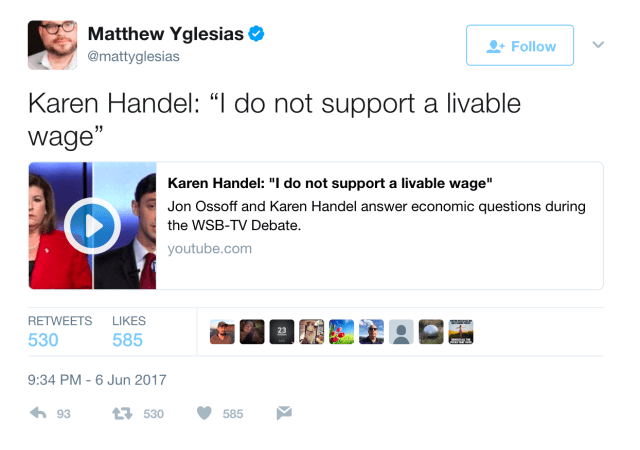
I Do Not Support a Livable Wage!

This is a quote from Karen Handel (running for congress against Jon Ossoff).  The quote has gone viral on Twitter:  https://twitter.com/HuffPost/status/872279182545494017

http://talkingpointsmemo.com/livewire/karen-handel-i-dont-support-livable-wage

Screen Shot 2017-06-08 at 12.58.11 PM.png

Screen Shot 2017-06-08 at 12.58.57 PM

Nice review of the context by George Lakoff on this blog post.

Posted in GOP, jobs, Uncategorized, Zeldin | Tagged , , , , | Leave a comment

Trump Names BP Oil Spill Lawyer as Top Environmental Attorney

President Donald Trump announced Tuesday his intention to nominate Jeffrey Bossert Clark—who defended BP in lawsuits surrounding the 2010 Deepwater Horizon oil spill and challenged the Obama administration over greenhouse gas rules on behalf of the U.S. Chamber of Commerce—to head the Justice Department’s Environment and Natural Resources Division.

Clark is a partner in the Washington, DC office of Kirkland & Ellis LLP and once served in George W. Bush’s administration from 2001 to 2005 as a deputy assistant attorney general for the Justice Department’s Environment and Natural Resources Division.

“He is a complex trial and appellate litigator with especially deep experience in administrative law, cutting across dozens of statutes and numerous agencies,” the White House announced.

However, as Robert F. Kennedy, Jr. commented, “Clark’s appointment is a doubling down on the administration’s strategy of retreating from the future and branding America as a petrostate while China steals our global energy, economic and moral leadership, and the rest of the world moves forward.”

InsideClimate News described Clark as a “climate policy foe” who has “repeatedly argued that it is inappropriate to base government policymaking on the scientific consensus presented by the Intergovernmental Panel on Climate Change [IPCC].”

According to the publication, “One of the legal briefs he signed is such a comprehensive compendium of thoroughly debunked denial of the scientific consensus that it stands as a classic of the genre, replete with condemnations not just of the EPA but of the IPCC, whose work the petitioners tried to persuade the court to rule out of bounds. A series of podcasts and papers he has written on The Federalist Society website continue his arguments against the endangerment finding and climate science more broadly.”

Clark has also criticized the U.S. Environmental Protection Agency (EPA) for concluding in late 2009 that carbon dioxide and other greenhouse gases threatens the public health and the environment and should be regulated under the Clean Air Act. As Clark wrote in a 2010 blog post over the EPA’s endangerment finding, “When did America risk coming to be ruled by foreign scientists and apparatchiks at the United Nations?”

“He has a long history of opposing climate action for corporate and ideological clients,” David Doniger, who heads the climate and clean air program at the Natural Resources Defense Counsel, told InsideClimate News about Clark. “I would expect that history would require him to recuse himself from such cases as over the Clean Power Plan, where he filed an amicus brief against the rule.”

Posted in Environment, EPA, Trump | Tagged , , | Leave a comment

Macron invites Americans upset over Trump exit from climate pact to find a ‘second homeland’

by Margaret Menge | Updated 06 Jun 2017 at 6:06 AM

French President Emmanuel Macron is offering refuge to American liberals upset at President Donald Trump’s decision to withdraw from the Paris climate agreement.

In a video posted to Twitter, speaking in English, Macron said:

“I wish to tell the United States: France believes in you. The world believes in you. I know that you are a great nation. I know your history, our common history.”

“If you’re wondering how to get into France, you can either be a Syrian [jihadi] or an American climate scientist.”

“To all scientists, engineers, entrepreneurs, responsible citizens who were disappointed by the decision of the president of the United States, I want to say that they will find in France a second homeland. I call them: Come and work here, with us, to work together on concrete solutions for our climate, our environment. I can assure you, France will not give up the fight.”

Macron also posted a picture to Twitter, with the words “Make Our Planet Great Again” on a green and blue background.

Macron is a 39-year-old liberal who worked in mergers and acquisitions for the Rothschild investment bank in Paris and as the economy minister to French Socialist Party President François Hollande before rebranding himself as an “outsider” last year and launching a campaign for president.

He defeated populist National Front leader Marine Le Pen in May to become the youngest-ever president of France.

It may be because of his youth that Macron is not aware that the specter of a young Frenchman calling out the president of the United States, speaking English with a French accent, may invite more ridicule from Americans than gratitude.

“If you’re wondering how to get into France, you can either be a Syrian [jihadi] or an American climate scientist,” newspaper columnist and talk radio guest host Mark Steyn said on “The Rush Limbaugh Show” on Friday afternoon, before noting that France would likely require more paperwork from the American climate scientist than from the jihadi.

And as for President Trump himself, The Washington Post reported Friday that Trump’s irritation with Macron’s disrespecting him at their first meeting may have, in fact, helped seal his decision on withdrawal from the Paris accord.

It occurred in Brussels, Belgium, on May 26, when the new French president approached the line of world leaders, with Trump in the middle, but veered off to his right. He ignored Trump to shake German Chancellor Angela Merkel’s hand first, and then the hand of NATO Secretary-General Jens Stoltenburg. Only then did he finally face Trump, who clasped Macron’s hand tightly and pulled the slender Macron toward him forcefully while shaking his hand vigorously, breaking out into a huge smile — not at Macron, but toward the cameras that he saw were pointed toward him.

At an earlier private meeting between Macron and Trump, the two had shaken hands, with both gripping tightly and grimacing for the cameras, in what some media organizations interpreted as an alpha male showdown.

In what was likely the best, or probably the most memorable, line from the president’s energetic address from the Rose Garden on Thursday, in which he laid out a strong case for exiting the Paris agreement, he said: “I was elected to represent the citizens of Pittsburgh, not Paris.”

Posted in climate change, foreign policy, GOP, Paris Climate Accord, Trump | 3 Comments

‘My Life Is Very Full’: People With Disabilities Worry About GOP Medicaid Cuts

Kaiser Health News

June 7, 2017

Evan Nodvin, seen here in his Atlanta-area apartment, uses services
that are covered by Medicaid. (Elly Yu/WABE)

Several decades ago, Evan Nodvin’s life probably would have looked quite different.

Nodvin has his own apartment just outside Atlanta, in Sandy Springs, Ga., and a job at a local community fitness center. He also has Down syndrome.

“I give out towels, and put weights away, and make sure people are safe,” the 38-year-old said.

To get to and from work, Nodvin relies on rides from people who are hired to help him. He also has a counselor to help him do daily chores like grocery shopping, cleaning and cooking.

“My favorite thing to cook on Wednesdays — I like to cook turkey patties once a week,” he said. “And on Thursdays, I make fish, and other days, I make other good stuff like spaghetti.”

Nodvin can live independently because of these services that are covered in Georgia under Medicaid, the government health insurance for people with disabilities and the poor. According to the Georgia Department of Community Health, the state spends about 6 percent of its Medicaid budget on services for people with developmental disabilities.

When Congress started to talk about making big changes to Medicaid in the health care bill in March, Nodvin went to Washington, D.C., with a group of advocates to lobby. He read a speech there, which he recited in his living room.

“As you can see, my life is very full. I work, live and play in the community. My dream is to continue this healthy and useful life. Thank you,” he read.

But that dream is uncertain. The Congressional Budget Office estimates the proposed cuts to Medicaid in the Obamacare repeal bill that passed the House of Representatives amounts to $834 billion over 10 years. In Georgia, more than half of the state’s Medicaid dollars go to the elderly or people with disabilities, according to the Georgia Department of Community Health.

Instead of matching state funds, under the new plan the federal government would give states a fixed amount of money based on what they’ve been spending, said Bill Custer, a professor of health administration at Georgia State University.

“In a state like Georgia, the impact would be immediate and fairly severe over time,” he said.

According to the Kaiser Family Foundation, Georgia ranked the second lowest in Medicaid spending per enrollee in fiscal year 2011. (Kaiser Health News is an editorially independent program of the foundation.) Georgia currently gets about two federal dollars for every one dollar the state puts in, but the new plan would give states a capped amount of funding for Medicaid.

Custer said Medicaid in Georgia might be OK in the beginning, but as health care costs rise, states will increasingly have to shoulder the burden.

“That means states are going to have to either find the money to maintain the program or shrink the program either by covering fewer services, or covering fewer people, or both,” he said.

That worries Eric Jacobson, executive director of the Georgia Council on Developmental Disabilities, a state advocacy group.

“Medicaid is the lifeline for people with disabilities,” he said.

Jacobson said the community support services like Nodvin gets under Medicaid are considered optional by states.

“Those are the kinds of services that we hope won’t get cut, but because of the reduction in funds, [they] might be the first on the chopping block,” he said.

He said services are already limited. According to the state Department of Community Health, nearly 9,000 people with intellectual or developmental disabilities are on a waiting list to get help in order to live on their own or in their communities.

Jacobson worries more people might be forced into institutions if there are budget cuts.

“The way I look at it, institutionalization for people with developmental disabilities — it’s kind of like sending you to jail for no crime,” he said. “You can’t go out. I remember talking to somebody, and he said, ‘I want to take my girlfriend to the movies. I can’t take my girlfriend to the movies because I’m not allowed to go off campus.’”

Jacobson said there’s been a movement over the past several decades to allow people with disabilities to live in their communities. He said it’s about quality of life and can save the state a lot of money.

In his Sandy Springs apartment, Evan Nodvin tabs through his CD collection. He has a Beatles poster hanging up near his room.

“I have Michael Jackson, Beatles, whatever … I got more of them here,” he said.

He’s lived on his own for the past 16 years, not long after graduating from high school. He has a job, a girlfriend and an apartment and, as he said in his speech in D.C.: “I am able to be independent because I get help from my Medicaid waiver in my state of Georgia.”

That’s why Nodvin and his family will be watching what happens next in Washington, D.C.

This story is part of a partnership that includes WABE, NPR and Kaiser Health News.

Kaiser Health News, a nonprofit health newsroom whose stories appear in news outlets nationwide, is an editorially independent part of the Kaiser Family Foundation.

Posted in ACA, AHCA, American Health Care Act, GOP, Health Care, Medicaid, mental health, Pre-existing Conditions, Trump, trumpcare | Leave a comment

Comey Statement for the Record Senate Select Committee on Intelligence

James B. Comey June 8, 2017

Comey statement annotated by the NY Times

Chairman Burr, Ranking Member Warner, Members of the Committee. Thank you for inviting me to appear before you today. I was asked to testify today to describe for you my interactions with President-Elect and President Trump on subjects that I understand are of interest to you. I have not included every detail from my conversations with the President, but, to the best of my recollection, I have tried to include information that may be relevant to the Committee.

January 6 Briefing

I first met then-President-Elect Trump on Friday, January 6 in a conference room at Trump Tower in New York. I was there with other Intelligence Community (IC) leaders to brief him and his new national security team on the findings of an IC assessment concerning Russian efforts to interfere in the election. At the conclusion of that briefing, I remained alone with the President- Elect to brief him on some personally sensitive aspects of the information assembled during the assessment.

The IC leadership thought it important, for a variety of reasons, to alert the incoming President to the existence of this material, even though it was salacious and unverified. Among those reasons were: (1) we knew the media was about to publicly report the material and we believed the IC should not keep knowledge of the material and its imminent release from the President-Elect; and (2) to the extent there was some effort to compromise an incoming President, we could blunt any such effort with a defensive briefing.

The Director of National Intelligence asked that I personally do this portion of the briefing because I was staying in my position and because the material implicated the FBI’s counter-intelligence responsibilities. We also agreed I would do it alone to minimize potential embarrassment to the President-Elect. Although we agreed it made sense for me to do the briefing, the FBI’s leadership and I were concerned that the briefing might create a situation where a new President came into office uncertain about whether the FBI was conducting a counter-intelligence investigation of his personal conduct.

It is important to understand that FBI counter-intelligence investigations are different than the more-commonly known criminal investigative work. The Bureau’s goal in a counter-intelligence investigation is to understand the technical and human methods that hostile foreign powers are using to influence the United States or to steal our secrets. The FBI uses that understanding to disrupt those efforts. Sometimes disruption takes the form of alerting a person who is targeted for recruitment or influence by the foreign power. Sometimes it involves hardening a computer system that is being attacked. Sometimes it involves “turning” the recruited person into a double-agent, or publicly calling out the behavior with sanctions or expulsions of embassy-based intelligence officers. On occasion, criminal prosecution is used to disrupt intelligence activities.

Because the nature of the hostile foreign nation is well known, counter- intelligence investigations tend to be centered on individuals the FBI suspects to be witting or unwitting agents of that foreign power. When the FBI develops reason to believe an American has been targeted for recruitment by a foreign power or is covertly acting as an agent of the foreign power, the FBI will “open an investigation” on that American and use legal authorities to try to learn more about the nature of any relationship with the foreign power so it can be disrupted.

In that context, prior to the January 6 meeting, I discussed with the FBI’s leadership team whether I should be prepared to assure President-Elect Trump that we were not investigating him personally. That was true; we did not have an open counter-intelligence case on him. We agreed I should do so if circumstances warranted. During our one-on-one meeting at Trump Tower, based on President- Elect Trump’s reaction to the briefing and without him directly asking the question, I offered that assurance.

I felt compelled to document my first conversation with the President-Elect in a memo. To ensure accuracy, I began to type it on a laptop in an FBI vehicle outside Trump Tower the moment I walked out of the meeting. Creating written records immediately after one-on-one conversations with Mr. Trump was my practice from that point forward. This had not been my practice in the past. I spoke alone with President Obama twice in person (and never on the phone) – once in 2015 to discuss law enforcement policy issues and a second time, briefly, for him to say goodbye in late 2016. In neither of those circumstances did I memorialize the discussions. I can recall nine one-on-one conversations with President Trump in four months – three in person and six on the phone.

January 27 Dinner

The President and I had dinner on Friday, January 27 at 6:30 pm in the Green Room at the White House. He had called me at lunchtime that day and

2

invited me to dinner that night, saying he was going to invite my whole family, but decided to have just me this time, with the whole family coming the next time. It was unclear from the conversation who else would be at the dinner, although I assumed there would be others.

It turned out to be just the two of us, seated at a small oval table in the center of the Green Room. Two Navy stewards waited on us, only entering the room to serve food and drinks.

The President began by asking me whether I wanted to stay on as FBI Director, which I found strange because he had already told me twice in earlier conversations that he hoped I would stay, and I had assured him that I intended to. He said that lots of people wanted my job and, given the abuse I had taken during the previous year, he would understand if I wanted to walk away.

My instincts told me that the one-on-one setting, and the pretense that this was our first discussion about my position, meant the dinner was, at least in part, an effort to have me ask for my job and create some sort of patronage relationship. That concerned me greatly, given the FBI’s traditionally independent status in the executive branch.

I replied that I loved my work and intended to stay and serve out my ten- year term as Director. And then, because the set-up made me uneasy, I added that I was not “reliable” in the way politicians use that word, but he could always count on me to tell him the truth. I added that I was not on anybody’s side politically and could not be counted on in the traditional political sense, a stance I said was in his best interest as the President.

A few moments later, the President said, “I need loyalty, I expect loyalty.” I didn’t move, speak, or change my facial expression in any way during the awkward silence that followed. We simply looked at each other in silence. The conversation then moved on, but he returned to the subject near the end of our dinner.

At one point, I explained why it was so important that the FBI and the Department of Justice be independent of the White House. I said it was a paradox: Throughout history, some Presidents have decided that because “problems” come from Justice, they should try to hold the Department close. But blurring those boundaries ultimately makes the problems worse by undermining public trust in the institutions and their work.

Near the end of our dinner, the President returned to the subject of my job, saying he was very glad I wanted to stay, adding that he had heard great things

3

about me from Jim Mattis, Jeff Sessions, and many others. He then said, “I need loyalty.” I replied, “You will always get honesty from me.” He paused and then said, “That’s what I want, honest loyalty.” I paused, and then said, “You will get that from me.” As I wrote in the memo I created immediately after the dinner, it is possible we understood the phrase “honest loyalty” differently, but I decided it wouldn’t be productive to push it further. The term – honest loyalty – had helped end a very awkward conversation and my explanations had made clear what he should expect.

During the dinner, the President returned to the salacious material I had briefed him about on January 6, and, as he had done previously, expressed his disgust for the allegations and strongly denied them. He said he was considering ordering me to investigate the alleged incident to prove it didn’t happen. I replied that he should give that careful thought because it might create a narrative that we were investigating him personally, which we weren’t, and because it was very difficult to prove a negative. He said he would think about it and asked me to think about it.

As was my practice for conversations with President Trump, I wrote a detailed memo about the dinner immediately afterwards and shared it with the senior leadership team of the FBI.

February 14 Oval Office Meeting

On February 14, I went to the Oval Office for a scheduled counter- terrorism briefing of the President. He sat behind the desk and a group of us sat in a semi-circle of about six chairs facing him on the other side of the desk. The Vice President, Deputy Director of the CIA, Director of the National Counter- Terrorism Center, Secretary of Homeland Security, the Attorney General, and I were in the semi-circle of chairs. I was directly facing the President, sitting between the Deputy CIA Director and the Director of NCTC. There were quite a few others in the room, sitting behind us on couches and chairs.

The President signaled the end of the briefing by thanking the group and telling them all that he wanted to speak to me alone. I stayed in my chair. As the participants started to leave the Oval Office, the Attorney General lingered by my chair, but the President thanked him and said he wanted to speak only with me. The last person to leave was Jared Kushner, who also stood by my chair and exchanged pleasantries with me. The President then excused him, saying he wanted to speak with me.

When the door by the grandfather clock closed, and we were alone, the President began by saying, “I want to talk about Mike Flynn.” Flynn had resigned

4

the previous day. The President began by saying Flynn hadn’t done anything wrong in speaking with the Russians, but he had to let him go because he had misled the Vice President. He added that he had other concerns about Flynn, which he did not then specify.

The President then made a long series of comments about the problem with leaks of classified information – a concern I shared and still share. After he had spoken for a few minutes about leaks, Reince Priebus leaned in through the door by the grandfather clock and I could see a group of people waiting behind him. The President waved at him to close the door, saying he would be done shortly. The door closed.

The President then returned to the topic of Mike Flynn, saying, “He is a good guy and has been through a lot.” He repeated that Flynn hadn’t done anything wrong on his calls with the Russians, but had misled the Vice President. He then said, “I hope you can see your way clear to letting this go, to letting Flynn go. He is a good guy. I hope you can let this go.” I replied only that “he is a good guy.” (In fact, I had a positive experience dealing with Mike Flynn when he was a colleague as Director of the Defense Intelligence Agency at the beginning of my term at FBI.) I did not say I would “let this go.”

The President returned briefly to the problem of leaks. I then got up and left out the door by the grandfather clock, making my way through the large group of people waiting there, including Mr. Priebus and the Vice President.

I immediately prepared an unclassified memo of the conversation about Flynn and discussed the matter with FBI senior leadership. I had understood the President to be requesting that we drop any investigation of Flynn in connection with false statements about his conversations with the Russian ambassador in December. I did not understand the President to be talking about the broader investigation into Russia or possible links to his campaign. I could be wrong, but I took him to be focusing on what had just happened with Flynn’s departure and the controversy around his account of his phone calls. Regardless, it was very concerning, given the FBI’s role as an independent investigative agency.

The FBI leadership team agreed with me that it was important not to infect the investigative team with the President’s request, which we did not intend to abide. We also concluded that, given that it was a one-on-one conversation, there was nothing available to corroborate my account. We concluded it made little sense to report it to Attorney General Sessions, who we expected would likely recuse himself from involvement in Russia-related investigations. (He did so two weeks later.) The Deputy Attorney General’s role was then filled in an acting capacity by a United States Attorney, who would also not be long in the role.

5

After discussing the matter, we decided to keep it very closely held, resolving to figure out what to do with it down the road as our investigation progressed. The investigation moved ahead at full speed, with none of the investigative team members – or the Department of Justice lawyers supporting them – aware of the President’s request.

Shortly afterwards, I spoke with Attorney General Sessions in person to pass along the President’s concerns about leaks. I took the opportunity to implore the Attorney General to prevent any future direct communication between the President and me. I told the AG that what had just happened – him being asked to leave while the FBI Director, who reports to the AG, remained behind – was inappropriate and should never happen. He did not reply. For the reasons discussed above, I did not mention that the President broached the FBI’s potential investigation of General Flynn.

March 30 Phone Call

On the morning of March 30, the President called me at the FBI. He described the Russia investigation as “a cloud” that was impairing his ability to act on behalf of the country. He said he had nothing to do with Russia, had not been involved with hookers in Russia, and had always assumed he was being recorded when in Russia. He asked what we could do to “lift the cloud.” I responded that we were investigating the matter as quickly as we could, and that there would be great benefit, if we didn’t find anything, to our having done the work well. He agreed, but then re-emphasized the problems this was causing him.

Then the President asked why there had been a congressional hearing about Russia the previous week – at which I had, as the Department of Justice directed, confirmed the investigation into possible coordination between Russia and the Trump campaign. I explained the demands from the leadership of both parties in Congress for more information, and that Senator Grassley had even held up the confirmation of the Deputy Attorney General until we briefed him in detail on the investigation. I explained that we had briefed the leadership of Congress on exactly which individuals we were investigating and that we had told those Congressional leaders that we were not personally investigating President Trump. I reminded him I had previously told him that. He repeatedly told me, “We need to get that fact out.” (I did not tell the President that the FBI and the Department of Justice had been reluctant to make public statements that we did not have an open case on President Trump for a number of reasons, most importantly because it would create a duty to correct, should that change.)

The President went on to say that if there were some “satellite” associates of his who did something wrong, it would be good to find that out, but that he

6

hadn’t done anything wrong and hoped I would find a way to get it out that we weren’t investigating him.

In an abrupt shift, he turned the conversation to FBI Deputy Director Andrew McCabe, saying he hadn’t brought up “the McCabe thing” because I had said McCabe was honorable, although McAuliffe was close to the Clintons and had given him (I think he meant Deputy Director McCabe’s wife) campaign money. Although I didn’t understand why the President was bringing this up, I repeated that Mr. McCabe was an honorable person.

He finished by stressing “the cloud” that was interfering with his ability to make deals for the country and said he hoped I could find a way to get out that he wasn’t being investigated. I told him I would see what we could do, and that we would do our investigative work well and as quickly as we could.

Immediately after that conversation, I called Acting Deputy Attorney General Dana Boente (AG Sessions had by then recused himself on all Russia- related matters), to report the substance of the call from the President, and said I would await his guidance. I did not hear back from him before the President called me again two weeks later.

April 11 Phone Call

On the morning of April 11, the President called me and asked what I had done about his request that I “get out” that he is not personally under investigation. I replied that I had passed his request to the Acting Deputy Attorney General, but I had not heard back. He replied that “the cloud” was getting in the way of his ability to do his job. He said that perhaps he would have his people reach out to the Acting Deputy Attorney General. I said that was the way his request should be handled. I said the White House Counsel should contact the leadership of DOJ to make the request, which was the traditional channel.

He said he would do that and added, “Because I have been very loyal to you, very loyal; we had that thing you know.” I did not reply or ask him what he meant by “that thing.” I said only that the way to handle it was to have the White House Counsel call the Acting Deputy Attorney General. He said that was what he would do and the call ended.

That was the last time I spoke with President Trump. ###

Posted in FBI, Russian connection, Trump, Uncategorized | Tagged , , | 2 Comments

BEAUTIFUL WINGED FRIENDS-save the butterflies from neonicotinoid pesticides & insecticides

Change.org

WHO is being affected?

Butterflies are the underdog pollinators.  While bees contribute to the pollination of a majority of plants, butterflies pollinate a number of different plant populations worldwide with their unique abilities.  They collect pollen and nectar on their long legs, both feeding themselves and allowing other plants’ seeds (on which they posit previously collected pollen and nectar) to be fertilized.  Their slender and tubular shape allows them to pollinate plants (like the firecracker plant and the sunflower) that the bodies of bees cannot successfully reach. To butterflies, finding safe and accessible egg-laying sites is an important habitat characteristic (Merckx, Dyck, Karlsson, Leimar). They are also extremely responsive to ecological changes, which makes them great indicators of an ecosystem’s condition (Hawkinson).  However, as more and more pesticides are sprayed in areas varying from school yards and agricultural fields,  the ability for butterflies to find safe spots to lay their eggs and live healthy lives has lessened at extraordinary rates (Hawkinson).

WHAT is the problem?

Habitat fragmentation (the loss and division of habitat stemming from a variety of different reasons) has increasingly become detrimental to many species.  To butterflies (and bees) pesticide usage is the antagonist responsible for the fragmentation of their habitats (plants and flowers), and as bee populations continue to decline due to the overuse of insecticides, it has become even more crucial to save the bees’ beautiful winged cousins.  Pesticides and insecticides, which have contributed to the 4% decline in butterfly populations since 2011 (Latham), are toxic to many butterfly species.  The primary culprit in this demoralizing loss of biodiversity is the neonicotinoid insecticide clothianidin.  This water soluble nicotine based insecticide (which can either be sprayed directly onto plants or applied to soil) intoxicates the nectar and pollen that butterflies gather, harming them by reducing available egg-laying sites and food sources (citybugs.tamu.edu).  Commonly found in urban areas and agricultural cultivation sites, these neonicotinoids must be eliminated.  We must act now to save the butterflies before it is too late.

HOW do we make a change?

To affect change, ask policymakers to increase taxes on these harmful pesticides and lower them on natural, mint, hot pepper, and garlic-based insecticides.  Insect infestations can be easily avoided with garlic insecticide sprays (made of vegetable oil, 2 cloves of garlic, water, and mild liquid soap), chile pepper insecticide sprays, or even soap sprays. The aromas of these alternatives to chemical pesticides are easily detectable to most insects, making them avoid affected plants while not causing harm to their beings.  Natural aroma pesticides and insecticides will save the future populations of the beautiful butterfly.  A friend to all, we cannot let chemicals destroy their chances of survival.  It is crucial that all neonicotinoid chemicals become not as easily accessible as they are today.  Butterflies play a crucial part in the environmental well being of our planet, pollinating, serving as indicators of important changes, and bringing such elegant beauty to nature.  As bee populations additionally continue to decline, it has become more important than ever to save their winged friends.  Help raise taxes on butterfly and bee killing neonicotinoid insecticides and make natural ones more easily accessible to the general public. Sign the petition below that will be sent to local Los Angeles finance department as well as the L.A. environmental health district office.

Not convinced? Follow the attached link to a video where young Chloe expresses her sentiments toward the decline in butterfly populations.

https://www.youtube.com/watch?v=43t3u7uyEPc


Posted in Environment, EPA | Tagged , , | Leave a comment

A Community Seeks Answers, Assurances About Health Care — In 10 Languages

Kaiser Health News

June 5, 2017

Mary Thach (left), pictured with her translator Diane Cao, at the Oakland Asian Cultural Center on May 31, had the entirety of her $69,000 throat surgery paid for by Medi-Cal. (Kellen Browning/California Healthline)

OAKLAND, Calif. — Ten years ago, Mary Thach unexpectedly needed throat surgery to improve her breathing and spent two weeks in the hospital. Her bill: $69,000.

Her first reaction was panic, said Thach, speaking through a Vietnamese interpreter. Uninsured at the time, she had no idea how to come up with the money. Then she learned from the hospital staff that as a low-income legal resident, she qualified for Medicaid, which ultimately paid the bill.

At a recent community meeting in this city, the 54-year-old Alameda resident teared up as she expressed her fear of losing Medicaid (known as Medi-Cal in California) under the Republican-sponsored American Health Care Act. The Congressional Budget Officeestimates could lead to the loss of health coverage for 23 million Americans.

“I’m scared that Mr. Trump will cut Medi-Cal. How will I take care of my health?” Thach said.

Facing concerns over immigration and GOP-led efforts to dismantle the Obama administration’s signature health care law and cut Medicaid, community groups in Oakland, Bakersfield, Fresno, Houston and other cities with large immigrant populations are holding meetings to allay fears, debunk myths and inform people of their rights.

More than 400 people attended the Oakland forum on Wednesday sponsored by the Oakland-based clinic system Asian Health Services. Some came to ask questions, others to share stories they hoped would motivate elected officials to help them. The room was so packed, a group of Chinese attendees had to observe from an overflow room. Most participants were middle-aged or senior citizens, many with notebooks and pens in hand.

With the help of headphones and a tableful of interpreters, the meeting was translated in 10 different Asian languages, including Cantonese, Mandarin, Mongolian and Korean and Tagalog. Questions were fielded by Asian Health Services staff, local politicians and an immigration attorney, who gave advice on interacting with Immigration and Customs Enforcement (ICE) officials.

Some attendees feared the use of government programs like Medi-Cal and CalFresh (food stamps) could prompt ICE inquiries or deportation. The attorney, Nancy Wong with Asian Pacific Islander Legal Outreach, said she’d seen no evidence of that and urged the audience to continue using those programs for now.

Republican Congress members from California contend the Affordable Care Act — also known as Obamacare — is failing and has raised costs to the point that care has become out-of-reach for many Americans.

Devin Nunes (R-Tulare) who supports the GOP replacement bill, favors moving people from the “broken” Medi-Cal program “into better, private coverage plans.” The GOP’s AHCA would reduce federal funding for Medicaid by $834 billion from 2017 to 2026, the Congressional Budget Office estimated.

Many Americans are concerned about major changes to their health coverage, organizers said, but members of Oakland’s Asian immigrant community face additional language, cultural, legal and other barriers to getting the health care they need.

Some at the forum feared that a preexisting condition, or being an immigrant — even a legal one — would disqualify them from future health coverage and other public benefits. In most cases, adults without authorization to live in the U.S. cannot qualify for full Medi-Cal coverage, although permanent residents with green cards can. Children in California whose families meet income limits can receive Medi-Cal regardless of their immigration status.

“Many of you went from worrying … that insurers would not cover you to overnight being entitled to full benefits,” Sherry Hirota, CEO of Asian Health Services, told the audience. “We can’t roll back, and we can’t let immigrants be criminalized for using health services. That’s why we’re here.”

Hirota said the ACA, including the expansion of Medicaid, allowed her clinic system to treat more than 9,000 new patients. More than 90 percent of the center’s patients are on Medi-Cal, she said.

“More [forums like these] are emerging, and they’re important because there are many questions and not enough information out there,” said Doreena Wong, a project director with Asian Americans Advancing Justice-Los Angeles.

The organization has helped put together similar informational events about health care and immigration in Spanish and Asian languages in Los Angeles and Orange counties.

Cary Sanders, director of policy analysis for the California Pan-Ethnic Health Network, an advocacy group, said the difficulty is that immigrants historically have been excluded from certain government health programs.

“California has certainly gone much further than other states to expand health care for immigrant communities,” Sanders said. “For certain groups, it’s still very difficult. They may only be eligible for emergency care. Because of that people often delay care. They have to use home remedies to limp along to take care of and manage health problems that, if left untreated, can become a lot more serious.”

At the forum, Alameda County Supervisor Wilma Chan pointed out that Asians make up close to 30 percent of the population in her county. Together with Latinos, they comprise more than half.

She asked that people not be afraid to access health care services or make use of any other public benefit.

“There is this idea that if you’re not a citizen, you can be deported if you go to a clinic or use food stamps … this has not happened,” Chan said.

One woman said her friends have encouraged her to stop using CalFresh to draw less attention to her family. A man asked whether paying cash at the clinic instead of using his Medi-Cal coverage would be safer for his mixed-status family.

Mandy Xue of Alameda was grateful for the meeting even though her concern had little to do with the goings-on in Washington. She learned two weeks ago at her son’s dentist’s office that his Medi-Cal coverage had ended. When she called the state for an explanation, she was told there was no record of her or her 13-year-old son, even though the Alameda resident says they have been covered since she was pregnant with him.

Xue, 45, was not sure what to do, and worried that she and her son would not be able to continue seeing their doctors.

The event was “very helpful,” Xue said through a Cantonese translator, because now “I know what the next step should [be] and what should I look for.”

Ngoc Nguyen, editor of California Ethnic Media Partnerships, contributed to this story.

This story was produced by Kaiser Health News, which publishes California Healthline, an editorially independent service of the California Health Care Foundation.

Kaiser Health News, a nonprofit health newsroom whose stories appear in news outlets nationwide, is an editorially independent part of the Kaiser Family Foundation.

Posted in ACA, AHCA, American Health Care Act, GOP, Health Care, Medicaid, Trump, trumpcare | Leave a comment

GOP Medicaid Cuts Hit Rural America Hardest, Report Finds

June 7, 2017

Medicaid advocates rally in Washington, D.C., on Tuesday. (Phil Galewitz/KHN)

Rural America carried President Donald Trump to his election night upset last November.

Trump Country it may be, but rural counties and small towns also make up Medicaid Country — those parts of the nation whose low-income children and families are most dependent on the federal-state health insurance program, according to a report released Wednesday.

Medicaid’s enrollment has swollen to more than 72 million in recent years, and the ranks of uninsured Americans has fallen to 9 percent in 2015 from 13 percent in 2013. That’s largely due to the Affordable Care Act, which allowed states to expand Medicaid eligibility with federal funds. Thirty-one states plus the District of Columbia did so.

Those gains may be in jeopardy under a GOP- and White House-backed health care measure called the American Health Care Act that would replace major parts of the ACA — known as Obamacare — and dramatically cut federal funding for Medicaid. The House passed the bill in May.

“There is no doubt that children and families in small towns would be disproportionately harmed by cuts to Medicaid,” said Joan Alker, executive director of the Georgetown University Center for Children and Families.

According to the center’s new report, Medicaid covered 45 percent of children and 16 percent of adults in small towns and rural areas in 2015. Those figures are lower in metropolitan areas — 38 percent of children and 15 percent of adults.

Rural areas have larger Medicaid populations because more people with disabilities live there, household incomes tend to be lower, unemployment rates higher and jobs with employer-paid insurance less common, the Georgetown report said.

In states that expanded Medicaid under Obamacare, the rate of uninsured people in small towns and rural areas fell by 11 percentage points between 2008-09 and 2014-15 — from 22 percent to 11 percent, the report said. That was slightly larger than the decrease in metro areas of expansion states.

If the House-passed bill became law, Medicaid would be cut by more than $800 billion over 10 years. Alker said that would lead to higher uninsured rates and reduce Americans’ access to health care.

The Republican-controlled Senate is expected to circulate a preliminary proposal of their repeal-and-replace legislation to members as early as this week. Compared with House members, senators are typically more sensitive to issues facing rural Americans because they represent entire states rather than districts often dominated by urban areas.

With the Senate edging closer to creating its own bill, disability and health advocates and Medicaid enrollees on Tuesday held “Don’t Cap My Care” rallies in nine cities imploring Congress to reject efforts to cut Medicaid funding.

About 400 people gathered outside the U.S. Capitol in Washington, D.C. — blind, disabled, elderly people among them — with many holding signs reading “Don’t Mess With Medicaid” and “No Cuts, No Caps to Medicaid.”

Ten million people with disabilities rely on Medicaid to help them live, work, attend school and participate in their communities.

Cindy Jennings, 53, of Lititz, Pa., who attended the Washington rally, said she fears the loss of Medicaid coverage under the Republican plan or reduced coverage for her son, Matthew. He is disabled and unable to speak because he was born with a chromosome abnormality.

“It’s frustrating and scary,” she said. “I need to stay healthy to care for him.”

Erickia Bartee, 31, of Owings Mills, Md., said Medicaid enables her to live in a group home and get drugs and other health services to live with cerebral palsy. “I will struggle to survive if my Medicaid benefits are cut,” she said.

Other findings from the report:

  • Thirteen states have at least 20 percent of adults in rural areas enrolled in Medicaid. Arizona leads the nation with 34 percent in the program.
  • Rural Oregon saw the biggest gain in adults with insurance over the study’s period. Its uninsurance rate dropped 19 percentage points, while adults in the state covered by Medicaid increased 17 percentage points.
  • In 14 states, more than half of children in rural areas are covered by Medicaid. Of those, Arkansas and Mississippi were the only states with 60 percent or more of children in rural areas on Medicaid.

The report defined America’s rural areas and small towns as non-metropolitan counties, whose main urban areas have no more than 50,000 people.

CATEGORIES: Medicaid, Repeal And Replace Watch, The Health Law

TAGS: , , ,

Posted in ACA, AHCA, American Health Care Act, GOP, Health Care, Medicaid, Trump, trumpcare | Leave a comment

A Crazy Man for President

OK, it took all of four months, but I think it’s been pretty well established by now: we’ve elected a crazy man for President.  Not that for most of us there were any doubts on that score on November 9th or on Inauguration Day.  But for those of us who held out some slim hope that what we saw during the campaign was all an act, a reality show designed to get the widest possible viewership, a sales pitch aimed at selling the product to a mass market, and that behind the curtain there lurked a shrewd, savvy wizard who might surprise and delight us – sorry, not going to happen!  Or alternatively that the Presidency itself, the solemn responsibilities of the office, might transform the campaign caterpillar into a beautiful butterfly – again, sorry, not going to happen!

If anybody still doubts that we’ve elected a crazy man for President I beg them to ponder the following three items, selected at random from countless more that could be cited:

Item:  President Trump withdraws the United States from the Paris Agreement, making it 194 parties remaining in the agreement and 1 choosing to leave.  No point in attempting to refute the Trumpian claim that the Paris Agreement is a “bad deal” for the United States.  Anybody anywhere can renege on a painstakingly negotiated deal, claiming to really really deserve more for less.  Simple.  Trump’s underlying attitude here reminds me of the Mel Brooks joke about the world’s first national anthem, dating from prehistoric times: “May they all go to hell, except Cave Seven!”

Item: President Trump submits a budget cutting $1 billion from cancer research.  Cancer research!  I get the cuts to PBS and the National Endowment for the Arts.  That’s been on the Republican hit list for decades.  I even get the cuts to the National Environmental Satellite, Data and Information Service, which operates satellites tracking hurricanes and gathering climate data.  Wouldn’t want to gather more empirical evidence of global warming; let’s poke out our eyes.  But cancer research?  Cancer research?  Really?

Item: After a terrorist attack in London, the mayor of London tries to reassure rattled citizens that the appearance of lots of police on the streets toting automatic weapons does not mean that a new attack is underway or imminent.  President Trump twists his words to make a racially-fueled, politically motivated attack on the mayor.  Not that different from hurling abuse at firemen attempting to put out the flames.  But this is the President of the United States hurling the abuse.

So how did we get here?  How did we get a crazy man for President?  I’m afraid a complete answer to this question would require far more insight, knowledge, and wisdom than I possess.  Maybe in twenty or fifty or a hundred years historians will understand the forces that led us to this pass.  But I think a few widespread beliefs, every one of them fallacious, can be identified as contributing to this mess.

You may get a crazy man for President if you believe that the best qualification for the office is being a rich businessman.  No, not all rich businessmen are crazy.  But some are.  And the skill set of a businessman is no closer to what the presidency demands than the skill set of, say, a janitor (consider: a janitor keeps things clean and running, knows something about repairs, sometimes needs to manage a crisis, etc.)

Related to this: you may get a crazy man for President if you think the country should be run like a business.  Which I guess means that the most successful countries are those which show a profit?  Anyhow, I think we already tried this one back in the day with Bob McNamara and a “metric” for everything, including “body counts”.  It ended in tears.  Not enough space to deconstruct the deep confusion of values this kind of thinking represents.

You may get a crazy man for President if you believe that saying out loud whatever pops into your brain is the same thing as “honesty”.

You may get a crazy man for President if you think having a sane President is not as important as hanging on to a stolen seat in the Supreme Court.  (Note to “strict constructionists”: maybe my copy of the Constitution is missing a page or something because I can’t find anything in it about the popular election of Supreme Court Justices)

You may get a crazy man for President if you think they’re all bums so what difference does it make.  If this is what you believe, then given the choice between a crazy man and a sane women, you may go with the crazy man because he seems to be more fun, or simply throw up your hands altogether and let everybody else decide.

You may get a crazy man for President if you believe that the job of the President is not to do what is best for the entire country but to give those you despise a poke in the eye with a sharp stick.

You may get a crazy man for President if you believe that things are so bad now they can’t get any worse.  Actually, they can.

You may get a crazy man for President if you think that all reporters are biased and all news is slanted one way or the other.  Shocking fact: there is such a thing as journalistic standards and there are actually reporters and news outlets that take them very seriously.  And there are also those that don’t.  And that matters.

You may get a crazy man for President if you notice the clear evidence of his insanity during the campaign but decide to ignore it and vote for him anyway because his party is your party, and besides it’ll probably be OK, he’ll surround himself with sane adults and somehow be kept under control.

It’s frustrating and seemingly pointless to try to reason with a crazy man.  Rational argumentation seems so much wasted breath.  At the risk of sounding vindictive (I wish no physical harm to the man) it seems to me the best advice is: “Don’t get mad, get even”.  Which means winning elections.  It’s the only way of reducing and hopefully eliminating the power of this crazy man and his enablers to do immense and lasting harm.

Posted in budget, climate change, Paris Climate Accord, Trump, Uncategorized | Tagged , , , , , , | 1 Comment

Sweet Home Alabama?

SELMA, AL - MARCH 06:  A pedestrian pulls a shopping cart by vacant buildings on March 6, 2015 in Selma, Alabama. 50 years after the historic civil rights march from Selma to Montgomery where marchers were beaten by State police officers as they crossed the Edmund Pettus Bridge, Selma struggles economically and is one of the poorest cities in Alabama with a 10.2 percent unemployment rate and over 40 percent of residents living below the national poverty level.  (Photo by Justin Sullivan/Getty Images)

Maybe he can find a job at that abandoned building?

While former Governor Robert Bentley was using Alabama taxpayer funds to fly helicopters to find his wallet and nearly getting himself impeached for misusing campaign funds (amongst other things), he was standing out front with his baton in the Republican hypocrite-parade. Since the beginning of the year, Alabama has cut away the “work requirement” exemption that was in place during the economic crash for people receiving food stamps from the Supplemental Nutrition Assistance Program (SNAP). Since January 1, thousands have been purged and now the remaining counties that still had the exemption have also seen thousands of people going hungry.

During the economic downturn of 2011-2013, several states – including Alabama – waived the SNAP work requirements in response to high unemployment. It was reinstituted for 54 counties on Jan. 1, 2016 and for the remaining 13 on Jan. 1, 2017. As of April 2017, the highest jobless rate among the 13 previously excluded counties was in Wilcox County, which reported a state-high unemployment rate of 11.7 percent, down more than 11 percentage points from the county’s jobless rate for the same month of 2011.

[…]

As of Jan. 1, 2017, there were 13,663 able-bodied adults without dependents receiving food stamps statewide. That number dropped to 7,483 by May 1, 2017. Among the 13 counties, there were 5,538 adults ages 18-50 without dependents receiving food stamps as of Jan. 1, 2017. That number dropped to 831 – a decline of about 85 percent – by May 1, 2017.

The good news is that Alabama is saving a few dollars. The bad news is that this bullshit form of bootstrap-pulling isn’t going to motivate people any more than they already are. Those areas don’t have an abundance of jobs, nor meaningful public transportation for people to get even volunteer work to meet these magic requirements.

Robert Gain volunteers in the kitchen at First Stop, Inc. and said he is trying to meet the requirements.

“Most of the people around here, their food stamps are canceled, and this is the only meal they’re going to get today,” Gain said.

[…]

Gain’s food stamps ran out on April 1.  It’s because of changes to the Federal Supplemental Nutrition Assistance Program, or SNAP, which limit people to receive three months of benefits within a three-year time frame unless they are working or volunteer training for at least 20 hours a week.

Gain is lucky as there aren’t enough positions, even in the volunteer world, to get the required hours needed. The good news is that Gov. Bentley was hoping to find a nice place for everyone to live.

Gov. Robert Bentley said a plan to borrow $800 million to build four new state prisons will be his most important goal during the 2017 legislative session, which is two weeks away.

You don’t have to wear a tinfoil hat to know that the Republican Party is driven by a racist and classist prison state ideology.

Posted in Education, Employment, GOP, Trump | Tagged , , , | Leave a comment

How ACA Repeal and Replace Proposals Could Affect Coverage and Premiums for Older Adults and Have Spillover Effects for Medicare

Published by Kaiser Family Foundation

Now that the House has passed its bill to repeal and replace the Affordable Care Act (ACA), Senate negotiators face a number of policy decisions that could be of particular interest to older adults who are not quite old enough for Medicare.  Prior to the ACA, adults in their fifties and early 60s were arguably most at risk in the private health insurance market.  They were more likely than younger adults to be diagnosed with certain conditions, like cancer and diabetes, for which insurers denied coverage.  They were also more likely to face unaffordable premiums because insurers had broad latitude (in nearly all states) to set high premiums for older and sicker enrollees.

The ACA included several provisions that aimed to address problems older adults faced in finding more affordable health insurance coverage, including guaranteed access to insurance, limits on age rating, and a prohibition on premium surcharges for people with pre-existing conditions.

The House-passed American Health Care Act (AHCA) would make a number of changes to current law that would result in a 5.1 million increase in the number of uninsured 50-64-year-olds in 2026, according to CBO’s updated analysis (Figure 1). 

These changes would disproportionately affect older adults with incomes below 200% of poverty.  Adults age 50-64 with incomes below 200% of the poverty level would see the biggest loss of coverage under the AHCA – a 150% increase in the number of uninsured in 2026 relative to current law, compared to 90% for all adults.  CBO projects the share of low-income older adults who are uninsured would rise from 12% under current law to 29% under the AHCA by 2026.

The increase in the number and share of uninsured older adults would be due to the following provisions in the AHCA:

  1. Age Bands. The AHCA broadens the limits on age bands established under the ACA, a change that is likely to lead to higher premiums for older enrollees.  The ACA prohibits insurers from charging older adults more than 3-times the premium amount for younger adults.  The House bill would allow insurers to charge older adults five times more than younger adults, beginning in 2018. States would have flexibility to establish different age bands (broader or narrower).
  2. State Waivers. The AHCA allows states to seek waivers that, if approved, would allow insurers to opt out of the ACA’s community rating and benefit requirements.  Insurers in these states could charge a higher premium to an applicant with a pre-existing condition who had a lapse in coverage of 63 days or more.  Before the ACA, insurers in nearly all states could deny non-group coverage for people with pre-existing conditions or charge them higher premiums.  These waivers would lower premiums for people who are healthy, but raise premiums and out-of-pocket costs for people who are sick.
    Because many health problems and pre-existing conditions tend to increase with age, the opt-out could particularly affect older adults.  For example, 47% of adults age 60-64 have a pre-existing condition that would have led to a denial of coverage pre-ACA, compared to 27% of non-elderly adults overall (Figure 2).

  1. Tax Credits. The AHCA changes the way that premium tax credits are calculated, providing lower premium subsidies for low-income adults, relative to the ACA – a change that would have a particularly pronounced effect for low-income older adults.  The combination of higher premiums (due to wider age bands) and lower tax credits (especially for those with lower incomes) will result in higher out-of-pocket premiums for older adults.
    CBO’s updated analysis illustrates how these proposed changes to the non-group market result in substantially higher premiums for low-income older adults.  According to CBO, a 64-year-old adult living on an income of $26,500 would, on average nationwide, pay a premium of $1,700 under current law in 2026, after receiving a tax credit of $13,600.  Under the AHCA, the tax credit for that 64-year-old would fall to $4,900, resulting in an average out-of-pocket premium in states not seeking waivers of $16,100.  That premium would also be for a plan, according to CBO’s estimates, with a higher deductible than under current law.
    Even in states that waive federal market regulations for benefits and community rating, the out-of-pocket premium for this low-income 64-year-old would rise to $13,600.  The impact on higher income 64-year-olds relative to current law would be more modest, since AHCA tax credits do not phase out by income like the ACA.
    The effects would vary geographically since AHCA tax credits (unlike ACA credits) do not vary based on actual local premiums.  For example, in Mecklenburg County, North Carolina (an area with particularly high premiums), a 60-year-old enrollee with income of $20,000 would pay $960 per year in premiums in 2020 for a mid-range plan under the ACA and would pay $19,060 for equivalent coverage under the AHCA.  The increased premiums would be less pronounced in areas with lower premiums.  But, given the effects of changes under the AHCA in allowed premium variation due to age, low and middle income older adults would see increases in premiums in almost all areas of the country (as shown here).  Older adults with higher incomes would fare better, since they would receive premium tax credits under the AHCA but not the ACA.
  2. Medicaid. Changes to Medicaid could also affect coverage and costs for low-income older adults, depending on how states respond to new financial arrangements in the AHCA.  The AHCA would limit federal funds for states that have elected to expand coverage under Medicaid, repealing the ACA’s higher federal match for these expansion states as of January 2020.  This provision – along with a cap on the growth in federal Medicaid funding over time on a per capita basis – is expected to result in 14 million people losing Medicaid coverage by 2026, some of whom would no doubt be older adults.  In 2013, about 6.5 million 50-64-year-olds relied on Medicaid for their health insurance coverage.1

The loss of coverage for adults in their 50s and early 60s could have ripple effects for Medicare, a possibility that has received little attention.  If the AHCA results in a loss of health insurance for a meaningful number of people in their late 50s and early 60s, as CBO projects, there is good reason to believe that people who lose insurance will delay care, if they can, until they turn 65 and go on Medicare, and then use more services once on Medicare.  This could cause Medicare to increase, and when Medicare spending rises, premiums and cost-sharing do too.

A 2007 study published in the New England Journal of Medicine that looked at previously uninsured Medicare beneficiaries helps explain this dynamic.  It showed a direct relationship between lack of insurance (pre-65) to higher service use and spending (post-65).  Previously uninsured adults were more likely than those with insurance to report a decline in health, and a decline in health (pre-65) was associated with 23.4% more doctor visits and 37% more hospitalizations after age 65.  Depending on the number of people who lose coverage and how long they remain uninsured, the impact for Medicare may initially be modest, but could compound with time.

In addition, the AHCA would repeal the Medicare payroll tax imposed on high earners, a change that would accelerate the insolvency of the Medicare Hospital Insurance Trust Fund and put the financing of future Medicare benefits at greater risk for current and future generations of older adults – another factor to consider as this debate moves forward.

This issue brief was funded in part by The Retirement Research Foundation.

Posted in ACA, AHCA, American Health Care Act, Health Care, Medicaid, Pre-existing Conditions, Trump, trumpcare | Leave a comment

Trade Schools in Suffolk County

By Elaine DiMasi (exploring a run as Dem. candidate for Congress in NY CD-1)
Let’s Reach Our Full Potential!
I want to grow our Trade Schools, as a third strong pillar to stand beside our renowned K-12 system and our world class colleges and universities. I envision a network of trade schools that site programs in the high schools, so there’s a path that students can find easily and does not separate them from their peers. This is important for teenagers. They’re ready for work, but they need a path.
My commitment to Trade Schools comes from the heart. My high school in Pittsburgh had a connection to Beattie Tech. While I was a senior taking second year physics and looking at colleges, some of my classmates were spending a half-day in English and Social Studies with me, then getting on the bus to go to auto mechanics and technical chemistry. They couldn’t have known it, but I was proud to be their classmate, and even a little envious. The importance of work reached me.
Posted in Education, Uncategorized, Zeldin | Tagged , , , | 2 Comments

The World Reacts To The US Abandoning the Paris Accord

Half a dozen world leaders lambasted Mr. Trump’s decision to pull the United States out of the Paris climate agreement this week sent shockwaves through global diplomacy.

Former policy experts warned that Trump’s decision to divorce the US from the climate crisis could be a defining moment for the Trump administration, which cares more about making  “America First” than engaging with international allies.

“I really think that is the major consequence of today: it’s not about the Paris agreement,” said Christiana Figueres, the former head of the United Nation’s climate change mission.

“I think the real problem today and the real sadness is the absolute death blow to the international credibly of the current U.S. leadership. … The blow to the international political credibility of the United States really cannot be underestimated.”

Trump’s Paris decision was the latest of foreign encounters that caused allies to publicly raise concerns about any relationship with the United States.

The Group of Seven (G7) summit turned into a debate on trade policy, an area where Trump feels the U.S. is short-changed.  German Chancellor Angela Merkel later said the meeting included a “very intense exchange” on climate change in which all six other leaders urged Trump stay in the deal.

Merkel — now arguably the leader of the Free World and a close ally of former President Obama — was visibly frustrated with Trump after the summit, saying Germany could no longer “completely depend” on the United States and that European leaders “must really take our destiny into our own hands.”

Trump’s relationship with other leaders is similarly frayed. His first impression of new, centrist French President Emmanuel Macron were dampened by a hostile handshake from the Frenchman, the Washington Post reported on Thursday.

Macron responded to Trump’s climate decision with a strong statement — delivered live at 10 p.m. in Paris on Thursday night — and sent a mocking tweet that read, “Make Our Planet Great Again.”

France, Italy and Germany released a joint statement on Thursday night saying the Paris deal could not be negotiated, despite Trump’s talk of getting a better deal.

Other reactions were more muted. Canadian Prime Minister Justin Trudeau — who has already clashed with Trump on trade policies — tweeted that he was “disappointed” in the U.S.’s decision, but committed his country to climate action.

British Prime Minister Theresa May released a similar statement, though the UK, dealing with its own surge of nationalist fervor after Brexit, avoided denunciations of Trump.

But other allies did not hold their fire. Belgian Prime Minister Charles Michel, for instance, called Trump’s decision a “brutal act.”

Diplomats say Trump’s decision— combined with his aggressive posture on trade and security issues — has already damaged the U.S.’s standing with key allies.

“I think something very, very serious is going on right now, and the question will be whether the next U.S. president can rescue this, quite frankly,” said Andrew Steer, the president of the World Resources Institute and a former World Bank official.

“What’s going on today is profoundly important in terms of geopolitics.”

Steven Pifer, a Brookings Institution scholar and former State Department official, said a weakened U.S. serves only empowers Russia, which has long looked to diminish U.S. influence around the world.

“My guess is, in the Kremlin, they are absolutely delighted,” Pifer, a former ambassador to Ukraine, said.

“To the extent that withdrawing from the Paris accord looks like the United States stepping back from an area where the U.S. has been leader, that’s simply music to [Vladimir] Putin’s ears.”

Diplomats said Trump’s tone could exacerbate his problems in dealing with other countries.

Figueres, who was instrumental in crafting the Paris accord, said Trump’s defiant, 20-minute Rose Garden speech against the deal would play badly with its strongest international supporters.

Similarly, Pifer said Trump’s decision to lecture European leaders about NATO during an event at the Article 5 memorial was likely taken poorly by allies. Article 5, he noted, has only been invoked once — after the 9/11 terror attacks on the United States.

“The diplomacy that’s being pursued by this administration — it’s strange to figure out and it’s going to be ultimately self-defeating,” he said.

Domestically, Democrats and former Obama administration diplomats were aghast at Trump’s Paris decision.

Leading congressional liberals slammed the deal, with Sens. Bernie Sanders (I-Vt.) and Elizabeth Warren (D-Mass.) both calling the decision an “abdication of American leadership.”

Todd Stern, Obama’s climate envoy to the UN, wrote in an op-ed for The Atlantic that, “pulling out of Paris would cause serious diplomatic damage” and “would be read as a kind of ‘drop dead’ to the rest of the world.”

Obama’s UN Ambassador Samantha Power tweeted simply, “The end of the American Century.”

Posted in Air Pollution, climate change, Environment, EPA, Paris Climate Accord, Trump | Tagged , , | Leave a comment

America Tells Trump To F^%$ Off!

More than 1,000 U.S. State and Local governments, college and university leaders, companies and investors let the rest of the world know that America is still with the Paris Accord, ignoring Mr. Trump’s irresponsible action last week.  The letter sent to the international community follows.

Open letter to the international community and parties to the Paris Agreement from U.S. state, local, and business leaders

We, the undersigned mayors, governors, college and university leaders, businesses, and investors are joining forces for the first time to declare that we will continue to support climate action to meet the Paris Agreement.

In December 2015 in Paris, world leaders signed the first global commitment to fight climate change. The landmark agreement succeeded where past attempts failed because it allowed each country to set its own emission reduction targets and adopt its own strategies for reaching them. In addition, nations – inspired by the actions of local and regional governments, along with businesses – came to recognize that fighting climate change brings significant economic and public health benefits.

The Trump administration’s announcement undermines a key pillar in the fight against climate change and damages the world’s ability to avoid the most dangerous and costly effects of climate change. Importantly, it is also out of step with what is happening in the United States.

In the U.S., it is local and state governments, along with businesses, that are primarily responsible for the dramatic decrease in greenhouse gas emissions in recent years. Actions by each group will multiply and accelerate in the years ahead, no matter what policies Washington may adopt.

In the absence of leadership from Washington, states, cities, colleges and universities, businesses and investors, representing a sizeable percentage of the U.S. economy will pursue ambitious climate goals, working together to take forceful action and to ensure that the U.S. remains a global leader in reducing emissions.

It is imperative that the world know that in the U.S., the actors that will provide the leadership necessary to meet our Paris commitment are found in city halls, state capitals, colleges and universities, investors and businesses. Together, we will remain actively engaged with the international community as part of the global effort to hold warming to well below 2°C and to accelerate the transition to a clean energy economy that will benefit our security, prosperity, and health.

Click here to read full press release.

Companies, investors, mayors and governors wishing to add their name to the statement can do so by registering here. Colleges and universities wishing to add their name can do so by registering here.

CITIES AND COUNTIES

  • Eric Garcetti, Mayor of Los Angeles
  • Bill De Blasio, Mayor of New York City
  • Kasim Reed, Mayor of Atlanta
  • Kirk Caldwell, Mayor of Honolulu
  • Martin J. Walsh, Mayor of Boston
  • Sylvester Turner, Mayor of Houston
  • Jackie Biskupski, Mayor of Salt Lake City
  • Roy D. Buol, Mayor of Dubuque
  • Steve Benjamin, Mayor of Columbia
  • Chris Coleman, Mayor of Saint Paul
  • Trish Herrera Spencer, Mayor of Alameda
  • Kathy Sheehan, Mayor of Albany
  • Allison Silberberg, Mayor of Alexandria
  • Jeanne Sorg, Mayor of Ambler
  • Terence Roberts, Mayor of Anderson
  • Christopher Taylor, Mayor of Ann Arbor
  • Van W. Johnson, Mayor of Apalachicola
  • Susan Ornelas, Mayor of Arcata
  • Jay Fisette, Chair, County Board of Arlington
  • Esther Manheimer, Mayor of Asheville
  • Steve Skadron, Mayor of Aspen
  • Steve Adler, Mayor of Austin
  • Catherine E. Pugh, Mayor of Baltimore
  • Denny Doyle, Mayor of Beaverton
  • Jesse Arreguin, Mayor of Berkeley
  • John Hamilton, Mayor of Bloomington
  • Suzanne Jones, Mayor of Boulder
  • Lori Liu, Mayor of Brisbane
  • Brenda Hess, Mayor of Buchanan
  • Miro Weinberger, Mayor of Burlington
  • E. Denise Simmons, Mayor of Cambridge, MA
  • John Tecklenburg, Mayor of Charleston
  • Rahm Emanuel, Mayor of Chicago
  • Mary Casillas Salas, Mayor of Chula Vista
  • Mayor Cranley, Mayor of Cincinnati
  • Brian Treece, Mayor of Columbia
  • Jeffrey Cooper, Mayor of Culver City
  • Michael S. Rawlings, Mayor of Dallas
  • Michael Hancock, Mayor of Denver
  • Frank Cownie, Mayor of Des Moines
  • Emily Larson, Mayor of Duluth
  • William V. Bell, Mayor of Durham
  • Salvatore J. Panto, Jr., Mayor of Easton
  • David Kaptain, Mayor of Elgin
  • Jac Asher, Mayor of Emeryville
  • Lucy Vinis, Mayor of Eugene
  • Stephen H. Hagerty, Mayor of Evanston
  • Lioneld Jordan, Mayor of Fayetteville
  • Jack Seiler, Mayor of Fort Lauderdale
  • Tom Henry, Mayor of Fort Wayne
  • Lily Mei, Mayor of Fremont
  • Rosalynn Bliss, Mayor of the City of Grand Rapids
  • Peter Swiderski, Mayor of Hastings-on-Hudson
  • Dawn Zimmer, Mayor of Hoboken
  • Svante Myrick, Mayor of Ithaca
  • Steven M. Fulop, Mayor of Jersey City
  • Sly James, Mayor of Kansas City
  • Bernard Carvalho, Mayor of Kauai
  • Dow Constantine, Executive of King County (WA)
  • Madeline Rogero, Mayor of Knoxville
  • Adam Paul, Mayor of Lakewood
  • Leslie Soden, Mayor of Lawrence
  • Mark Stodola, Mayor of Little Rock
  • Robert Garcia, Mayor of Long Beach
  • Dennis Coombs, Mayor of Longmont
  • Greg Fischer, Mayor of Louisville
  • Skylar Peak, Mayor of Malibu
  • Kirsten Keith, Mayor of Menlo Park
  • Philip Levine, Mayor of Miami Beach
  • Tom Barrett, Mayor of Milwaukee
  • Mark Gamba, Mayor of Milwaukie
  • Betsy Hodges, Mayor of Minneapolis
  • Isiah (Ike) Leggett, County Executive of Montgomery County
  • Ken Rosenberg, Mayor of Mountain View
  • Megan Barry, Mayor of Nashville
  • Jon Mitchell, Mayor of New Bedford
  • Mitch Landrieu, Mayor of New Orleans
  • Setti Warren, Mayor of Newton
  • Paul A. Dyster, Mayor of Niagara Falls
  • David Narkewicz, Mayor of Northampton
  • Libby Schaaf, Mayor of Oakland
  • Buddy Dyer, Mayor of Orlando
  • Greg Scharff, Mayor of Palo Alto
  • Jack Thomas, Mayor of Park City
  • Jim Kenney, Mayor of Philadelphia
  • Greg Stanton, Mayor of Phoenix
  • William Peduto, Mayor of Pittsburgh
  • Ted Wheeler, Mayor of Portland
  • Liz Lempert, Mayor of Princeton
  • Jorge O. Elorza, Mayor of Providence
  • Hillary Schieve, Mayor of Reno
  • Levar M. Stoney, Mayor of Richmond
  • Lovely Warren, Mayor of Rochester
  • Darrell Steinberg, Mayor of Sacramento
  • Ed Lee, Mayor of San Francisco
  • Sam Liccardo, Mayor of San Jose
  • Helene Schneider, Mayor of Santa Barbara
  • Javier Gonzales, Mayor of Santa Fe
  • Ted Winterer, Mayor of Santa Monica
  • Chris Coursey, Mayor of Santa Rosa
  • Ed Murray, Mayor of Seattle
  • Mike Nichols, Mayor of Solana Beach
  • Joe Curtatone, Mayor of Somerville
  • Suzanne Smith, Executive Director of Sonoma County Regional Climate Protection Authority
  • Shirlee Zane, Chairwoman of Sonoma County, California Board of Supervisors
  • Pete Buttigieg, Mayor of South Bend
  • Lyda Krewson, Mayor of St. Louis
  • Rick Kriseman, Mayor of St. Petersburg
  • Glenn Hendricks, Mayor of Sunnyvale
  • Daniel E. Dietch, Mayor of Surfside
  • Stephanie A. Miner, Mayor of Syracuse
  • Kate Stewart, Mayor of Takoma Park
  • Andrew Gillum, Mayor of Tallahassee
  • Bob Buckhorn, Mayor of Tampa
  • Mohammed Hameeduddin, Mayor of Teaneck
  • Mark Mitchell, Mayor of Tempe
  • Jonathan Rothschild, Mayor of Tucson
  • Brian Stack, Mayor of Union City
  • Shelley Welsch, Mayor of University City
  • Muriel Bowser, Mayor of Washington, DC
  • Lauren Meister, Mayor of West Hollywood
  • Jeri Muoio, Mayor of West Palm Beach
  • Christopher Cabaldon, Mayor of West Sacramento
  • Thomas Roach, Mayor of White Plains
  • Debora Fudge, Mayor of the Town of Windsor
  • Allen Joines, Mayor of Winston-Salem
  • Mike Spano, Mayor of Yonkers

STATES

  • State of California
  • State of Connecticut
  • State of North Carolina
  • State of Oregon
  • State of New York
  • State of Rhode Island
  • Commonwealth of Virginia
  • State of Washington
  • State of Hawaii

HIGHER EDUCATION

  • Christine Riordan, President of Adelphi University
  • Raymond Crossman, President of Adler University
  • Elizabeth Kiss, President of Agnes Scott College
  • James Mullen, President of Allegheny College
  • Sylvia Burwell, President of American University
  • Carolyn Martin, President of Amherst College
  • Sara Wenger Shenk, President of Anabaptist Mennonite Biblical Seminary
  • Thomas Manley, President of Antioch College (OH)
  • Melinda Treadwell, Provost of Antioch University New England
  • Michael Crow, President of Arizona State University
  • Paul Pribbenow, President of Augsburg College
  • Robert Goldberg, Interim President of Barnard College
  • Clayton Spencer, President of Bates College
  • Mariko Silver, President of Bennington College
  • Lyle Roelofs, President of Berea College
  • Ellen Kennedy, President of Berkshire Community College
  • Robert Kustra, President of Boise State University
  • Glen LeRoy, President of Boston Architectural College
  • Clayton Rose, President of Bowdoin College
  • Mickey Burnim, President of Bowie State University
  • Ronald Liebowitz, President of Brandeis University
  • John Sbrega, President of Bristol Community College
  • Thom Chesney, President of Brookhaven College
  • Kimberly Cassidy, President of Bryn Mawr College
  • John Bravman, President of Bucknell University
  • Christopher Kimball, President of California Lutheran University
  • Jeffrey Armstrong, President of California Polytechnic State University-San Luis Obispo
  • Timothy White, Chancellor of California State University System
  • Gayle Hutchinson, President of California State University-Chico
  • Leroy Morishita, President of California State University-East Bay
  • Jane Conoley, President of California State University-Long Beach
  • Dianne Harrison, President of California State University-Northridge
  • Robert Nelsen, President of California State University-Sacramento
  • Gregory Smith, President of Central Community College
  • William Guerriero, Interim President of Chandler-Gilbert Community College
  • David Finegold, President of Chatham University
  • James Milliken, Chancellor of City University of New York (CUNY)
  • David Angel, President of Clark University
  • Anthony Collins, President of Clarkson University
  • David McInally, President of Coe College
  • Susan Stuebner, President of Colby-Sawyer College
  • Brian Casey, President of Colgate University
  • Darron Collins, President of College of the Atlantic
  • Lee Bollinger, President of Columbia University
  • Katherine Bergeron, President of Connecticut College
  • Maria Thompson, President of Coppin State University
  • Carol Quillen, President of Davidson College
  • Jean Goodnow, President of Delta College
  • Adam Weinberg, President of Denison University
  • Neil Weissman, Acting President of Dickinson College
  • Elsa Núñez, President of Eastern Connecticut State University
  • Mary Cullinan, President of Eastern Washington University
  • Donald Eastman, President of Eckerd College
  • Lee Pelton, President of Emerson College
  • Janet Eisner, President of Emmanuel College
  • Jake Schrum, President of Emory & Henry College
  • F. Javier Cevallos, President of Framingham State University
  • Ronald Nowaczyk, President of Frostburg State University
  • Elizabeth Davis, President of Furman University
  • Robert Kenny, Interim President of Goddard College
  • José Bowen, President of Goucher College
  • Robert Pura, President of Greenfield Community College
  • Raynard Kington, President of Grinnell College
  • Jane Fernandes, President of Guilford College
  • Jonathan Lash, President of Hampshire College
  • Kimberly Benston, President of Haverford College
  • Lisa Rossbacher, President of Humboldt State University
  • Alan Cramb, President of Illinois Institute of Technology
  • James Troha, President of Juniata College
  • Jorge Gonzalez, President of Kalamazoo College
  • Dawood Farahi, President of Kean University
  • Leslie Bellavance, President of Kendall College of Art and Design of Ferris State University
  • Sean Decatur, President of Kenyon College
  • Alison Byerly, President of Lafayette College
  • Linda Lujan, President of Lamar Community College
  • Mary Spilde, President of Lane Community College
  • Lewis Thayne, President of Lebanon Valley College
  • Jo Ann Rooney, President of Loyola University Chicago
  • Kevin Wildes, President of Loyola University New Orleans
  • Paula Carlson, President of Luther College
  • Brian Rosenberg, President of Macalester College
  • Kevinq Quigley, President of Marlboro College
  • David Podell, President of Massachusetts Bay Community College
  • Lou Anna Simon, President of Michigan State University
  • Laurie Patton, President of Middlebury College
  • John Anderson, President of Millersville University of Pennsylvania
  • Debra Derr, President of Mt. Hood Community College
  • Charles Lief, President of Naropa University
  • Milan Milasinovic, President of New England Culinary Institute
  • Joel Bloom, President of New Jersey Institute of Technology
  • Michael Young, President of New York Film Academy
  • Andrew Hamilton, President of New York University
  • Christa Slejko, President of North Lake College
  • Joseph Aoun, President of Northeastern University
  • Morton Schapiro, President of Northwestern University
  • Marvin Krislov, President of Oberlin College
  • Jonathan Veitch, President of Occidental College
  • Lawrence Schall, President of Oglethorpe University
  • Allan Belton, President of Pacific Lutheran University
  • Thomas Ramage, President of Parkland College
  • Cathy Dove, President of Paul Smith’s College
  • Eric Barron, President of Pennsylvania State University
  • Melvin Oliver, President of Pitzer College
  • Mark Mitsui, President of Portland Community College
  • Wim Wiewel, President of Portland State University
  • John Flicker, President of Prescott College
  • Thomas Schwarz, President of Purchase College, State University of New York
  • Carlee Drummer, President of Quinebaug Valley Community College
  • Peter Mercer, President of Ramapo College of New Jersey
  • Bradley Bateman, President of Randolph College
  • William Destler, President of Rochester Institute of Technology
  • Donald Farish, President of Roger Williams University
  • Robert Barchi, President of Rutgers the State University of New Jersey New Brunswick Campus
  • James Dlugos, President of Saint Joseph’s College of Maine
  • Eugene Cornacchia, President of Saint Peter’s University
  • Janet Dudley-Eshbach, President of Salisbury University
  • Stephen Sundborg, S.J., President of Seattle University
  • Kathleen McCartney, President of Smith College
  • Linda Schott, President of Southern Oregon University
  • Paul LeBlanc, President of Southern New Hampshire University
  • David Evans, President of Southern Vermont College
  • Mary Campbell, President of Spelman College
  • Tuajuanda Jordan, President of St. Mary’s College of Maryland
  • Nancy Zimpher, Chancellor of State University of New York (SUNY)
  • James Stellar, Interim President of State University of New York at Albany
  • Donald Christian, President of State University of New York at New Paltz
  • Deborah Stanley, President of State University of New York College at Oswego
  • Quentin Wheeler, President of State University of New York College of Environmental Science and Forestry
  • Harvey Kesselman, President of Stockton University
  • Kristine Young, President of SUNY Orange
  • Valerie Smith, President of Swarthmore College
  • Steven Knapp, President of The George Washington University
  • David Van Zandt, President of The New School
  • Kim Schatzel, President of Towson University
  • Patricia McGuire, President of Trinity Washington University
  • Joanne Berger-Sweeney, President of Trinity College
  • Karin Hilgersom, President of Truckee Meadows Community College
  • Anthony Monaco, President of Tufts University
  • Stephen Ainlay, President of Union College (NY)
  • Melik Khoury, President of Unity College
  • Nicholas Dirks, Chancellor of University of California, Berkeley
  • Ralph Hexter, Interim Chancellor of University of California, Davis
  • Howard Gillman, Chancellor of University of California, Irvine
  • Dorothy Leland, Chancellor of University of California, Merced
  • Kim Wilcox, Chancellor of University of California, Riverside
  • Pradeep Khosla, Chancellor of University of California, San Diego
  • Susan Herbst, President of University of Connecticut
  • Eric Spina, President of University of Dayton
  • Dennis Assanis, President of University of Delaware
  • Rebecca Chopp, Chancellor of University of Denver
  • Louise Pagotto, Interim Chancellor of University of Hawai’i Kapi’olani Community College
  • Helen Cox, Chancellor of University of Hawai’i Kaua’i Community College
  • David Lassner, President of University of Hawai’i System
  • J. Bruce Harreld, President of University of Iowa
  • Jay Perman, President of University of Maryland Baltimore
  • Freeman Hrabowski III, President of University of Maryland Baltimore County
  • Donald Boesch, President of University of Maryland Center for Environmental Science
  • Wallace Loh, President of University of Maryland College Park
  • Juliette Bell, President of University of Maryland Eastern Shore
  • Javier Miyares, President of University of Maryland University College
  • Kumble Subbaswamy, Chancellor of University of Massachusetts Amherst
  • J. Keith Motley, Chancellor of University of Massachusetts Boston
  • Michelle Behr, Chancellor of University of Minnesota-Morris
  • Mark Huddleston, President of University of New Hampshire
  • Michael Schill, President of University of Oregon
  • Ronald Crutcher, President of University of Richmond
  • Paul Fitzgerald S.J., President of University of San Francisco
  • Harris Pastides, President of University of South Carolina Columbia
  • Ana Mari Cauce, President of University of Washington
  • Robert Caret, Chancellor of University System of Maryland
  • Jonathan Chenette, President of Vassar College
  • Thomas Greene, President of Vermont College of Fine Arts
  • Marc Mihaly, President and Dean of Vermont Law School
  • Peter Donohue, President of Villanova University
  • Scott Miller, President of Virginia Wesleyan College
  • Paula Johnson, President of Wellesley College
  • Jonathan Gibralter, President of Wells College
  • Michael Roth, President of Wesleyan University
  • John Dunn, President of Western Michigan University
  • Lee Rasch, President of Western Technical College
  • Sabah Randhawa, President of Western Washington University
  • Dennis Hanno, President of Wheaton College (MA)
  • Kathleen Murray, President of Whitman College
  • Adam Falk, President of Williams College
  • Richard Helton, Interim President of Wittenberg University

BUSINESSES AND INVESTORS

  • 2 Point Perspective: Architecture
  • 2050 Partners, Inc.
  • 22 Designs
  • 23andMe
  • 3rd Rock Data, Inc.
  • 475 High Performance Building Supply
  • 7th Generation Labs
  • Adidas
  • Admix, Inc.
  • Adobe
  • Adrian Dominican Sisters, Portfolio Advisory Board
  • Adventive
  • AdventureCORPS, Inc.
  • Aegis Renewable Energy
  • Aggie Writing Services
  • Airbnb
  • Alameda Natural Grocery
  • Aleva Stores
  • Allianz SE
  • Alnical LLC
  • AlphaGlider LLC
  • Alpine Enterprises Inc.
  • Alter Eco
  • Alter Eco Foods
  • Amalgamated Bank
  • Amavida Coffee and Trading Company
  • Amazon
  • Ambata Capital, LLC
  • Ambatalia
  • Ameresco, Inc.
  • American Outdoor Products, Inc.
  • American Reading Company
  • Amicus Green Building Center, LLC
  • Amper Music
  • Amy’s Kitchen
  • Angstrom Science Inc.
  • Annie’s, Inc.
  • AnthemWild
  • Anthesis Group
  • Anthropocene Institute
  • Antonelli’s Cheese LLC
  • Aphra Communications
  • Appalachian Ski Mtn. Inc.
  • Appalachian Tails
  • Apple
  • Applied Sustainability Group
  • AppNexus
  • Apricus Solar Hot Water
  • Arapahoe Basin
  • Arctic Solar Ventures Corporation
  • Arjuna Capital
  • Arkadium
  • Arkin Tilt Architects
  • Armstrong Design Office
  • Artemis Water Strategy
  • As You Sow
  • Aspen Brewing Company
  • Aspen Skiing Company
  • Assistant Solar LLC
  • At the Epicenter
  • Athens Impact Socially Responsible Investments
  • Aunt Bertha
  • Autodesk
  • Avalon Enterprises Inc
  • Aveda
  • Avery Dennison
  • AVG
  • AW Bernard, Inc.
  • Azzad Asset Management
  • B Lab
  • B.E.S.T.
  • Badger
  • Bamboo Living
  • BamCore LLC
  • Bard Rao + Athanas Consulting Engineers LLC.
  • Bario Neal Jewelry
  • Barrett International Technology Incorporated
  • Beautycounter
  • Beechleaf Design
  • BELKIS Consulting, LLC
  • Bella Luna Toys
  • Ben & Jerry’s
  • Bent Paddle Brewing Co.
  • Bergsund DeLaney Architecture
  • Beyond Broth
  • Big Kid Science
  • Big Path Capital
  • Big Sky Resort
  • Biohabitats, Inc
  • Biomimicry 3.8
  • Biositu, LLC
  • Bisbee Food Co-op
  • Bloomberg LP
  • Blue Apron
  • Blue Brook Architecture, Inc.
  • Blue Cross Blue Shield of Massachusetts
  • Blue Gothic Design Studios, LLC
  • Blue Moon Wellness
  • Blue Mountain Solar, Inc.
  • Blue Star Integrative Studio
  • BlueKitty, Inc.
  • Bluestone Life Insurance Company
  • Blumenthal Consulting
  • Bogus Basin Mountain Recreation Area
  • Bonnaire Enterprises LLC
  • Bora Architects
  • Boreal Mountain Resort
  • Boston Common Asset Management, LLC
  • Boston Trust/Walden Asset Management
  • Boulder Associates
  • Box Latch Products made by Eco Latch Systems, LLC
  • Boyne Resorts
  • Brannan Management Company
  • Breaking Ground Contracting
  • Brew Media Relations
  • Brewery Vivant
  • Bridges Produce
  • Brighton Resort
  • Brink Communications
  • Briotech, Inc
  • BROAD Group
  • Brooks Sports
  • Bruss Project Management
  • Buglet Solar Electric Installation
  • Bullitt Foundation
  • Bunk House at ZION
  • Burton Snowboards
  • Business Consulting of NH, LLC
  • Business Culture Consultants
  • Business Wisdom
  • C+C
  • CA Technologies
  • Cahail Construction
  • Califia Farms
  • California Ski Industry Association
  • California State Controller
  • CalPERS
  • CalSTRS
  • Calvert Research and Management
  • Cambridge Energy Advisors
  • Cambridge Naturals
  • Campbell Soup Company
  • Campman
  • Cantabrigian Mechanics
  • Capricorn Investment Group
  • Carbon Credit Capital
  • Carol Cone ON PURPOSE
  • Carolina Biodiesel, LLC
  • Catbird
  • Catholic Health Initiatives
  • Cause Strategy Partners, LLC
  • CDI Meters, Inc.
  • Ceconi Consulting
  • Center for Purposeful Leadership
  • CenterPoint Financial, Inc.
  • CF Services Group, Inc.
  • CFO on Speed Dial
  • ChangeWorks of the Heartland
  • Chosen Futures
  • Christopher Intellectual Property Law, PLLC
  • Christopher Reynolds Foundations
  • Chuckanut Builders
  • Ciao Thyme
  • Circle Furniture
  • City Compost
  • Clarifai
  • Classique Floors + Tile
  • Clean Edge, Inc.
  • Clean Yield Asset Management
  • CleanCapital
  • CleanChoice Energy, Inc.
  • ClearBridge Investments
  • Clif Bar & Co.
  • Clif Family Winery
  • Climate Coach International
  • Climate Social, LLC
  • Cloudability
  • Codecademy
  • Coerver Analytics, LLC
  • Coherence Collaborative
  • Collective Resource, Inc.
  • Columbia Green Technologies
  • Columbia Sportswear Company
  • Committee on Mission Responsibility Through Investment of the Presbyterian Church U.S.A.
  • Common
  • Confections With Convictions, LLC
  • Confluence Sustainability
  • Congregation of St. Joseph
  • Connective Impact
  • Conscious Business Institute
  • CONTEMPL8 T-SHIRTS LLC
  • Convex Technologies, Inc.
  • Cool Energy, Inc.
  • Copper Mountain Ski Resort
  • Coppertoppe Inn & Retreat Center
  • Coradine Aviation Systems
  • Cornerstone Capital Group
  • Cornucopia Group
  • Corporate Sustainability Advisors LLC
  • Cotopaxi
  • COULSON
  • Council Fire
  • CRAFT
  • Craft, Main & Co.
  • Creative Action Network
  • Creative Creek, LLC
  • Cricket Design Works
  • Crosby Hop Farm, LLC
  • CrowdBureau, LLC
  • Crystal Mountain Resort
  • CTA Architects Engineers
  • Culinary Culture Connections, LLC
  • Curren Media Group
  • Current-C Energy Systems, Inc.
  • Dana Lund Landscaping
  • Dang Foods
  • Danone
  • DanoneWave
  • Dansko Inc
  • Daughters of Charity, Province of St. Louise
  • Debra’s Natural Gourmet
  • Decheng Capital
  • Decoding Sustainability
  • Deer Valley Resort
  • Dehn Bloom Design
  • Desmos Inc
  • Detour, The Adventure Travel Marketplace
  • Dignity Health
  • Digs
  • Distance Learning Consulting
  • Dobson Pipe Organ Builders
  • Domini Impact Investments LLC
  • Dominican Sisters of Hope
  • Dominican Sisters of Sparkill
  • DoneGood
  • Dopper
  • Dr. Brite
  • Dr. Bronner’s Magic Soaps
  • e-DonorCare Technologies, Inc
  • Eagle Creek
  • Earth Equals, Inc.
  • Earth Equity Advisors
  • Earth Friendly Products
  • EarthKind Energy
  • Earthly Ideas LLC
  • Earthy, LLC
  • Eastern Bank
  • eBay
  • Echo Credits
  • Eclipse Services, A Division of Quadrivium, Inc.
  • Eco-Products
  • Ecobutterfly Organics
  • EcoConsulting
  • Ecodeo
  • EcoPlum
  • Ecosystems Group, Inc.
  • EDF Group
  • Edison International
  • Eighty2degrees Design Studio
  • EILEEN FISHER
  • Elk Packaging
  • Emerger Strategies
  • Emmy’s Organics, Inc.
  • Encourage Capital
  • Endosys
  • Endurance Capital Partners, LLC
  • Energineers
  • Energy Studio, Inc.
  • EnergyWorks
  • enso collaborative
  • Enviro-Stewards Inc.
  • Environment & Enterprise Strategies
  • Envizi
  • Epic Capital Wealth Management
  • Equilibrium Services Group, Inc.
  • Espresso Parts
  • Ethical Bean Coffee
  • Ethos Capital Realty Partners
  • Etsy, Inc.
  • Evangelical Lutheran Church in America
  • Evelina Eco Events
  • Everence and the Praxis Mutual Funds
  • Evergreen Consulting & Training
  • Evergreen Sustainability, LLC
  • Evian
  • Evolution Marketing
  • Ewers Architecture
  • Facebook
  • Fattail Financial Advisory Group Inc
  • Felican Sisters of North America
  • Fetzer Vineyards
  • Fiberactive Oranics, LLC
  • Fieldlens
  • Filtrine Manufacturing Company
  • Fireclay Tile
  • Firefly Chocolate
  • First Affirmative Financial Network
  • Fission Strategy
  • Flink Energy Consulting
  • Florida Eco Products
  • Footprint Power LLC
  • Formata
  • Foursquare
  • Framework LLC
  • Franciscan Sisters of Allegany NY
  • Fred Thomas Resort Inc.
  • Friends Fiduciary Corporation
  • Full Picture
  • FullCycle Energy LP
  • Fully
  • FUTUREMADE
  • Gale River Motel, LLC
  • Gap Inc.
  • Gara Landscapes, LLC
  • Gaumenkitzel Restaurant
  • GCI General Contractors
  • General Assembly
  • Generate Capital, Inc.
  • Gladstone Group
  • Global Organics
  • Globelé Energy
  • GOOD COMPANY
  • Good Start Packaging
  • GoodLight Natural Candles
  • Goodmeetsworld
  • Google Inc.
  • goTenna
  • Governance & Accountability Institute, Inc.
  • GPM Global
  • Gracefully Global Group LLC
  • Great Green Content
  • Green America’s Green Business Network
  • Green Century Capital Management
  • Green Dinosaur, Inc.
  • Green Girl Land Development Solutions LLC
  • Green Hammer
  • Green Heron Tools, LLC
  • Green Ideals Group
  • Green Retirement, Inc.
  • Greenbank Associates
  • greenblendz, inc
  • Greentown Labs
  • Greenvest
  • Griesinger Films
  • Group Nine Media
  • GruenerVentures
  • Halperin Creative, LLC
  • Hammerschlag & Co. LLC
  • Hand in Hand Soap
  • Handy
  • Hangar
  • Hannon Armstrong
  • Happy Family Brands
  • Hazelrigs Architecture & Design, pllc
  • HeartPath Acupuncture, LLC
  • Helicon Works
  • Heritage Solutions
  • Hewlett Packard Enterprise
  • HJKessler Associates
  • Holiday Valley Resort
  • Home Efficiency Resources
  • Homefree, LLC
  • Horse & Dragon Brewing Company
  • House Kombucha
  • HSL Development
  • Humanity, Inc/SoulBrandingSM℠ Institute
  • Hungryroot
  • HydroCycle Engineering
  • HydroQuest
  • ICCR (Interfaith Center on Corporate Responsibility)
  • IceStone LLC
  • ICO Consulting
  • Ideal Energy Inc
  • Ideal Energy Inc.
  • IKEA NA Services LLC
  • Image 4
  • Impact Infrastructure, Inc.
  • Impax Asset Management
  • Incandescent
  • Independence Solar
  • Independent Power Systems
  • Indigo Natural Marketing & Sales
  • Indow
  • Infer Energy
  • Infinera
  • Infinitum Humanitarian Systems
  • Information Technology Industry Council
  • Ingersoll Rand
  • inNative
  • Innovative Power Systems, Inc.
  • Inntopia
  • Inquiry Institute International
  • Insight Network LLC
  • InStep Consulting LLC
  • Integral Group
  • Integrated Power Contracting LLC
  • Intel Corporation
  • Interface
  • Intersection
  • Intex Solutions, Inc.
  • Invenergy
  • Investment Insights, Inc
  • IRN-The Reuse Network
  • Iroquois Valley Farms
  • ISOS Group
  • iSpring
  • J. Glynn & Company
  • J&B Importers, Inc.
  • Jahmu PBC
  • Janarus – The Good Janitors
  • JanSport
  • JLens Investor Network
  • JLL
  • Joe’s Tree Service, LLC
  • Johnson Controls
  • Jonathan Rose Companies
  • Joule Energy
  • JSA Financial Group
  • JTN Energy
  • Just Business
  • JUST Water
  • Kahl Consultants
  • Kargo
  • Keap Candles
  • KEEN, Inc
  • Keene Advisors
  • Kennard Wealth Management Group
  • KERBspace
  • Kickstarter, PBC
  • Kikim Media
  • Killington Pico Ski Resort
  • Kimberton Whole Foods
  • Kinetic North Consulting LLC
  • Kirksey Architecture
  • KL Felicitas Foundation
  • Kleynimals
  • Kohler Co.
  • Knotel
  • Koppett.
  • Kuity, Corp.
  • L’Oréal
  • Lamey-Wellehan
  • Last Bottle Clothing
  • Law Office of Nancy D. Israel
  • Law++
  • Leadership Momentum
  • LEEDerGroup.com
  • Levi Strauss & Co.
  • Lex Machina
  • Lex Ultima Consulting, LLC
  • Liftopia
  • LighTec, Inc.
  • Livingston Energy Innovations
  • LivSolar Eco Energy
  • Liz Muller & Partners
  • LMK Brands
  • Longhorn Solar
  • Loom Decor
  • Loon Mountain
  • Loring, Wolcott & Coolidge
  • Los Angeles Cleantech Incubator (LACI)
  • Lotus Foods, Inc.
  • Lyft
  • M&E Engineers, Inc.
  • Mack Weldon
  • Macroclimate LLC
  • Macson Investments
  • Manaaki
  • Management Resources
  • Mangrove Web Development
  • Manhattan Holistic Chamber of Commerce
  • ManpowerGroup
  • Marqeta, Inc.
  • Mars, Incorporated
  • Marshall Street Management
  • Maryknoll Sisters
  • Massanutten Resort
  • Matter Unlimited
  • McKnight Foundation
  • McPherson Strategies, LLC
  • Meetup
  • Merck Family Fund
  • Mercury Press International
  • Mercy Health
  • Mercy Investment Services
  • Metro Paws LLC
  • Metropolitan Group
  • Metrus Energy, Inc.
  • MH Immigration Consulting
  • Michael W. Grainey Consulting, LLC
  • Microsoft
  • Midland Machinery Co., Inc
  • Midland Machinery Co., Inc.
  • Mightybytes
  • Millennium Microgrid
  • Miller/Howard Investments, Inc.
  • Millyard Communications
  • Mirova
  • Missy J’s Snacks + Treats
  • MMercer Consulting
  • Modavanti
  • Monadnock Food Co-op
  • MongoDB
  • Moontrail
  • Moore Capital Management
  • MooreBetterFood
  • Motivate
  • Mountain Gear
  • Mountain High Resort
  • Mountain Rider’s Alliance
  • MovingWorlds
  • Mt Bachelor LLC
  • Mt. Hood Meadows Ski Resort
  • mvWiFi, llc
  • My Trail Company
  • MyFlightbook
  • Namu Baru Inc.
  • NASW, SC Chapter
  • Nathan Cummings Foundation
  • National Car Charging LLC
  • National Co+op Grocers
  • National Latino Farmers & Ranchers Trade Association
  • Natixis Asset Management
  • Natural Habitats USA
  • Natural Investments
  • Nau International
  • NeedsList, PBC
  • Neighborhood Sun
  • NEMO Equipment
  • Nestlé U.S.
  • NetRaising
  • Nettleton Strategies
  • New Belgium Brewing
  • New York City Office of the Comptroller
  • NewsCred
  • Next 15
  • Nia Impact Advisors, LLC
  • NIKE
  • No Typical Moments
  • Normandeau Associates, Inc
  • North Berkeley Investment Partners
  • North Coast Organics
  • Northeast Solar
  • NorthStar Asset Management, Inc.
  • Northwest Coalition for Responsible Investment
  • Noyes Law Corporation
  • Nth Power
  • Numa Marketing
  • Nurx
  • Nutiva
  • NYS Office of the State Comptroller
  • Oasis Montana Inc.
  • Oberon Fuels, Inc.
  • Objective Consulting, Inc.
  • Ocean View Enterprises
  • Octagon Builders
  • Office Nomads
  • OgreOgress productions
  • OhmConnect
  • Oliver Russell
  • Omnidian
  • One Architecture
  • One Village Coffee
  • OnwardClick, Inc.
  • Optoro
  • Oregon State Treasury
  • ORGANIC INDIA
  • organicARCHITECT
  • OSC2
  • Outdoor Industry Association
  • Outerknown
  • Outpost Natural Foods
  • Owens Business & Consulting, LLC
  • P.L.A.Y. Pet Lifestyle And You, Inc.
  • Paladino and Company
  • paleBLUEdot LLC
  • Paradigm General Contractors/ Construction Managers
  • Parasolka
  • Parnassus Investments
  • Patagonia
  • Pax World Funds
  • Peace Coffee
  • Pearson
  • Pegasus Capital Advisors, L.P.
  • Peninsula Clean Energy
  • PeopleDoc
  • PeopleSense Consulting
  • Perkins+Will
  • Permaculture Gardens
  • Pete and Gerry’s Organics, LLC
  • Peter L. VIlla Fine Art
  • PG&E Corporation
  • Pinwheel
  • PIPs Rewards
  • Pisticci Restaurant
  • Placetailor Inc.
  • PlanGreen
  • PlayingFire
  • PLC Repair
  • Plum Organics
  • POWDR
  • Prairie Ventures, LLC
  • Prana Business LLC
  • PRB Connect
  • Preserve
  • Priority Veterinary Management Consultants
  • Progressive Asset Management
  • Progressive Investment Management
  • PromptWorks, LLC
  • ProofPilot
  • Prophecy Impact Investments, LLC
  • Prosperity Candle
  • Providence St. Joseph Health
  • PSCCU
  • Public – Supply
  • Puget Sound Solar
  • Pulp Pantry
  • Pure Strategies
  • Putnam-Pritchard Interiors/NUBU Design
  • Quad Analytix
  • Quality Choices, Inc.
  • Quantum Financial Planning LLC
  • Quarterdeck LLC
  • Queen & Associates
  • Queridomundo Creative
  • Quizlet, Inc.
  • Quri
  • Rancho Gallina Eco-Retreat
  • Ravenswood Natural Health
  • RC Flying Cameras, LLC
  • RDF LLC
  • Re-nourish, LTD.
  • REBBL
  • Red Key Solutions
  • Reddick Investment Properties
  • Region VI Coalition for Responsible Investment
  • ReGrained
  • REI Co-op
  • Resource Fiber LLC
  • Resources In Action
  • REV Sustainability
  • Reykjavik Geothermal
  • Reynders, McVeigh Capital Management
  • Rhode Island General Treasurer Seth Magaziner
  • Ribose Inc.
  • Rio Grande Renewables, LLC
  • RiskSOURCE Clark Theders
  • Rivanna Natural Designs, Inc.
  • Rivermoor Energy
  • rksDesign
  • Rods and Cones
  • Royal Caribbean Cruises Ltd
  • Royal DSM
  • RRS
  • Rune’s Furniture
  • s2 Sustainability Consultants
  • SABArchitects
  • Safari Energy
  • Salesforce
  • Sarah Severn Consulting
  • Saris
  • Savenia LLC
  • Schweitzer Mountain Resort
  • Scott Echols Group, LLC
  • Sealed Air Corporation
  • Seattle City Light
  • Seed CX
  • SEED Systems, Inc.
  • Seniorlink Inc
  • Seventh Generation
  • SexyGenius PBC
  • SFMG
  • SharePower Responsible Investing, Inc
  • Shartsis Friese LLP
  • Sheng AI International llc
  • Shift Advantage
  • Shifting Patterns Consulting
  • Shutterstock, Inc.
  • Sierra Leadership
  • Sierra Nevada Brewing Co.
  • SigFig
  • Silicon Ranch Corporation
  • Silicon Valley Leadership Group
  • Simple Energy
  • Sisters of Bon Secours, USA
  • Sisters of Charity, BVM
  • Sisters of Charity, Halifax
  • Sisters of Our Lady of Christian Doctrine
  • Sisters of Saint Joseph
  • Sisters of Saint Dominic of Blauvelt, NY
  • Sisters of St. Francis of Philadelphia
  • Sisters of St. Joseph
  • Sisters of the Humility of Mary
  • Sisters of the Presentation of the BVM, Aberdeen SD
  • Skanska USA Inc.
  • Ski Butlers
  • Skyline Bear Valley Resorts
  • SMASHsolar
  • Snowshoe Mountain, Inc.
  • Social(k) Inc.
  • Socially Responsible Investment Coalition
  • Society of St Ursula
  • Soda Springs Ski Resort
  • Sojourn Partners
  • Sol Coast Consulting & Design, LLC
  • SolarReserve
  • Solberg MFG
  • SolEd Benefit Corp
  • Sonen Capital
  • Sons and Daughters Farm
  • Sourcepoint Technologies
  • South Carolina Small Business Chamber of Commerce
  • South Salem Cycleworks
  • Spector and Associates
  • SPEEDILICIOUS
  • Splice
  • Spotify USA Inc.
  • Square Organics
  • Squarespace, Inc.
  • Squaw Valley Ski Holdings
  • Stakeholders Capital
  • Starbucks Coffee Company
  • Starting Line Physical Therapy
  • STAY VOCAL
  • Sterner Insurance
  • Steve Harvey Law LLC
  • Stevens Pass Mountain Resort
  • STOKE Certified
  • StoneWork Capital
  • Stonyfield
  • Strategic Rise Partners
  • Stratus Clean
  • Strugatz Ventures Inc.
  • Sugarbush Resort
  • SunCommon
  • Sunlight Electric, LLC
  • Sunsprout Farms of Central Ohio LLC
  • Surface LLC
  • SustainAbility
  • Sustainability and Impact Investing Group of Rockefeller & Co.
  • Sustainability Dashboard Tools
  • Sustainability Solutions LLC
  • Sustainable Action Consulting PBC
  • Sustainable Business Consulting
  • Sustainable Choices, LLC
  • Sustainable Design Consulting, LLC
  • Sustainable Food Lab
  • Sustainable Food News
  • Sustainable Furnishings Council
  • Sustainable Health Solutions Inc.
  • Sustainable Investment Group (SIG)
  • Sustainable Source Studios
  • Sustainabody
  • Sustrana
  • SVT Group
  • Sycamore Properties
  • Synapse International
  • T1C MOMANT
  • Taos Ski Valley, Inc.
  • Target
  • Teague Hopkins Group
  • Teak Media + Communication
  • Tech Networks of Boston
  • Tech:NYC
  • Telluride Ski & Golf
  • Ten Over Studio Inc
  • Terra Alpha Investments, LLC
  • Terrapin Bright Green
  • TerraVerde Capital Management LLC
  • Tesla
  • Teton Gravity Research
  • Tevlin Strategic Communication
  • Text100
  • Thanksgiving Coffee Company
  • The Added Edge
  • The Alchemist Brewery
  • The Ansar Law Firm
  • The Blueshirt Group
  • The Builders Fund
  • The Carry-On Collective
  • The Estée Lauder Companies
  • The Green Engineer, Inc.
  • The Hartford
  • The Hvizda Team LLC/ Keller Williams Realty Metro
  • The John Merck Fund
  • The Leland Group
  • The Lion Company, Inc.
  • The North Face
  • The Pension Boards – UCC, Inc.
  • The Philosopher’s Stoneground Regenerative Nut Butters
  • The Plantsman
  • The Rose Family Foundation
  • The Ruskin Group
  • The Scott Petinga Group
  • The Shift Network
  • The Stella Group, Ltd.
  • The Sustainability Guys
  • The Traveler Site
  • The Wei
  • The YES Bar Company
  • Thinkshift Communications
  • thinkstep Inc.
  • Third Partners, LLC
  • This Is Folly Design
  • Thornton Tomasetti
  • Thought Leader Public Relations
  • Three Corners Capital
  • Thrive Impact Sourcing and Ingage Partners
  • Tierra Vista Tours & Consulting
  • Tiffany & Co.
  • Timberland
  • Time Crunch Health & Fitness
  • Time4Good
  • Ting
  • Toad&Co
  • TopHatch, Inc.
  • Toshiba America Business Solutions, Inc.
  • TPSS Co-op
  • Trade It, Inc.
  • Traditional Medicinals
  • Transformative Wealth Management, LLC
  • TransPower
  • TravGanic
  • Tri-State Coalition for Responsible Investment
  • Trillium Asset Management
  • Trinity Health
  • Triple Mountain
  • TripZero
  • Triskele Collaborative
  • Tuckerman & Co.
  • Tumblr, Inc.
  • Twilio
  • Twitter
  • Uber Technologies, Inc.
  • UltraCell Insulation, LLC
  • UncommonGoods
  • Under Armour
  • UNFI United Natural Foods Inc.
  • Unilever
  • Unitarian Universalist Association
  • United Church Funds
  • Unity Digital Agency
  • Urban Moonshine
  • Urban Offsets
  • Vail Resorts
  • Velasquez Family Coffee
  • Verdical Group
  • Veris Wealth Partners
  • Veritas Technologies LLC
  • Vermont Ski Areas Association
  • Vermont Smoke & Cure
  • Vert Asset Management
  • Veteran Compost
  • VF Corporation
  • Via
  • VIANOVA
  • Vigilent
  • Vilicus Farms
  • Village Capital
  • Vincent P. Calvano, LLC
  • Vinyasun
  • Virgin Management
  • Visceral
  • VisionPoint Consulting, Inc.
  • Vivid Story
  • Volvo Group North America
  • Wagner Custom Skis
  • Warby Parker
  • WashPark Capital
  • Waste Farmers
  • Watershed West, LLC
  • WaterSmart Software PBC
  • WayUp
  • WeNeedaVacation.com
  • Western Union
  • Whale’s Tale
  • Wholesum Harvest
  • Wild Joe*s Coffee Spot
  • Win Before Trial
  • Windham Mountain Resort
  • Winkler Development Corporation
  • Wired Flare
  • WNWN International, Inc.
  • Wolf, DiMatteo + Associates
  • Woodward Tahoe
  • WorkSquare
  • World Centric
  • Worthen Industries
  • Wrangler
  • Wrigley Investments LLC
  • http://www.cohassetinsurance.com
  • Wynkoop Properties, LLC
  • Xanterra Parks & Resorts
  • Xylem Inc.
  • Yahoo! Inc
  • YellowDog Printing & Graphics
  • YIKES, Inc.
  • Yodsampa Consulting
  • Yogauonline
  • York Machine Works
  • Z I A [zero impact architecture]
  • Zaurie Zimmerman Associates, Inc.
  • Zimmer Environmental Improvement
  • Zmartar, LLC
  • Zocdoc
  • Zola

Signatories in bold >$100 million in annual revenues or >$5 billion in assets under management.

Posted in climate change, Environment, Paris Climate Accord, Trump | Tagged , , | Leave a comment

John Oliver Blasts ‘F–king Egomaniac’ Trump for Leaving Paris Climate Accord

By now we should all know, the Paris agreement was about “2 degrees Celsius”.  If global warming exceeds these 2 extra degrees things become irreversible.  Bad things.

Most people understand this, which is why it was possible (although not easy) to get nearly all nations to sign on to the Paris agreement (except for Nicaragua and Syria).

You can look at the list of nearly all major companies that are highly critical of the latest Trump move, you can take a look at the first ever tweet of Lloyd Blandfein (CEO of Goldman Sachs):

“Today’s decision is a setback for the environment and for the U.S.’s leadership position in the world. #ParisAgreement” (Note: Lloyd Blankfein had never used twitter before, this was his first tweet and it got over 10,000 retweets and 23,000 likes.)

or you can check the fact checkers on Trumps speech trying to justify his (or Bannon’s?) move. It is apparently full of lies and deceptions:

ABC

WaPo

WUSA*9

The Guardian

Vox.com

Scientific American

NBC

and the list goes on and on…

Or you can just throw up your arms in despair (as I did) and watch this by John Oliver!  It is better for your mental health and you might even smile!

Finally, if you care about what Europeans think of all this, and if you like opera, check this out! (Courtesy of Margaret Backman).


Posted in climate change, GOP, Paris Climate Accord, Trump, Uncategorized, Zeldin | Tagged , , , , , , , | 1 Comment

Trump has damaged America, not the environment

Trump has spent his life being powerful just because he is rich. And in America, wealth is everything. If you’re rich you are powerful and revered. The American Dream was never about becoming a professor or scientist, it is about becoming rich. That was the crux of his campaign message — I am rich, therefore I am successful and clever.

We are now in no doubt that rich is all he is. Any idea that after election a hidden clever Trump would emerge from behind the bombastic facade is long gone.

Trump knows that at the level of his personal experience (and his knowledge seems to be almost entirely limited to his personal experience) his wealth has given him clout and made him powerful. As he said himself (about grabbing women), in his world when you’re rich you can get away with anything. He has taken this idea into his Presidency, assuming that because America is the largest economy in the world, it will also by default be the most powerful and influential.

With his withdrawal from the Paris accord he has discovered that wealth alone does not equate to power or influence on the global stage. America under Trump has given up its position of moral leadership, and has shown the world it no longer wants to occupy that position. Overnight, Trump created a power vacuum at a global level. It looks like China and Europe are stepping in to fill it. This could, in the future, be seen as a turning point in the decline of America; the point at which America went it alone, and stepped out of the most important global movement of our times, and of future times.

Despite the rage burning in the stomach of any thinking person, anyone who believes the earth is round and the future is bleak, this could be a good thing in the long term.

America produces 14% of global emissions, so the remainder is still being addressed by other nations. Meanwhile, America’s abdication from the throne of Global Leader seems to have inspired China to make a grab for the crown, possibly triggering something of a competition to out-Green America, and become a global clean-energy leader. This is a good thing.

America will take 4 years to drop out of the Accord, and will finish the process the day after the next American Election, so in fact this may just be an even shorter term vision than we realised, one intended to appeal to Trump’s coal-digging, truck-driving, oil-drilling constituency as a great soundbite, but which will actually not affect anything. One can hope.

Otherwise, If Trump actually manages to make any of this happen, it is clear that any revival of the Coal industry that he somehow brings around will be undermined by the fact that clean energy will become cheaper than coal, and that clean energy race will now more likely be won by China, further undermining Trump’s goals of a stronger economy and more balance of trade. There will come a time when his broke coal miners will have to buy Chinese solar panels.

In fact, provided the global coalition around the Paris Accord holds together, which it shows surprising signs of doing, then America dropping out will not be a trigger for its collapse. And if American States and companies continue to honour the Accord, then Trump’s move may have very little negative impact. However, it has totally undermined American supremacy globally.

His recent foreign trip made America less relevant in Europe and with NATO, not only because of the message he delivered, but because of the way he delivered it. He has left Europe and NATO in no doubt that he is an incompetent fool, so for now at least they will not bother with him. America is therefore less relevant globally. Trump has failed to realise that just turning up as the richest guy in the room doesn’t win you power or influence on the global stage. Being wise and mixing might with genuine leadership has made America significant up until now. Trump has blown that in a very short time.

Trump has left the world wide open for new countries and leaders to step into the role America has enjoyed since the war. That global leadership not only cost America money, it also won it influence and made it matter in a way that made it money — American goods, American films, America as a destination, all of these things were the pay-back.

One imagines that global leaders, apart from a few of the worst dictators, are now just putting America on hold until it removes Trump. China has stepped in to show leadership in climate change, alongside Merkel, who is now seen by most as the Leader of the Free World.

Trump is doing incredible damage to his own country, and most of all to his own voters. The extent of his narcissism and egotism is shown in this latest move, as it will bring him benefit in the short term, by shoring up his core vote, but will damage America and his voter base in the long term — but by then he’ll be dead, so he clearly doesn’t care.

As for those around him, the real blame falls at the feet of Fox News and the Republicans who are still supporting him. Surely they can’t all be as stupid and egocentric as Trump. Some of them must know what they are doing. Or are they all in fact ignorant, uneducated, and uncaring about anyone other than themselves?

Either way, they have blown it. The Paris accord will carry on, and the rest of the world will continue to fight global warming. They will be led by China, Germany, and France. China does incredibly well being able to stand on the same stage as respected, mature, leaders like Merkel, and be so associated with Europe as a partner in an honourable cause. America meanwhile will continue to decline under Trump. The democracy continues to be weakened, and with it America’s ability to be a relevant and significant country globally. The impact of climate change, and the leadership now shown by China and Europe will damage American businesses, in a country built on oil and petrol cars. They may still have a lot of bombs, and lots of money, but America is no longer taken seriously globally. Trump’s voters wanted isolationism, and now they have it. But it’s not protectionism, it’s just self-harm.

Posted in climate change, Environment, foreign policy, Paris Climate Accord, Trump, Uncategorized | Tagged , , | Leave a comment

Trump Has Pulled the US Out of the Paris Accord. Here’s What Some Leading CEOs Think.

 
As of 1:00 pm EST June 2, 2017
Amazon via twitter: Amazon continues to support the Paris climate agreement and action in climate change we believe that robust clean energy and climate policies can support American competitiveness, innovation and job growth. We remain committed to putting our scale and inventive culture to work in ways that are good for the environment and our customers.
Apple via Tim Cook letter to employees: I spoke with President Trump on Tuesday and tried to persuade him to keep the U.S. in the agreement. But it wasn’t enough.
 
Blackrock CEO Larry Fink: “I do not agree with all of the President’s policies and decisions, including today’s announcement to exit the US from the Paris Agreement which I believe is a critical step forward in addressing climate change.”
Boston Consulting Group CEO Rich Lesser: We are disappointed at the United States government’s decision to withdraw from the Paris Climate Agreement and its potential impact on global efforts to address climate change.
Cargill: It is extremely disappointing. Exiting international accords like the Paris Agreement will negatively impact trade, economic vitality, the state of our environment, and relationships amongst the world community.
Disney via CEO Robert Iger’s twitter: As a matter of principle, I’ve resigned from the Presidents Council over the #ParisAgreement withdrawal.
Dow Chemical: Dow is the leading materials science company in the world and innovates and manufactures many low carbon technologies that enable reductions in greenhouse gas emissions and create jobs and economic value in the United States. While we are disappointed in the decision to withdraw the United States from its commitments in the Paris Climate Agreement, we understand there are always many potential solutions to challenges and are eager to work toward alternative solutions. We will continue to collaborate with President Trump as well as other businesses, NGOs and academics to continue to advocate for smart policies that enable the reduction of global greenhouse gas emissions and ensure that global markets stay open to American exports and innovation.
Facebook via Mark Zuckerberg’s Facebook page: Withdrawing from the Paris climate agreement is bad for the environment, bad for the economy, and it puts our children’s future at risk.
Ford: “We believe climate change is real, and remain deeply committed to reducing greenhouse gas emissions in our vehicles and our facilities
General Electric via Jeff Immelt’s twitter: Disappointed with today’s decision on the Paris Agreement. Climate Change is real. Industry must now lead and not depend on government.
General Mills: In a statement to BuzzFeed News, cereal company General Mills said it was “disappointed” by the withdrawal and remained committed to “addressing challenges related to climate change.”
General Motors: GM will not waver from our commitment to the environment and our position on climate change has not changed. International agreements aside, we remain committed to creating a better environment.
Goldman Sachs via CEO Lloyd Blankfein’s twitter: Today’s decision is a setback for the environment and for the U.S.’s leadership position in the world. #ParisAgreement (Note: Lloyd Blankfein had never used twitter before, this was his first tweet and it got over 10,000 retweets and 23,000 likes.)
Google via CEO Sundar Pichai’s twitter: Disappointed with today’s decision. Google will keep working hard for a cleaner, more prosperous future for all.
HP: Climate change is one of the most significant and urgent issues facing business and society today. The science is clear, the impacts are serious and the need to act is essential.
IBM via twitter: Climate change is an international problem that requires an international solution, we believe it is important for the world to reduce GHG emissions. Therefore IBM supported – and still supports – US Participation in the Paris Agreement.
Intel: Climate Change is a real issues, and we firmly believe the US should continue to participate in the Paris Climate Accord. Withdrawal won’t change our investment in renewable energy, and we will continue to advocate for the US to engage.
JPMorgan via CEO Jamie Dimon: “I absolutely disagree with the Administration on this issue. But we have a responsibility to engage our elected officials to work constructively and advocate for policies that improve people’s lives and protect our environment.”
Microsoft: Brad Smith, Microsoft’s president, said in a statement that the company was disappointed in the decision.
National Grid: A clean energy transition is good for our customers and the economy, and the right thing to do. That’s why National Grid remains committed to addressing climate change head on and will continue to support our customers and communities to reduce harmful emissions and better prepare our economy for the future. In recent weeks, we have joined several of the largest US companies to urge President Trump to keep the United States in the Paris Agreement on climate change.
 
PepsiCo: PepsiCo’s longstanding commitment to addressing climate change will not change. 
 
Salesforce via twitter: We are disappointed by the Administration’s decision to withdraw from the Paris Agreement, as climate change continues to threaten our planet and global economies.
Shell via twitter: Our support for the #ParisAgreement is well known. We will continue to do our part providing more & cleaner energy.
Siemens: Siemens supports the Paris Climate Accord signed by 194 countries as it is an important element in enabling and encouraging governments, other businesses and investors to turn the billions of dollars in existing low-carbon investments into the trillions of dollars the world needs to tackle climate change. Siemens is disappointed by President Trump’s decision to withdraw the US from the Paris Climate Accord.
Tesla via CEO Elon Musk’s twitter: Am departing presidential councils. Climate change is real. Leaving Paris is not good for America or the world.
Twitter via CEO Jack Dorsey’s twitter: This is an incredibly shortsighted move backwards by the federal government. We’re all on this planet together and we need to work together.
Uber CEO Andrew Salzberg via Medium: Today’s announcement from President Trump that the United States will not honor the agreement is a huge disappointment. Addressing rising temperatures is vital to ensuring the continued health and prosperity of populations across the globe.
Unilever via CEO Paul Polman’s twitter: #Paris Agreement = huge economic opportunity. Inaction is existential threat. No turning back. Business must lead.
Walmart: “We think countries working together on shared goals to reduce greenhouse gas emissions is a laudable and necessary goal.”
Posted in climate change, foreign policy, Paris Climate Accord, Trump | Tagged , | 5 Comments

Trump is Frustrated Right Now

May 31 in WaPo

President Trump has been in office for four months, and according to one of the best indicators of what he’s thinking — his Twitter account — he seems pretty frustrated about it.

Screen Shot 2017-06-02 at 2.06.37 PM

Which makes sense. Trump has hardly any legislative victories to tweet about but lots of news about his campaign’s ties to Russia to defend.

Congress hasn’t accomplished much, and it may not: Lawmakers have only seven weeks of work left before their five-week break in August.

What Trump has tried to do alone has been stopped by the courts. Then there’s the near-ceaseless news about the investigation into Russia meddling in the election and Trump’s ties to it.

Let’s take a moment to put all of that in context by looking what, exactly, is frustrating Trump

Republicans in Congress have a long to-do list — and not a lot done


1) They want to roll back the Affordable Care Act

The hold up: Republicans are trying to do this without Democratic votes, but divisions in their own party aren’t much easier.

2) Reform the tax code for the first time in decades

The hold up: Republicans are trying to do this without Democrats, but see above.

3) Pass a budget to keep the federal government open by Oct. 1

The holdup: Republicans will probably need Democrats’ support.

4) Raise the debt ceiling, which the Treasury Department wants done by August

The holdup: Republicans probably need Democrats’ support for this, too.

What Republicans in Congress have done is limited


1) They’ve put Judge Neil M. Gorsuch on the Supreme Court (after blowing up the 60-vote filibuster for Supreme Court nominations).

2) They’ve repealed more than a dozen Affordable Care Act regulations (but the obscure law they were using to do this over Democrats’ heads has expired).

What Trump has done without Congress is also limited


1) He tried to temporarily ban travelers from several majority-Muslim countries

But that got held up: Federal courts have paused both his travel bans.


2) He tried to force sanctuary cities to hand over illegal immigrants when asked

But a federal judge said Trump’s method of doing this isn’t legal.

3) He rolled back President Barack Obama’s greenhouse gas limits

This will be caught up in courts, too.

4) He fired his FBI director because of “this Russia thing” (he has yet to name a replacement).

Speaking of Russia, a lot has happened on that front

1) The FBI confirmed to Congress that it is investigating whether the Trump campaign helped Russia meddle in the U.S. election.

2) The FBI’s investigation isn’t just looking at former Trump campaign aides; it’s looking at Trump’s son-in-law and top adviser, Jared Kushner.


3) The Justice Department appointed a special counsel to have wide latitude to investigate Russia and Trump.

4) The House and Senate intelligence committees are also conducting their own investigations of Trump and Russia. 

On top of all this, Trump is also one of the most unpopular presidents in modern history and inexperienced in politics. Which means that even if Republicans in Congress were free of family problems, Trump isn’t in a position of strength to negotiate with them.

Call it a slow start for a newbie president, call it a Republican Party getting used to governing. Call it a witch hunt, if you want. But it’s clear that these first four months of Trump’s presidency are not playing out how Trump envisioned.


Posted in Uncategorized, Zeldin | Tagged , , , | 2 Comments