Which is exactly why they’re trying to ram a Senate bill through without letting the public know what’s in it.
Take Action
Send a letter to Republican senators and stop Mitch McConnell from forcing Trumpcare!
As Republicans continue to barrel towards repealing the nation’s healthcare reform efforts regardless of the suffering it will cause, their efforts continue to get even more wildly unpopular among voters.
As the GOP-led Senate prepares to take up the measure, only 35 percent of voters surveyed approve of the bill passed by the House last month. Nearly half of voters, 49 percent, disapprove of the bill. The other 16 percent don’t know or don’t have an opinion, the poll shows.POLITICO/Morning Consult polling indicates the bill has become less popular since the House advanced it in early May. Immediately after the bill passed, slightly more voters approved of the bill, 38 percent. Opposition to the bill was lower, too, immediately after the House passed it: 44 percent.
Which is the one and only reason Senate Republicans are keeping their version of the bill a closely-held secret until the last possible moment: They know the public is going to hate it. It’s going to look very much like the House bill, it’s going to uninsure millions of American citizens for no other reason than to pass the House-style tax cuts, people are going to die as a direct result and nearly everybody in America knows all of that.
Many in the Republican base are still fine with it, because they would agree to saw off their own legs and glue live chickens to the stumps if they thought Barack Obama would be against them doing that, but anyone with a preexisting condition, anyone who has health insurance now that didn’t have it before, anyone on Medicaid who couldn’t get it before and anyone who has a basic sense of decency isn’t a fan. And Republican disapproval, too, is rapidly rising:
Among Republican voters, 30 percent disapprove of the GOP health care bill. That is up from 15 percent of Republicans disapproving in early May.
That’s a trend that Republicans can’t afford to see continue, hence both the secrecy and the speed. There won’t be hearings because the Republican leadership simply can’t afford to have their own base continue to hear about this thing—and given that only a third of all American voters like it, total, that shows you just how despised it is among voters who aren’t a part of their base.
[I]ndependent voters disapprove of the bill by a 2-to-1 margin: 26 percent approve, versus 53 percent who disapprove.
That’s abysmal. You could get higher approval ratings by promising to give everyone in America free herpes.
[F]ew voters are cheering for the legislation’s passage. Only 27 percent think it will make the U.S. health care system better, compared to 41 percent who think it will make the system worse. Just 17 percent think it will decrease costs for them and their families, while 46 percent think costs will increase.
Voters are making a dramatic statement here: All but a handful detest this “reform” effort and oppose Republicans following through on it. And nearly everyone is clear on the effects, saying this bill will hurt both the overall U.S. healthcare system and them, personally.
The bad news is that the Republican lawmakers installed by those voters simply do not seem to care. At all. Rather than listening to voters warning them about how disastrous the bill will be they’ve decided to hunker down and simply not tell anyone what will be in it from now on, rushing to pass a final version within days of public release so that the public won’t have a chance to either review it or complain.
Why? What’s in this for Republican lawmakers? It’s going to cost them votes even among their own base, it’s going to open them up to endless future campaign commercials each featuring individual Americans from their own states and districts who lost insurance, or care, or even loved ones due to the Republican effort, and in return they get—what?
What’s being promised to them that outweighs all that?
My report is on Moby Dick. Moby Dick was a whale and he was mean, so my dad went to fight him. I stopped reading after a while but I think he had superpowers or something.
Among the now uncountably large list of government functions Trump son-in-law Jared Kushner is now in charge of, for some reason: our government’s “technology.” Something about it, anyway. It’s unclear. The job seems to entail throwing a lot of buzzwords at the wall and seeing what sticks.
But Jared’s first real foray into the world of being an administration-approved public speaker did not go well, so we suspect the White House won’t be doing that again.
Kushner is not a very impressive speaker. He’s reciting his speech like a sixth grader, not like a White House aide who actually knows what he’s talking about.But put that aside. It’s the content that’s appalling. Kushner burbles about heading up the Office of American Innovation, which has “empowered interagency teams” that are “analyzing and auditing current infrastructure.” They have discovered that the government operates 6,100 data centers, the “vast majority” of which can be migrated to the cloud.
That sounds like quite the audit! Of course, I was able to come up with the same information in about five minutes by hopping over to the GAO website:
Whichever Team Trump hangers-on wrote Jared’s speech are evidently from the same team that writes Donald Trump’s speeches, and have similar faith in their charge when it comes to understanding or retaining information. As is now commonplace with Trump himself, Jared here isn’t describing a new government initiative—he’s describing an old government initiative, but giving himself and his own team credit for it. If Jared and his team at any point did more research on the matter than simply sitting around a table googling federal websites, it isn’t evident in their efforts.
Well, at least Jared is now free to more fully focus on his other administration efforts, like bringing peace to the Middle East and solving the nation’s opioid epidemic. Surely at least one of these intractable problems can be brought to heel with the equivalent of a high school book report.
NB. This is a pretty good synopsis of Jared’s presentation.
Trump, Arif and Sater, at right, Trump Soho launch party, 2007 Photographer: Mark Von Holden/WireImage
Special counsel Robert Mueller’s investigation is looking at “suspicious financial activity” involving “Russian operatives.” Bloomberg’s Timothy L. O’Brien reports that the other shoe to drop may involve “a troubling history of Trump’s dealings with Russians exists outside of Russia: in a dormant real-estate development firm, the Bayrock Group, which once operated just two floors beneath the president’s own office in Trump Tower.” O’Brien writes that “one of Bayrock’s principals was a career criminal named Felix Sater who had ties to Russian and American organized crime groups. Before linking up with the company and with Trump, he had worked as a mob informant for the US government, fled to Moscow to avoid criminal charges while boasting of his KGB and Kremlin contacts there, and had gone to prison for slashing apart another man’s face with a broken cocktail glass.” Lots of other shady details at the link.
President Donald Trump speaks during an event in the Roosevelt Room of the White House. (Jabin Botsford/The Washington Post via Getty Images)
President Donald Trump repeatedly talks tough about reining in the pharmaceutical industry, but his administration’s efforts to lower drug prices are shrouded in secrecy.
Senior administrative officials met Friday to discuss an executive order on the cost of pharmaceuticals, a roundtable informed by Trump’s “Drug Pricing and Innovation Working Group.” Kaiser Health News examined documents that shed light on the workings of this working group.
The documents reveal behind-the-scenes discussions influenced by the pharmaceutical industry. Joe Grogan, associate director of health programs for the Office of Management and Budget (OMB), has led the group. Until March, Grogan served as a lobbyist for Gilead Sciences, the pharmaceutical company that priced its hepatitis C drugs at $1,000 per pill.
To solve the crisis of high drug prices, the group discussed strengthening the monopoly rights of pharmaceuticals overseas, ending discounts for low-income hospitals and accelerating drug approvals by the Food and Drug Administration. The White House declined to comment on the working group.
The group initially met May 4 in the Eisenhower Executive Office Building and has since met every two weeks. In addition to OMB, the working group includes officials from the White House National Economic Council, Domestic Policy Council, Health and Human Services, the FDA, the Federal Trade Commission, the Department of Commerce, the Office of the U.S. Trade Representative and the Department of Justice.
According to the documents — the latest of which is dated June 1— the working group focused on the following “principles” and “talking points”:
Extending the patent life of drugs in foreign markets to “provide for protection and enforcement of intellectual property rights.” This will ensure “that American consumers do not unfairly subsidize research and development for people throughout the globe.”
Extending monopoly protections for drugs overseas has been one of the pharmaceutical industry’s top priorities since the Trans-Pacific Partnership was defeated last year.
That policy would push up global drug prices, according to Médecins Sans Frontières.
Promoting competition in the U.S. drug market — both by “modernizing our regulatory and reimbursement systems” and limiting “barrier to entry, including the cost of research and development,” according to the documents.
The working group also discussed two broad policy ideas that have been championed by the pharmaceutical industry, according to sources familiar with the process:
Value-based pricing, when pharmaceutical companies keep the list prices of drugs unchanged but offer rebates if patients don’t improve. It’s unclear who would audit the effectiveness of the drugs, what criteria they would use to evaluate them and who would receive the rebates. Grogan invited Robert Shapiro — an adviser for Gilead and former secretary of Commerce under President Bill Clinton — to brief the working group on value-based pricing on May 18. Shapiro is the chairman and co-founder of Sonecon LLC, a Washington, D.C., firm that consulted with Gilead, Amgen and PhRMA, according to his curriculum vitae.
Grogan and Shapiro also discussed issuing 10-year U.S. Treasury bonds to drug manufacturers to pay for expensive, hepatitis C drugs like Sovaldi and Harvoni under Medicare and Medicaid, to avoid rationing drugs to the sickest patients. The 2015 Senate investigation, for example, found that though Medicaid spent more than $1 billion on Sovaldi, just 2.4 percent of Medicaid patients with hepatitis C were treated.
After the working group’s first meeting on May 4, Grogan distributed detailed policy recommendations on expediting generic drug approvals, creating a new tax credit “of up to 50 percent” for investments in generic drug manufacturing, distribution and research and development. The documents also propose scaling back the 340B program, which requires drug manufacturers to provide some medicines at a discount to hospitals that treat low-income patients.
Most of these policies would not ease patient costs, and at least one would increase prices, say experts who reviewed the documents at the request of Kaiser Health News.
“This six-page document contains the kind of solutions to the cost-of-drugs problem that you would get if you gathered together all the executives of pharma and asked them ‘What sort of token gestures can we do?’ ” said Vinay Prasad, a professor of medicine at Oregon Health and Sciences University who studies the costs of cancer drugs.
The pharma-friendly recommendations appear to clash with earlier press reports indicating that OMB Director Mick Mulvaney was considering requiring drugmakers to pay rebates to Medicare patients, a measure the pharmaceutical lobby fiercely opposes.
Brand-name drug prices — which account for 72 percent of drug spending — go untouched in the handouts, said Fiona Scott Morton, a Yale economics professor and former attorney with the Justice Department’s antitrust division.
“The changes to generic markets to promote competition look helpful, but there need to be some more ideas to create more competition for branded drugs or consumers aren’t really going to notice this,” Scott Morton said.
Some of the text in the document is cribbed directly from policy papers published by the pharmaceutical industry’s powerful lobby — Pharmaceutical Research and Manufacturers Association (PhRMA).
Under the subtitle, “Encourage Use of 21st Century Tools for Drug Evaluation, Review and Approval,” one handout proposes the FDA use less rigorous clinical trial standards to speed drug approvals.
The handout cites a PhRMA paper from March 2016 that includes an identical subtitle, “Encourage Use of 21st Century Tools for Drug Evaluation, Review and Approval,” and recommends the FDA implement less rigorous clinical trial standards.
These recommendations would not lower drug prices, experts say.
Such measures “would be like a firefighter spraying gasoline on your burning garage,” Prasad said.
Another section — which recommends giving the FDA more discretion to evaluate generic copies of complex drugs — closely resembles a National Law Review article written by two lobbyists in the pharmaceutical division of Foley & Lardner, whose clients include generic drugmakers.
The handouts further recommend allowing drugmakers to supply data and off-label information to insurers and pharmacy benefit managers during the clinical trial period, before they secure FDA approval.
That’s a “terrible idea,” said Jerry Avorn, a professor at Harvard Medical School and the chief of the Division of Pharmacoepidemiology and Pharmacoeconomics at Brigham and Women’s Hospital. “That’s why we have the whole approval process, to determine what’s actually true,” he said.
KHN’s coverage of prescription drug development, costs and pricing is supported in part by the Laura and John Arnold Foundation.
Kaiser Health News, a nonprofit health newsroom whose stories appear in news outlets nationwide, is an editorially independent part of the Kaiser Family Foundation.
The summer after I graduated high school, I worked in an abortion clinic in Washington, D.C.
This was a year before Roe v. Wade, and abortion was still outlawed in states throughout the country. Many women still had to travel far from home for safe, legal reproductive health care.
I used to drive our patients from the airport to the clinic and back again. I still remember the fear in the eyes of many women as they tried to leave the recovery room too early because they wanted to get home as quickly as possible. Their parents or husbands or bosses had no idea they were there. Abortion was still something that was whispered about — and anti-women laws made it far more dangerous than it should have been.
After Roe v. Wade, I remember thinking, Well, at least we’ll never see that kind of inhumane treatment of women in America ever again.
But unless Americans — especially young Americans — rise up to stop President Trump and his allies in Congress, I’m afraid we could be heading back to those bad old days.
We’re already seeing the Trump administration take some big steps to limit the rights of women to control their own bodies.
The new House health care bill, which passed this spring, aims to defund Planned Parenthood and the vital health care it provides. I’ve made clear that if Trump signs the bill into law, I will challenge it in court.
And right now, Trump’s team is considering a new rule that would allow any company to drop coverage for birth control — a cruel and unnecessary rollback of common sense policy. I don’t need to tell you that access to affordable birth control is not a trivial issue. The pill can cost up to around $1,200 per year. If you’re earning minimum wage in New York, that’s about the equivalent of a full month’s pay.
So it’s no surprise that before the Affordable Care Act’s free contraception mandate, more than half of women under age 34 had been through times when they couldn’t afford birth control. Before the Affordable Care Act’s contraception rules went into effect, about 20% of women paid out of pocket for oral contraceptives. Now less than 4% do, according to the Kaiser Family Foundation.
Thanks to the Affordable Care Act’s contraception mandate, the National Women’s Law Center reported that American women now save roughly $1.4 billion per year on oral contraceptives — and more women now have the financial freedom to choose the birth control that’s right for them, like an IUD.
If you care about women’s autonomy, if you care about preventing unplanned pregnancies, protecting cost-free access to birth control is a no-brainer.
I won’t sugarcoat it — these rights are under attack. But we can fight back.
In my state of New York, I’ve introduced a bill that would require all health plans to provide cost-free contraceptive coverage — no matter what Washington does. It would also mandate that health plans cover emergency contraception and male contraception.
States have the power to make a real difference, and New York isn’t alone. A number of states have taken similar action.
So get on the phone. Call your state senator. Call your governor. Call your state attorney general. Tell them to ensure anti-choice leaders in Washington can never take away your access to affordable contraception. States have the power to protect you, even if the federal government won’t. Demand that they stand with you and fight for your rights.
There are many people in Washington who want to take us back to the pre-Roe days. But there are allies in every state ready and eager to fight. Find them. Join them. And together, we can protect the rights of all women to the reproductive health care they need.
Thank you for taking the time to read my op-ed. Together we will ensure that all New Yorkers have access to cost-free contraception.
Patients with opioid use disorder are much more likely than the general population to have a host of other health conditions, including hepatitis C, post-traumatic stress disorder, and anxiety.
That’s according to a new analysis from health care company Amino, which culled data from the claims of 3.1 million privately insured patients between 2014 and 2016. It calculated the frequency of a slew of health conditions — from back pain to binge drinking — in patients diagnosed with opioid use disorder. Then, it compared those rates to the general patient population.
Here’s what it found.
As the chart shows, patients with opioid use disorder are diagnosed with hepatitis C nine times as often as other patients, at least among the privately insured.
Cases of hepatitis C have skyrocketed as the opioid epidemic has spread: There were an estimated 30,500 new cases in the U.S. in 2014, nearly double the number of new cases in 2011. Most of those new cases are among people who inject drugs such as heroin.
Hepatitis C infections have increased particularly sharply among young people who live in rural areas of Appalachian states, according to the Centers for Disease Control and Prevention.
Painkiller prescriptions for back pain were an early target in the efforts to curb opioid misuse and abuse — and for good reason. The analysis by Amino shows that “failed back syndrome” — a broad category that covers back pain after surgery — is seven times more frequently diagnosed in patients with opioid use disorder.
Earlier this year, the American College of Physicians reviewed the evidence on treating back pain and released a new set of guidelines. Its recommendation: Opioids should be a last resort for treating lower back pain, after every other treatment has failed. It recommendeds patients first try non-drug therapies such as exercise, massage, and yoga.
If those don’t work, the ACP told doctors to have patients pop an over-the-counter pain reliever and wait it out, noting that most back pain improves over time regardless of treatment.
The new report also adds to the evidence of the connection between substance abuse disorders and other mental health conditions.
Alcoholism is diagnosed eight times more often in patients with opioid use disorder, according to the new analysis. And patients with opioid use disorder are also more frequently diagnosed as having suicidal thoughts, anxiety, depression, and insomnia. Many find it difficult to get the care they need. In part, that’s because people with mental health conditions and substance abuse problems are among the most likely to be uninsured.
Former President Barack Obama established a task force last year to tackle that problem. In October, the task force released a report urging mental health and substance abuse treatments to be covered like medical and surgical care.
By Bill Palmer Updated: 6:18 pm EDT Sun Jun 18, 2017 |
The demise of Donald Trump’s presidency is now inevitable, with his exit merely being a matter of when and how. Will the Republican Congress throw him overboard to try to avoid being wiped out in the midterms? Will a Democratic Congress impeach him after the midterms? Will Mike Pence and the cabinet invoke the 25th Amendment? According to one of Trump’s own advisers, Trump wants to resign – he just has hesitations about doing it.
All the way down in the last full paragraph of a new Politico article (link), you’ll find this reveal: “But Trump, too, is cognizant of the comparison to Nixon, according to one adviser. The president, who friends said does not enjoy living in Washington and is strained by the demanding hours of the job, is motivated to carry on because he ‘doesn’t want to go down in history as a guy who tried and failed,’ said the adviser. ‘He doesn’t want to be the second president in history to resign.’”
In other words, Donald Trump very clearly wants to resign. His only hangup, according to what he’s telling his own advisers, is how history will end up portraying him. He’s only five months into his term, and he’s still clueless about the realities of politics. So perhaps he hasn’t figured out that his historically low popularly will never recover. And perhaps he’s in denial about how his scandals will ultimately force him out of office one way or the other. But the key here is that he wants out, which is half the battle when it comes to getting rid of him.
How much worse do things have to get before Donald Trump figures out that his presidency has already failed, and that the longer he remains in office, the worse history will judge him? That’s unclear. But by his own words he already wants out, which means we’re closer to his exit than was previously known.
All of Palmer Report’s content is made available to you for free, with no subscription fees or paywalls.
(Photo courtesy of the Office of the Architect of the Capitol)
Congress struggling to finish a huge budget reconciliation bill. A GOP president pushing a major overhaul of federal payments for health insurance that could transform the lives of sick patients.
Sound familiar? The year was 1986. I was a rookie health reporter on Capitol Hill and watched a Medicare bill move from introduction, to hearings, to votes in subcommittees, to full committees and then to the entire House — an operation that took months and was replicated in the Senate, before the two chambers got together to iron out their differences for final passage. Everything was published in the official Congressional Record in almost excruciating detail for everyone to see — as long as they could read really tiny type.
Since then, in three decades of reporting, I’ve had a front-row seat to Congress’ slow, stuttering retreat from such step-by-step transparency, a process known as “regular order.”
It has now culminated in the Senate GOP leadership’s top-secret process to try to write a health bill that could change the formula for nearly one-fifth of the nation’s economy, with a vote they want to cast by July 4. In fact, a GOP Senate aide told the news site Axioson Monday that no details would be forthcoming until the bill is finished, adding, “We aren’t stupid.” That means bypassing the debate that traditionally went into lawmaking, in order to achieve consensus.
The extreme secrecy is a situation without precedent, at least in creating health law. Still, it’s not hard to see how we got here — and there is plenty of bipartisan blame to go around.
Since 1986, I have chronicled the passage (and repeal) of the Medicare Catastrophic Coverage Act, the fight over President Bill Clinton’s health proposal, passage of the Medicare prescription drug bill and passage of the Affordable Care Act, in addition to a dozen budget reconciliation measures that altered health care, often in fundamental ways.
Despite promises from incoming Democratic and Republican leaders over the past decade to restore a time-honored process, regular order has not returned. In fact, not only has it become increasingly rare, but the legislative process itself has become ever-more truncated, with Congress skipping steps it deemed inconvenient to partisan ends, particularly as leaders have “end run” the committees that are supposed to do the lion’s share of legislative work.
So long as there is bipartisan agreement, regular order can still prevail. A major bill completed in 2015 to reconfigure how Medicare pays doctors was the product of 15 months of work by Democrats and Republicans in the House and Senate, and passed three committees in open session by unanimous roll call votes.
But it has become progressively — and distressingly — more acceptable to set transparency aside in lawmaking over the years.
In the 1980s, Rep. Bill Natcher (D-Ky.) routinely closed the subcommittee markup of the spending bill to fund the Departments of Labor, Health and Human Services, and Education, even when there was no particular controversy to avoid. Reporters got to see the bill for the first time at the full Appropriations Committee markup.
Markups at the House Ways and Means Committee under Chairman Dan Rostenkowski (D-Ill.) also were frequently closed to the press and public, mostly for tax bills. Still, once I personally held up a health subcommittee markup for nearly a half-hour because the vote to close the session required a majority of members present. I refused to leave until a couple of committee members could be located and brought to the room to vote in person and kick me out.
Even meetings open to the press were sometimes less than revealing. In House-Senate conference meetings, members would frequently refer to what they were talking about using numbers on notes that were not shared with the audience, including reporters. So they basically spoke in code, and if you didn’t have the key you were just out of luck.
Of course, today there are fewer and fewer formal conference committees, places the two sides hammer out their differences in the public eye. Often the final versions of contentious bills are worked out behind closed doors, often without all of the members of the conference committee. In 2003, House Ways and Means Committee Chairman Bill Thomas (R-Calif.) retreated with all the Republican conferees and two of seven Democrats into his Capitol hideaway office in a group he called “the coalition of the willing.” They wrote the final bill in secret while reporters and lobbyists stood outside in the hall for weeks on end. (Sitting in the Capitol is considered civil disobedience and is strictly forbidden.) We were there so long and got to know one another so well that on my birthday someone got all the conferees in the room to sign a birthday card for me.
The final version of that bill was the one that passed the House in the dead of night – Republicans purposely scheduled the vote to begin at 1 a.m. (on the theory it would be easier to get wavering members to vote yes if only to go home to bed). The vote didn’t end until nearly 6 a.m., after President George W. Bush reportedly got the last few members to switch, via phone calls.
In 2009, creation of the Affordable Care Act was both open and closed. There were hundreds of hearings and markups that lasted days, or, in the case of the Senate Health, Education, Labor and Pensions Committee, months. But the unsuccessful effort by Senate Finance Committee Chairman Max Baucus (D-Mont.) to bring Republicans into the fold consisted of weeks of closed-door discussions, and the Senate bill that would ultimately become the foundation of the ACA was written in Senate Majority Leader Harry Reid’s office before being debated on the Senate floor for almost a month.
We got a sneak preview of how the GOP might shepherd its health bill through in 2015, when Republicans — who by then controlled Congress — orchestrated a “dress rehearsal” ACA repeal bill that was vetoed (as they knew it would be) by President Barack Obama. The bill was prewritten by leadership, approved by the relevant House committees, passed by the House and sent to the Senate. The Senate passed it with small changes (and without committee consideration). Rather than having a conference, the amended Senate bill was then simply approved by the House and sent to Obama for his veto.
That secretive process is being reiterated now. Only this time a Republican, Donald Trump, is president and the potential for change is real. People are outraged over the lack of transparency and the loss of regular order. But both Democrats and Republicans have laid the track on which this train is rolling.
Kaiser Health News, a nonprofit health newsroom whose stories appear in news outlets nationwide, is an editorially independent part of the Kaiser Family Foundation.
So what do these politically powerful forces have next on the agenda?
The first target could be the U.S. Environmental Protection Agency’s (EPA) endangerment finding, David Stevenson, a former EPA transition team member and policy director at the libertarian think tank Caesar Rodney Institute told New Republic.
This Obama-era finding that greenhouse gas emissions endangers public health and welfare might seem wholly unremarkable. However, the endangerment finding not only cemented a consensus within the scientific community, it also legally obligates the EPA to regulate sources of that pollutant under the Clean Air Act—including power plants, cars, trucks and other sources that combust coal, oil and natural gas. By unraveling the endangerment finding, the U.S. is legally washing its hands of climate change litigation brought by environmental groups.
“As long as that’s sitting there, the potential for legal challenges just goes on and on and on, and that’s not productive for any of us,” Stevenson explained.
Undoing the 2009 finding was a major topic of discussion at a March conference hosted by the Heartland Institute, the nation’s leading climate skeptic think tank. Reuters reported that at least three conservative groups has petitioned the EPA to undo the finding. Myron Ebell, who led Trump’s EPA transition team, similarly considers it a major priority.
As it happens, current EPA administrator and former Oklahoma Attorney General Scott Pruitt filed a lawsuit in 2010 to overturn the endangerment finding, which he and his fellow litigants characterized as “arbitrary and capricious.” And let’s not forget that Pruitt, who urged Trump to exit from the Paris accord, does not even believe that carbon dioxide is a “primary contributor” to climate change.
However, there could be more sinister moves at play. For one, “undoing the endangerment finding would also empower the federal government to instantly repeal all existing regulations that reduce global warming,” New Republic’s Emily Atkin noted, such as the Clean Power Plan and Obama-era fuel economy standards for cars and light trucks—two of the Heartland Institute’s top five environmental policy priorities.
Other potential post-Paris moves include gutting the scope and powers of the EPA. Stevenson lauded Trump’s proposed EPA budget, which cuts the agency’s funds by 31 percent.
“There are about 50 small EPA programs that look like they’re ineffective,” he said. “They’re going to be cut.”
Lastly, the New Republic piece highlighted one of the most daunting post-Paris goals of all: the “intellectual validation” of climate denial.
“Now that denial is the official policy of the U.S. government, they are getting the legitimacy they desire, whether they deserve it or not,” Atkin wrote. “For an ideology based in falsehoods, that is perhaps the greatest victory they could possibly achieve under Trump.”
EcoWatch is the nation’s leading environmental news site engaging millions of concerned citizens every month. We are leading the charge in using online news to drive fundamental change to ensure the health and longevity of our planet.
Photos by Bingham Greenebaum Doll LLP and Pacific Legal Foundation
If the republic survives four years of Donald Trump, much of the damage he has done to civil liberties, environmental protections, health coverage, reproductive freedom, LGBTQ rights, and police reform can theoretically be undone. What cannot be undone, regardless of what the future may hold, are his Article III federal judicial appointees. These judges will sit for life, and many of them have been selected expressly for the long, long lifespans they will bring to the bench.
At this moment, Trump has more than 130 judicial vacancies to fill, in large part because Senate Republicans used their authority to obstruct dozens of judicial picks toward the end of Barack Obama’s second term. Trump has now named 16 potential jurists to the federal trial and appellate courts—work that has been farmed out almost entirely to the Federalist Society. Given the option to put up any number of nominees with moderate temperaments and conservative but sane academic or intellectual records—conservatives in the mold of Neil Gorsuch, Trump’s successful choice for the Supreme Court—the decision seems to have been made that these jobs should instead go to polemicists and bomb-throwers, performance artist lawyers who have spent their intellectual lives staking out absurd and often abhorrent legal positions.
On Wednesday, three of them had a turn before the Senate Judiciary Committee: 44-year-old Kevin Newsom, an 11th U.S. Circuit Court of Appeals nominee from Alabama; 52-year-old John Bush, a 6th Circuit nominee from Kentucky; and 37-year-old Damien Schiff, a nominee for the U.S. Court of Federal Claims, which oversees environmental and agency suits. With the exception of Newsom, this was no ordinary slate of wonky, diligent legal thinkers. Bush and Schiff are to blogging as the president is to tweeting: all in.
Schiff, an attorney at the Pacific Legal Foundation, has a sideline as a blogger. In a 2007 post on his personal blog, he wrote, “It would seem that Justice [Anthony] Kennedy is (and please excuse the language) a judicial prostitute, ‘selling’ his vote as it were to four other Justices in exchange for the high that comes from aggrandizement of power and influence, and the blandishments of the fawning media and legal academy.” In 2009, Schiff railed against the anti-bullying program in a California school district: “I have not seen the proposed lesson, but … it seems to teach not only that bullying of homosexuals is wrong, but also that the homosexual lifestyle is … good, and that homosexual families are the moral equivalent of traditional heterosexual families.” Schiff then added: “Perhaps someone will respond: would you have objected to an anti-racism curriculum being taught in 1950s Arkansas? I guess my answer there would be a qualified yes, that I would have objected, not that I would approve of racism, but that, as a prudential matter, the best way to get people to drop their racist views would not be to force the teaching of their children.”
Referencing Schiff, Sen. Sheldon Whitehouse observed that “if President Obama had sent in a nominee who had called Justice Kennedy a ‘judicial prostitute,’ the other side of this dais would have its hair on fire.” Whitehouse didn’t even bother to question the lawyer/blogger, yielding his time with the observation that “this just isn’t normal.”
Then there is Bush, who is becoming a familiar type in the fake news era. Blogging under a pseudonym, the Kentucky lawyer wrote more than 400 posts for the website Elephants in the Bluegrass. His wide-ranging and unfiltered commentary has included, for instance, the claim that abortion and slavery are “[t]he two greatest tragedies in our country.” His blog posts have cited conspiracy theories and false information, including references to the claim that President Obama was not born in the United States. In his Senate questionnaire,he described the vicious 1991 beating of Rodney King as a “police encounter.” As Eleanor Clift notes in the Daily Beast, he has also gone on record arguing that the Supreme Court made a bad ruling in the landmark freedom of the press case New York Times Co. v. Sullivan. In the Trump era, that’s a feature, not a bug.
Members of the Judiciary Committee must typically comb through decades of writing to find this volume of inflammatory material. By collecting years’ worth of this stuff on their own blogs, Schiff and Bush made a bunch of staffers’ jobs a whole lot easier. When it came time to testify, though, both men tried to argue that what they’d written back then somehow didn’t reflect their views now.
In his hearing Wednesday, Bush simply took the position that, while he had written all of these things, they were simply “political” ideas that wouldn’t affect his work as a jurist. He apologized for his use of anti-LGBTQ slurs and insisted that once he dons the black robes, he will be a new man, cleansed of all such beliefs and positions.
To which the response, not offered by Schiff or Bush but ricocheting around the chamber, is quite simple: You say it because you can.
One can only hope that this horrible shooting results in some tampering down of the D.C. vitriol. From my perspective, Trump unleashed this intense anger and permission to spew uncivil rhetoric. Trump started by using the debates to debase participants, calling them names. Exactly when did that become an acceptable debate technique? And now, we will have to abide the debate about “gun control” versus “Congress should be allowed to carry guns”. Really, have we returned to the Wild West?
I am not interested in living in a country where everyone is free to carry a gun. It’s simply uncivilized. How did we arrive at this awful crossroads?
And a day later:
I’m no Pollyanna and know that the professed unity of Democrats & Republicans in the face of the awful events at yesterday’s baseball practice will be short lived & some cracks are already evident.
However, in a small but revealing way, Jake Tapper had a joint interview with Pelosi and Ryan, who spoke of their respect for each other and personal anecdotes concerning their families. Americans need to see more of these insightful moments of the humanity between opponents and how they respect and are respectful of each other.
Someone like Sean Hannity should be forced to watch the Pelosi/Ryan interview multiple times. Even perhaps the McConnel and Schumer interview. In my memory, politicians have never before underscored their ability to work together rather than the animosity resulting from their differences of opinion. I watched some of Hannity’s program last evening, my first time ever, & was struck at how he spews hateful views and ideas.
This may not last, but it’s helpful and a modest step forward. Something struck a chord and this kumbaya moment, no matter how short, is valuable.
President Trump and his allies in Congress are seeking to eliminate energy efficiency requirements for appliances, automobiles and other energy consuming applications in an effort that will cost American families and consumers trillions of dollars over time, according to a new report issued today by Public Citizen.
“Trump’s decision to target efficiency initiatives discredits his claim that he withdrew from the Paris climate accord because of concerns that the deal would cost U.S. jobs. These programs unambiguously would help meet the goals of the accord and benefit the U.S. economy and yet Trump is still targeting them,” said Taylor Lincoln, research director of Public Citizen’s Congress Watch division and author of the report, Blinded by the Light.
Among the findings of the report:
The far-right U.S. House Freedom Caucus seeks to repeal 22 efficiency standards for appliances that would save consumers $212 billion over the next 30 years if the standards are left intact, according to U.S. Department of Energy projections. Standards for all appliances are projected to cumulatively save Americans $2.4 trillion by 2035.
The Trump administration has proposed eliminating the Energy Star program, which recognizes products with outstanding efficiency performance. The program saved Americans $430 billion from 1990 to 2015, and $36 billion in 2015, alone, according to the U.S. Environmental Protection Agency.
The Trump administration has put on hold automobile fuel efficiency standards for vehicles sold in 2022 to 2025 that would save consumers $56 billion due to reduced fuel costs just for vehicles sold in those model years.
Additionally, the Trump administration proposes to eliminate the Advanced Research Projects Agency-Energy program, which provides capital for early-stage clean energy pursuits. Relatedly, the administration proposes to cut the budget of the U.S. Office of Energy Efficiency and Renewable Energy (EERE) by 70 percent. EERE conducts research into clean energy technologies and is credited with helping to bring the cost of solarelectricity down nearly to that of electricity generated by fossil fuels.
Energy efficiency requirements have a record of spurring innovation that yields better products, as in the case of the light bulb standard in the 2007 energy bill, which hastened the development of inexpensive, super-efficient LED light bulbs, according to the report. Improved efficiency also has been the primary reason that U.S. electricity consumption has increased by only five percent since 2001 while the economy has grown by 75 percent.
“Even if Trump believes that climate change is a hoax and breathing smog builds character, he should see his way to supporting energy efficiency initiatives simply because they save consumers so much money,” said David Arkush, managing director of Public Citizen’s climate program. “The savings from these programs literally approach the scale of Trump’s most lavish promises for infrastructure spending.”
I called Senators Schumer and Gillibrand’s office yesterday. I spoke to Jason at Schumer’s office and Saj (her nickname) at Gillibrand’s office.
I stated I heard that 13 Republican men were hiding behind closed doors, trying to come up with a bill that was abominable enough for the Republican caucus to support. That bill would destroy the ACA, gut Medicaid and give huge tax cuts to the rich.
I asked them both to urge the senators to do everything in their power — procedurally — to stall this legislation at least until the summer recess. This way the Republican senators will get an ear full from their constituents when they return home to their states.
I told them my personal story, of my autistic brother. I informed them that my brother is not a lazy person looking for “free stuff”. My brother is disabled. My family has relied on Medicaid for his care most of his life. My family would’ve been devastated without Medicaid. And now the Republicans are trying to take that away — to give tax cuts to their rich donor class?!?
This is where I found a stark contrast.
Both staffers seemed genuinely concerned. They asked me questions about my brother.
You can pay a staffer to take down comments from a constituent but you cannot make a staffer compassionate or empathetic. Those traits come from the person. When I called Zeldin’s office and repeated the same story, I just get an unemotional, “I’ll pass that on to the congressman” line. No one in Zeldin’s office could care less about my brothers situation. No one!
Both tried to ease my anxiety by stating the senators are going to do everything in their power to prevent the Republicans from destroying the ACA.
Jason tried to ease my anxiety by stating he personally did not believe the Senate would find consensus to destroy the ACA. I politely reminded him that many of my friends kept telling me not to worry, that Donald Trump would not win. I simply cannot find comfort in hopeful thinking. I informed him that although I believe Republicans destroying the ACA will be a political disaster for them, I do not want to see Americans suffer in order to have another reason to bash the Republican Party.
Charlene Yurgaitis gets health insurance through Medicaid in Pennsylvania. It covers the counseling and medication she and her doctors say she needs to recover from her opioid addiction. (Ben Allen/WITF)
Republicans in both the House and the Senate are considering big cuts to Medicaid. But those cuts endanger addiction treatment, which many people receive through the government health insurance program.
Charlene Yurgaitis is one of the people who’s been helped. She’s 35 and lives in Lancaster, Pa., and once supervised 17 people at an insurance company. But when some college students moved in next door to her about a decade ago, she started doing oxycontin with them. Then she moved onto heroin and harder drugs.
Earlier this year, Yurgaitis finally had enough of that life and went into recovery. It’s been difficult.
“I’ve been doing everything that I can possibly do to stop using,” she said. “My normal thought is to just do it. Nobody will ever know.”
To support her determination to stay sober, Yurgaitis gets a monthly shot of Vivitrol, also known as naltrexone.
“That stops me,” she said.
The medication blocks receptors in her brain so she can’t get high off opioids, but it also costs about $1,000 a dose. The monthly shots are paired with weekly therapy sessions, and regular visits with a recovery coach. Medicaid in Pennsylvania pays for all of the treatment.
Having this health insurance is how she’s managed to break her addiction over the past few months, Yurgaitis said.
“I would never be able to afford counseling,” she said. “I would never be able to afford psych meds. I would never be able to afford the Vivitrol shot.”
Yurgaitis is one of more than 124,000 Pennsylvanians who depended on Medicaid to get help for their drug or alcohol addiction last year. The Republican health care bill that passed the U.S. House of Representatives in May would reduce spending on Medicaid by more than $800 billion across 10 years. The Senate is modifying that bill but has been deliberating in secret. Deep cuts to Medicaid are expected in the Senate version of the bill, too.
Yurgaitis’ congressman, Rep. Lloyd Smucker, a Republican, voted for the GOP bill in the House; in the Senate, Pennsylvania Republican Pat Toomey has said he agrees that Medicaid should be cut.
Pennsylvania expanded Medicaid under the Affordable Care Act, and the state pays no more than 10 percent of the bills for the people who gained coverage under the expansion; federal funds contribute the other 90 percent. Toomey says states should have to pay a higher share.
“If it’s not worth it to the state to buy this coverage at 43 cents on the dollar [about what the state contributes to non-expansion Medicaid recipients], then how is it worth it to those very same taxpayers — who, at the end of the day, have to provide the funding for the federal program — why is it worth it to them to pay 90 cents on the dollar? It just doesn’t make sense,” Toomey said.
If federal Medicaid money gets cut, that would leave states to either fill in the financial gap, limit access to care or drop some people’s coverage.
At a clinic in Harrisburg, Dr. Sarah Kawasaki said recovering from opioid addiction is so physically difficult that people need access to medication like naltrexone to help them break free.
If they can’t get that medicine, she said, “I think that by necessity, they would probably have to go back to using heroin or any other medications they could find on the street to avoid getting sick. And I would worry about that.”
If Medicaid funding is reduced, Kawasaki said she expects more people to die from overdoses, and predicts a rise in hepatitis C and HIV infections because of dirty needles.
Yurgaitis, the patient in recovery, gets emotional thinking about the potential cuts.
“Why are you trying to change something that’s working? You know, that’s what I don’t understand,” she said. “If I don’t have those places to go to, I don’t have anything else. I need to have that safe place to go to, and when I’m in my counseling session, that’s my safe place. That’s where I can unleash my demons, and clear my head out.”
Yurgaitis hopes she’ll be able to get treatment for years to come, so that at some point she can go back to work — perhaps helping other people recover from addiction.
This story is part of a partnership that includes WITF, NPR and Kaiser Health News.
Kaiser Health News, a nonprofit health newsroom whose stories appear in news outlets nationwide, is an editorially independent part of the Kaiser Family Foundation.
President Trump’s proposed 2018 budget would result in deep cuts to federal payments to states. Federal funds currently account for nearly a third of state expenditures, so if enacted, Trump’s budget would kick huge decisions to statehouses: raise taxes, reduce benefits, or eliminate services.
Start with state government’s largest expenditure, Medicaid (nearly 30 percent). The Trump budget, combined with proposals in the House-passed American Health Care Act (AHCA), could cut the federal contribution to Medicaid more than $1 trillion over the next decade.
The AHCA would gradually eliminate the Affordable Care Act’s Medicaid expansion and change the federal match rate to a per-capita cap, which would grow at a slower rate than current Medicaid spending. In total, the Congressional Budget Office (CBO) estimates the AHCA changes would reduce federal Medicaid spending $834 billion over 10 years. The president’s budget includes another $600 billion in cuts, which appear to be in addition to the AHCA’s cuts. However, in line with the rest of this “black box” budget, even the White House doesn’t know for sure (or won’t say). But if they are combined, they would cut federal Medicaid funding nearly in half by 2026.
In its typical understated way, the CBO describes what comes next. Its March score of the AHCA (which looked a lot like the new CBO score), said, “How individual states would ultimately respond [to Medicaid cuts] is highly uncertain.”
That’s because Trump and the House Republicans are offering states a trade-off that would fundamentally change the way the half-century old program works. Under the current funding mechanism, the federal government pays a percentage of program costs no matter how fast they grow. The Trump-House GOP replacement would cap federal contributions based on each state’s number of enrollees (per-capita cap), or offer funds in a block grant. States would get far more control over how they run the program—but with far less money to do so.
So would states raise taxes to fill the funding gap or drop people from health care? Connecticut and New Jersey established task forces to prepare responses to Medicaid cuts. But Texas Gov. Gregg Abbot cheered Obamacare’s “spiraling to a hasty death.” Regardless, even states that want to maintain current coverage levels would need billions in new dollars every year. That’s a huge lift for states and why CBO estimated 14 million would lose Medicaid if AHCA became law.
Then there’s the rest of Trump’s budget. Along with some budget tricks, the administration finds balance by reducing non-defense discretionary spending 2 percent each year—totaling $1.4 trillion over 10 years.
Specifically, it proposes double-digit percentage cuts to the departments of Agriculture, Commerce, Education, Health and Human Services, Housing and Urban Development, and Transportation, all of which send money to states. Some examples of program cuts over the 10-year period:
$200 billion cut from the SNAP (i.e., food stamps); currently completely federally funded, the budget also proposes requiring states to chip in a quarter of funds.
$100 billion cut from the Highway Trust Fund, which sends money to states for highway and mass transit projects.
$20 billion from Temporary Assistance for Needy Families, a joint federal-state funded program that provides welfare cash.
The National Association of State Budget Officers has a good roundup of the numerous other state administered programs cut or eliminated in the budget, including EPA grants, community development block grants, rental assistance programs, low income home energy assistance programs, and more. And what about the administration’s new social program, paid parental leave? The budget forces states to raise their unemployment taxes to pay for it.
Would states raise taxes to keep these programs? Does the equation change if the state and local tax deduction is repealed?
There are a lot of unknowns, but we know the administration and Congress are both interested in cutting federal payments to states, and that states don’t have enough money to replace those funds. As with health care, the federal budget cuts would probably reduce services and beneficiaries. But because they’re state programs, what each state does is highly uncertain.
Posts and Comments are solely the opinion of the author and not that of the Tax Policy Center, Urban Institute, or Brookings Institution.
The President’s fiscal year 2018 budget request to Congress includes many elements that shift more responsibility to state and local governments or modify some longstanding fiscal federalism practices through funding eliminations or major reductions.
Below are statements pulled directly from the Administration’s budget documents produced by the Office of Management and Budget and the individual Departments, and written testimony on the budget from Administration officials.
New State Financial Requirements
SNAP – First-time State Funding Match Shift to States – $191 billion from 2020-2023
The Budget also proposes to re-balance the Federal/State partnership in SNAP benefits to low-income households by gradually establishing a State match for benefit costs, phasing in from a national average of 10 percent in 2020 to 25 percent, on average, by 2023. To help States manage their costs, new flexibility regarding benefit levels would be provided. This proposal allows States to determine their level of SNAP benefits…and gives States options that can mitigate the effects of the funding shift…By giving States a financial stake in the cost of providing these benefits, rather than relying entirely on Federal funds, it would increase State incentives to create economic paths to self-sufficiency.
FEMA – State Homeland Security Grant and Urban Area Security Initiative – First-time State Funding Match Shift to States – $267 million
The Budget proposes a 25 percent non-Federal cost match for grant dollars with State and local partners. General Kelly, May 24, 2017 written testimony to Congressional committee: By using a cost-sharing approach, Federal dollars are spent on activities that our non-Federal partners themselves would invest in, providing clear results in priority areas.
Parental Leave – Funded by State Unemployment Insurance (UI) Taxes
The Budget also includes a proposal to provide six weeks of paid parental leave, which is paid for with a package of mandatory savings proposals to improve Unemployment Insurance (UI) program integrity and solvency. Using the UI system as a base, the proposal will allow States to establish paid parental leave programs in a way that is most appropriate for their workforce and economy. States would be required to provide six weeks of parental leave and the proposal gives States broad latitude to design and finance the program. The proposal is fully offset by a package of sensible reforms to the UI system—including reforms to reduce improper payments, help unemployed workers find jobs more quickly, and encourage States to maintain reserves in their Unemployment Trust Fund accounts.
Better Done At The State And Local Level
Labor – Workforce Investment and Opportunity Act (WIOA)Adult Employment and Training, Youth Activities and Dislocated Workers and Employment Service Reduced – $1.3 billion or 39%
The Budget would decrease funding for WIOA Title I and III formula programs by $1.3 billion, shifting more responsibility for funding these programs and training American workers to States, localities, and employers and giving them more freedom to design their programs. The Budget also provides States and localities with new flexibility and discretion to serve workers based on the specific training needs of their workforce.
Education – 21st Century Community Learning Centers Eliminated – $1.16 billion
The provision of before- and after-school academic enrichment opportunities may be better supported with other Federal, State, local or private funds, including the $15 billion Title I Grants to Local Educational Agencies program.
Education – Student Support and Academic Enrichment Grants Eliminated – $277 million
Also, the activities authorized under this program generally can be supported with funds from other Federal, State, local or private sources, including the $15 billion Title I Grants to Local Educational Agencies program.
Transportation – Transit Capital Investment Program (New Starts)-Future Grants Eliminated – $928 million
Future investments in new transit projects would be funded by the localities that use and benefit from these localized projects. Several major metropolitan regions have recently passed multi-billion revenue measures to fund transit projects, and the Administration believes that is the most appropriate way to fund transit expansion and maintenance efforts. These regions realize waiting for Federal grant funding is not the most efficient way to meet their local transportation needs.
HUD – Community Development Block Grant (CDBG) Eliminated – $2.9 billion
The Budget recognizes that State and local governments are better positioned to address local community and economic development needs.
Regional Commissions Eliminated – $156 million
The Appalachian Regional Commission (ARC), the Delta Regional Authority (DRA), the Denali Commission and the Northern Border Regional Commission (NBRC) are independent agencies that award Federal grants for regional development. The proposed elimination of the regional commissions reflects the need to reduce unnecessary Federal spending and streamline the Federal Government’s role, while encouraging States and localities to partner with the private sector to develop local-tailored solutions to local problems.
EPA – Geographic Programs Eliminated – $427 million
These programs perform local ecosystem protection and restoration activities, which are best handled by local and State entities. The EPA will encourage (the six Chesapeake Bay states and Washington D.C., five Gulf of Mexico states, New York and Vermont, Long Island Sound states and local entities, state, tribal, and local entities, the state of California and local entities, the eight Great Lakes states and tribal and local entities) to continue to make progress from within core water programs in (restoring the Bay, restoring the Gulf of Mexico, restoring Lake Champlain, restoring the Sound, restoring the Puget Sound, restoring the San Francisco Bay, protecting and restoring sensitive aquatic ecosystems in South Florida, restoring the Great Lakes).
HUD – Choice Neighborhoods Eliminated – $125 million
State and local governments may be better positioned to fund locally-driven strategies for neighborhood revitalization. Moreover, local government’s commitment to policy changes and interagency coordination are critical to achieving the educational and public safety goals associated with the program, and to achieve the necessary scale to impact entire neighborhoods.
HUD – Home Investment Partnerships Program Eliminated – $948 million
The Administration devolves affordable housing activities to State and local governments who are better positioned to comprehensively address the array of unique market challenges, local policies, and impediments that lead to housing affordability problems.
HUD – Housing Trust Fund and Capital Magnet Fund Eliminated – $194 million
The Budget would devolve some affordable housing activities to State and local governments who are better positioned to comprehensively address the array of unique market challenges, local policies, and impediments that lead to housing affordability problems.
Legal Services Corporation Eliminated – $351 million
The proposal also puts more control in the hands of State and local governments which better understand the needs of their communities.
You’re Doing Too Much
EPA – Categorical Grants Reduced – $482 million
Many States have been delegated authority to implement and enforce Federal environmental laws including the Clean Air Act, Clean Water Act, and Safe Drinking Water Act. The Budget proposes to eliminate or substantially reduce Federal investment in State environmental activities that go beyond EPA’s statutory requirements. States may be able to adjust to reduced funding levels by reducing or eliminating additional activities not required under Federal law, prioritizing programs, and seeking other funding sources including fees. Grants proposed for elimination include Beaches Protection, Lead, Multipurpose Grants, Nonpoint Source, Pollution Prevention, Radon and Underground Storage Tanks. Grants proposed for reductions include Hazardous Waste Financial Assistance, Pollution Control, Public Water System Supervision, and State and Local Air Quality Management.
The Budget also recognizes the need for greater contribution from State and local governments and the private sector to help address affordable housing needs among low-income households.
You’re Already Doing It
DHS – Transportation Security Administration Law Enforcement Grants Eliminated – $45 millionThe amount of financial support offered by this program has waned in recent years, declining below 50 percent of total State and local law enforcement costs in fiscal year 2016 and continuing to decline. As such, State and local jurisdictions are supporting more of the cost of providing law enforcement presence at airports. Discontinuing this program should not place an undue burden on State and local jurisdictions, since they already pay the majority of law enforcement costs.
You Have Other Funds You Can Use
EPA – Water Quality Research and Support Grants Eliminated – $26.8 million
States have the ability to develop technical assistance plans for their water systems using Public Water System Supervision funds and set-asides from the Drinking Water State Revolving Fund (DWSRF).
HHS – Social Services Block Grant (SSBG) Eliminated – $1.4 billion
SSBG is a permanently authorized program, which funds a wide variety of services. There are 29 broad service categories within SSBG (including “other”). However, better targeted State and Federal programs currently fund most of these services. SSBG lacks strong performance metrics and the means to hold States accountable for spending SSBG funds effectively.
You’re Not Doing It Right
HHS – Temporary Assistance for Needy Families (TANF) Reduction and TANF Contingency Fund Reduced TANF by 10% – $1.2 billion Eliminated Contingency Fund – $567 million
While the proposal would reduce the amount available to States for cash assistance and other benefits that promote self-sufficiency, the proposal also recognizes that TANF’s flexible spending rules have resulted in States using a large portion of TANF funds for benefits and services that do not directly serve the core intent of the program – to help low-income families meet their basic needs and move them toward self-sufficiency.
While the intent of the Contingency Fund has been to assist States experiencing increased demand for cash assistance during economic downturns, States may use contingency funds for any TANF purpose, many of which have no direct relationship to helping families meet needs in hard economic times. Some States have used contingency funds to simply replace existing block grant funds, without spending more to address increased need.
Labor – Unemployment Insurance Solvency Standard
Despite several years of recovery since the recession, State Unemployment Insurance (UI) programs are still not adequately financed. Fewer than half the States have sufficient reserves to weather a single year of recession, the common measure of trust fund solvency. The Budget proposes to add a minimum solvency standard to address the challenge States face in maintaining sufficient reserves in their Unemployment Trust Fund accounts to weather future recessions. This proposal would impose credit reductions on States that fail to meet the solvency standard for two consecutive years.
It’s Yours Anyhow
FEMA – Continuing Training Grants, National Domestic Preparedness Consortium, Countering Violent Extremism/Complex Coordinated Terrorist Attack Grants, and Emergency Food and Shelter Program Eliminated – $279 million
These programs are eliminated because they are duplicative of other Federal programs and are primarily State and local responsibilities.
Justice – State Criminal Alien Assistance Program Eliminated – $210 million
This program represents a general revenue transfer to States that neither focuses resources on immigration enforcement nor fully reimburses their detention costs.
You No Longer Need It
HHS – Low Income Home Energy Assistance Program (LI-HEAP) Eliminated – $3.38 billion
Perhaps more notably, the Budget recognizes the program is no longer a necessity as States have adopted their own policies to protect constituents against energy concerns.
Reduction reflects success of LUST cooperative agreement funding over the past decade to a position where states can now undertake a more primary responsibility.
Education – Impact Aid Payments to Local Education Agencies (LEAs) for Federal Property Eliminated – $67 million
The Administration believes that the majority of LEAs receiving assistance under this program have now had sufficient time to adjust to the removal of the property from their tax rolls.
I read Mr. Zeldin’s op-ed concerning the opioid epidemic in wonderment. It is hard to disagree with his view that the opiod epidemic is a crisis America needs to confront. But, to see Mr. Zeldin pound his chest over his so-called achievements is an insult to all of us.
He has already broken his promise to “continue working to advance legislation that helps those coping with drug addiction, by increasing treatment and recovery services to stop the tragic loss of life, family, and community as a result of addiction.” House Republican just approved a health care bill (of which Mr. Zeldin is still an outspoken champion) that, in the view of experts, make the epidemic even worse — by repealing Obamacare protections for access to drug addiction treatment.
The Affordable Care Act (also known as Obamacare) required insurers to cover ten essential health benefits, one of which is mental health services and addiction treatment.
In contrast, the American Healthcare Act (AHCA), the Republican health care bill, allows states to get waivers to this requirement that would allow state insurers to exclude mental health services and addiction treatment from the coverage available.
Before Obamacare, it was fairly common for insurers to leave out addiction treatment in their plans. If someone with a drug use disorder wanted coverage, she would need to find a more expensive plan that did include addiction treatment — and perhaps she wouldn’t be able to find a plan, particularly an affordable one, at all. Obamacare solved that problem.
An analysis of Obamacare concluded that it helped 2.8 million Americans with drug use disorders and nearly 1.3 million with serious mental disorders. Under Mr. Zeldin’s AHCA, these people would stand to lose addiction and mental health coverage if essential health benefits were repealed.
The AHCA’s waiver provision is not the only hurdle to obtaining addiction coverage. Several other aspects of the AHCA threaten to reduce health coverage, particularly to people who rely on coverage to get drug treatment.
Over the next few years, the AHCA would phase out the Medicaid expansion. It would pull back Obamacare’s tax credits, as well as regulations that shield older people from high premiums, effectively making coverage more expensive for older, low- income Americans. It also cuts Medicaid by transitioning its benefits to a “per capita cap” system or a block grant system that gives states less money for the program, on top of imposing a work requirement for Medicaid eligibility.
Obviously, losing access to Medicaid and other insurance would hurt a lot of people in general, removing access to any health care. But one of the forms of health care that is most affected here would be coverage for drug treatment. And those most affected will low-income people, for whom the cost of insurance will not be offset by the proposed tax credit plan under the AHCA. This group simply will not be able to afford addiction-related care. So millions of Americans with drug use disorders stand to suffer under the bill — in the middle of the deadliest drug crisis in US history.
For Mr. Zeldin to brag about his efforts to fight the opiod endemic in the face of championing a healthcare bill that will eviscerate coverage borders on outrage. This is just a continuation of his penchant for deceiving his constituency over his actions in Congress.
Bruce Colbath
R&R has published several other posts on Zeldin and the drug crisis:
Regarding the drug epidemic, the CDC (Center for Disease Control) has pointed out 2 trends: A 15-year increase in overdose deaths involving prescription opioid pain relievers and a recent surge in illicit opioid overdose deaths, driven largely by heroin. Prescription …
This letter appeared today March 1st in the East Hampton Press on page A7 Rep. Lee Zeldin writes about his health care goals in the Riverhead Local: “… here in Suffolk County, our communities and families have been severely impacted …
Published by Mother Jones The Office of National Drug Control Policy is facing a 95 percent budget cut. JULIA LURIE MAY 5, 2017 12:45 PM The White House is calling for a 95 percent funding cut for the Office of National …
Published by ShareBlue Media By Oliver Willis |APRIL 28, 2017 Rep. Lee Zeldin (R-NY) refused to answer a mother after she pleaded with him to stop Donald Trump from gutting coverage for substance abuse treatment for her heroin-addicted son. Rep. Lee …
Previously unannounced directives will limit the Department of Justice’s use of a storied civil rights enforcement tool, and loosen the Department of Education’s requirements on investigations.
An American flag outside the Justice Department in Washington, D.C. (Cliff Owen/AP Photo)
For decades, the Department of Justice has used court-enforced agreements to protect civil rights, successfully desegregating school systems, reforming police departments, ensuring access for the disabled and defending the religious.
Now, under Attorney General Jeff Sessions, the DOJ appears to be turning away from this storied tool, called consent decrees. Top officials in the DOJ civil rights division have issued verbal instructions through the ranks to seek settlements without consent decrees — which would result in no continuing court oversight.
The move is just one part of a move by the Trump administration to limit federal civil rights enforcement. Other departments have scaled back the power of their internal divisions that monitor such abuses. In a previously unreported development, the Education Department last week reversed an Obama-era reform that broadened the agency’s approach to protecting rights of students. The Labor Department and the Environmental Protection Agency have also announced sweeping cuts to their enforcement.
“At best, this administration believes that civil rights enforcement is superfluous and can be easily cut. At worst, it really is part of a systematic agenda to roll back civil rights,” said Vanita Gupta, the former acting head of the DOJ’s civil rights division under President Barack Obama.
Consent decrees have not been abandoned entirely by the DOJ, a person with knowledge of the instructions said. Instead, there is a presumption against their use — attorneys should default to using settlements without court oversight unless there is an unavoidable reason for a consent decree. The instructions came from the civil rights division’s office of acting Assistant Attorney General Tom Wheeler and Deputy Assistant Attorney General John Gore. There is no written policy guidance.
Devin O’Malley, a spokesperson for the DOJ, declined to comment for this story.
Consent decrees can be a powerful tool, and spell out specific steps that must be taken to remedy the harm. These are agreed to by both parties and signed off on by a judge, whom the parties can appear before again if the terms are not being met. Though critics say the DOJ sometimes does not enforce consent decrees well enough, they are more powerful than settlements that aren’t overseen by a judge and have no built-in enforcement mechanism.
Such settlements have “far fewer teeth to ensure adequate enforcement,” Gupta said.
Consent decrees often require agencies or municipalities to take expensive steps toward reform. Local leaders and agency heads then can point to the binding court authority when requesting budget increases to ensure reforms. Without consent decrees, many localities or government departments would simply never make such comprehensive changes, said William Yeomans, who spent 26 years at the DOJ, mostly in the civil rights division.
“They are key to civil rights enforcement,” he said. “That’s why Sessions and his ilk don’t like them.”
Some, however, believe the Obama administration relied on consent decrees too often and sometimes took advantage of vulnerable cities unable to effectively defend themselves against a well-resourced DOJ.
“I think a recalibration would be welcome,” said Richard Epstein, a professor at New York University School of Law and a fellow at the Hoover Institution at Stanford, adding that consent decrees should be used in cases where clear, systemic issues of discrimination exist.
Though it’s too early to see how widespread the effect of the changes will be, the Justice Department appears to be adhering to the directive already.
On May 30, the DOJ announced Bernards Township in New Jersey had agreed to pay $3.25 million to settle an accusation it denied zoning approval for a local Islamic group to build a mosque. Staff attorneys at the U.S. attorney’s office in New Jersey initially sought to resolve the case with a consent decree, according to a spokesperson for Bernards Township. But because of the DOJ’s new stance, the terms were changed after the township protested, according to a person familiar with the matter. A spokesperson for the New Jersey U.S. attorney’s office declined comment.
Sessions has long been a public critic of consent decrees. As a senator, he wrote they “constitute an end run around the democratic process.” He lambasted local agencies that seek them out as a way to inflate their budgets, a “particularly offensive” use of consent decrees that took decision-making power from legislatures.
On March 31, Sessions ordered a sweeping review of all consent decrees with troubled police departments nationwide to ensure they were in line with the Trump administration’s law-and-order goals. Days before, the DOJ had asked a judge to postpone a hearing on a consent decree with the Baltimore Police Department that had been arranged during the last days of the Obama administration. The judge denied that request, and the consent decree has moved forward.
The DOJ has already come under fire from critics for altering its approach to voting rights cases. After nearly six years of litigation over Texas’ voter ID law — which Obama DOJ attorneys said was written to intentionally discriminate against minority voters and had such a discriminatory effect — the Trump DOJ abruptly withdrew its intent claims in late February.
Attorneys who worked on the case for years were barely consulted about the change — many weren’t consulted at all, according to two former DOJ officials with knowledge of the matter. Gore wrote the filing changing the DOJ’s position largely by himself and asked the attorneys who’d been involved in the case for years to sign it to show continuity. Not all of the attorneys fell in line. Avner Shapiro — who has been a prosecutor in the civil rights division for more than 20 years — left his name off the filings written by Gore. Shapiro was particularly involved in developing the DOJ’s argument that Texas had intentionally discriminated against minorities in crafting its voter ID legislation.
“That’s the ultimate act of rebellion,” Yeomans, the former civil rights division prosecutor, said. A rare act, removing one’s name from a legal filing is one of the few ways career attorneys can express public disagreement with an administration.
Gore has no history of bringing civil rights cases. A former partner at the law firm Jones Day, he has instead defended states against claims of racial gerrymandering and represented North Carolina when the state was sued over its controversial “bathroom bill,” which requires transgender people to use the facility that matched their birth gender.
All of the internal changes at the DOJ have left attorneys and staff with “a great deal of fear and uncertainty,” said Yeomans. While he says the lawyers there would like to stay at the department, they fear Sessions’ priorities will have devastating impact on their work.
The DOJ’s civil rights office is not alone in fearing rollbacks in enforcement. Across federal departments, the Trump administration has made moves to diminish the power of civil rights divisions.
The Department of Education has laid out plans to loosen requirements on investigations into civil rights complaints, according to an internal memo sent to staff on June 8 and obtained by ProPublica.
Under the Obama administration, the department’s office for civil rights applied an expansive approach to investigations. Individual complaints related to complex issues such as school discipline, sexual violence and harassment, equal access to educational resources, or racism at a single school might have prompted broader probes to determine whether the allegations were part of a pattern of discrimination or harassment.
The new memo, sent by Candice Jackson, the acting assistant secretary for civil rights, to regional directors at the department’s civil rights office, trims this approach. Jackson was appointed deputy assistant secretary for the office in April and will remain as the acting head of the office until the Senate confirms a full-time assistant secretary. Trump has not publicly nominated anyone for the role yet.
The office will apply the broader approach “only” if the original allegations raise systemic concerns or the investigative team argues for it, Jackson wrote in the memo.
As part of the new approach, the Education Department will no longer require civil rights investigators to obtain three years of complaint data from a specific school or district to assess compliance with civil rights law.
Critics contend the Obama administration’s probes were onerous. The office “did such a thorough review of everything that the investigations were demanding and very expensive” for schools, said Boston College American politics professor R. Shep Melnick, adding that the new approach could take some regulatory pressure off schools and districts.
But some civil rights leaders believe the change could undermine the office’s mission. This narrowing of the department’s investigations “is stunning to me and dangerous,” said Catherine Lhamon, who led the Education Department’s civil rights office from August 2013 until January 2017 and currently chairs the United States Commission on Civil Rights. “It’s important to take an expansive view of the potential for harm because if you look only at the most recent year, you won’t necessarily see the pattern,” said Lhamon.
The department’s new directive also gives more autonomy to regional offices, no longer requiring oversight or review of some cases by department headquarters, according to the memo.
The Education Department did not respond to ProPublica’s request for comment.
Education Secretary Betsy DeVos has also proposed cutting over 40 positions from the civil rights office. With reduced staff, the office will have to “make difficult choices, including cutting back on initiating proactive investigations,” according to the department’s proposed budget.
Elsewhere, Trump administration appointees have launched similar initiatives. In its 2018 fiscal plan, the Labor Department has proposed dissolving the office that handles discrimination complaints. Similarly, new leadership at the Environmental Protection Agency has proposed entirely eliminating the environmental justice program, which addresses concerns that almost exclusively impact minority communities. The Washington Post reports the plan transfers all environmental justice work to the Office of Policy, which provides policy and regulatory guidance across the agency.
Mustafa Ali, a former EPA senior adviser and assistant associate administrator for environmental justice who served more than 20 years, quit the agency in protest days before the plan was announced. In his resignation letter, widely circulated in the media, Ali suggested the new leadership was abandoning “those who need our help most.”
The New York Times has a good look at how one particular conspiracy theory, a completely false notion that ex-FBI director James Comey said Trump did not ask he halt the Flynn investigation in his mid-May Senate testimony despite Comey in fact asserting no such thing, ricocheted around the usual conservative sites in a transparent hoax. It started with troll Jack Posobiec, who simply made it up. Breitbart and Alex Jones jumped on it and soon it made it to Rush Limbaugh and, of course, Fox News’ Sean Hannity.
It was an absolute fraud, and one that could easily have been proven a fraud by anyone who bothered to check—and it’s difficult to believe that the entire staff of Breitbart and Sean Hannity’s show were so uninformed as to the explosive nature of Comey’s testimony that they could have plausibly believed it in the first place. Comey’s testimony about Trump pressuring him to drop the investigation was the top news story of the day; peddling a tweet from a known hoaxer that claims the exact opposite can’t be described as “falling for” a hoax. It counts as being an accessory to it. Sean Hannity and his ilk were spreading the false version on purpose.
In an email, Mr. Posobiec described his work as “reality journalism — part investigative, part activist, part commentary.” A day before his tweet, the White House had allowed him into an Oval Office photo op with the president, and he tried to ask a question about Seth Rich, the murdered Democratic National Committee staff member.
The reason for peddling the hoaxes is simple: Many or most of their followers will believe them. They won’t check. So it doesn’t matter whether the news they present is entirely fabricated. They will get the desired effect—angry conservatives obligingly believing the conservative president has been vindicated—and suffer no consequences no matter how quickly their claims are proven false in other venues. It helps when you have an administration eager to help the effort. It helps more to have already pre-segregated news markets such that conservative fans aren’t likely to ever find out you’ve lied to them.
“The ability to mitigate such disinformation campaigns was far easier in the 1990s,” said Chris Lehane, who worked as an aide in the Clinton White House. Back then, he added, “for the most part the existing distribution channels were not as segmented across ideological lines that, in effect, create parallel realities that run along ideological grounds.”
It’s a conservative propaganda effort. It’s the dissemination of provably false information up and down the conservative “news” chain, from the lowest dregs to the Fox News cameras, facilitated by a conservative movement so contemptuous of mere objective reality that they don’t just tolerate, but demand they be given more pleasing versions.
The Times doesn’t touch on just how frighteningly dangerous the embrace of such tactics is. It is the cornerstone of authoritarian, fundamentalist, and fascist governments. When the government and their compliant media figures simply alter the news to best benefit the party, that’s the end of things. Democracy cannot exist in such places, and there is no informed consent of the governed if the governed are simply given whatever false information will render them most compliant.
Ever since winning the Republican nomination, the majority of President Donald Trump’s companies’ real estate sales have gone to shell companies that conceal the buyers’ identities.
Since President Trump won the Republican nomination, the majority of his companies’ real estate sales are to secretive shell companies that obscure the buyers’ identities, a USA TODAY investigation has found.
Over the last 12 months, about 70% of buyers of Trump properties were limited liability companies – corporate entities that allow people to purchase property without revealing all of the owners’ names. That compares with about 4% of buyers in the two years before.
Since Election Day, Trump’s businesses have sold 28 of those U.S. properties for $33 million. The sales include luxury condos and penthouses in Las Vegas and New York and oceanfront lots near Los Angeles. The value of his companies’ inventory of available real estate remains above a quarter-billion dollars.
Profits from sales of those properties flow through a trust run by Trump’s sons. The president is the sole beneficiary of the trust and can withdraw cash any time.
The increasing share of opaque buyers comes at a time when federal investigators, members of Congress and ethics watchdogs are asking questions about Trump’s sales and customers in the U.S. and around the world. Some Congressional Democrats have been asking for more detail about buyers of Trump’s domestic real estate since USA TODAY’s initial report.
Their concern is that the secretive sales create an extraordinary and unprecedented potential for people, corporations or foreign interests to try to influence a President. Anyone who wanted to court favor with the President could snap up multiple properties or purposefully overpay, without revealing their identity publicly.
The real estate cache, which Trump has never fully revealed and is not required by law to disclose, offers unique opportunity for anyone to steer money to a sitting President. The increase in purchasers shielded by LLCs makes it far more difficult to track who is paying the President and his companies for properties ranging in price from $220,000 to $10 million – or more.
The clear post-nomination shift since last year to more shell-company purchases is unique to sales by Trump’s companies, even in his own towers and neighborhoods. Condos owned by others in the same buildings, and sold during the same time period, were bought by LLCs in no more than 20% of the transactions. In some areas, the share was far less.
“If what’s going on is somebody is buying something from The Trump Organization to buy favor, there’s no way you’d ever figure out who that person is or what favor they’re trying to buy,” said Jack Blum, a Washington attorney specializing in offshore tax evasion and financial crime and former staff lawyer for two U.S. Senate committees.
The reason for the shift is unclear. The White House refers all questions about Trump’s businesses to The Trump Organization, which would not answer questions about the sales.
Experts in real estate and corporate law say there are many reasons to create an LLC and use it to buy property. Some buyers, including celebrities, foreign political dissidents and even police officers, may use them to protect privacy. Investment groups use them to purchase properties in partnership.
The method is more common among the wealthy or famous in the buying of multimillion-dollar properties. For instance, President Obama and his wife are behind Homefront Holdings LLC, a corporation registered in Delaware which in May purchased the family’s home in the Kalorama neighborhood of Washington D.C. for $8.1 million, according to district property records
There are more nefarious reasons to use LLCs, including to illegally hide assets, shield profits from taxation and launder drug money or funds embezzled from a foreign company or government. Even when LLCs are used legally, they can hide the identities of the buyers.
USA TODAY found no sales by Trump’s companies that were obviously above the market rate, based on analysis of comparable properties in the same buildings and neighborhoods.
In Las Vegas, condos sold by Trump’s companies sold within a few dollars per square foot of other resellers’ units in the building. Prices were near flat, moving up $6 per square foot since Trump took office compared to before he announced he was running.
In New York, the tiny number of sales and uniqueness of each skews comparisons. Two were below-market sales by Trump to his son, Eric. The two since the election are at opposite ends of the spectrum. One $16 million deal was a short sale of a penthouse at Trump Park Avenue. At $3,800 per square foot, it sold in the low end of the range of a dozen comparable units in its Manhattan neighborhood. A smaller $2.5 million condo at Trump Parc East, at $3,085 per square foot, was at the high end of the range for 47 recent sales of comparable condos in the area.
The Trump Organization announced in January that a new corporate ethics officer would screen all real estate deals to prevent conflicts of interest. Neither the company, nor the ethics lawyer, would discuss on the record its screening process, specific deals or buyers’ identities.
Sen. Sheldon Whitehouse, a Rhode Island Democrat on the Senate Judiciary Committee investigating the Trump campaign’s contacts with Russians during the 2016 election, raised concerns about the source of funds, considering Trump’s history with foreign investors in his development projects.
“Once you know—as we do – that corrupting influence by Russia is a matter of Russian practice through shell corporations, that puts a particular spotlight on transactions in which the President of the United States through his direct business interests is involved,” said Whitehouse, who is pushing legislation that would force more disclosure about the owners of all LLCs in real-estate transactions. “It’s easy: simply disclose who the party of interest is on the other side so we know it’s an ordinary business transaction and it’s not influence peddling.”
Tracking down the people behind 2 L Nevada LLC shows how difficult it can be to determine who is paying Trump.
The LLC paid a half-million dollars for two condos in the President’s shimmering golden tower near the Las Vegas strip in April. The only person identified for the buyer in public real estate records is the lawyer for the company.
In incorporation papers, 2 L Nevada lists one officer — another LLC with an address at a Vancouver mail drop being used by as many as a dozen Canadian companies.
USA TODAY reporters scoured public records to identify the names of every company and person using the mail drop address in Canada, and eventually found the buyer.
Brian Lovig of Kelowna, British Columbia, the conservative blogger behind 2 L Nevada LLC, said he had nothing to hide. It’s an investment, and he said his family used an LLC on the advice of their trust’s manager. He said he didn’t think any buyer could influence the President via real estate purchases.
“Buying a few units in a hotel isn’t going to make the President jump circles,” Lovig said.
In fact, Trump attorneys have argued that same point, saying profits from individual real-estate sales route through a maze of subsidiaries and eventually become mixed in a large pool of undifferentiated money in the trust. That, they say, makes a conflict from an individual sale difficult to imagine.
Another entity using LLCs to deal in luxury Trump real estate is the Black Tulip Organization, a French-owned investment firm with offices in New York and Miami. Records show Black Tulip provided the money behind the purchase of two of Trump’s Vegas condos during the election, and three more since Election Day – using five different LLCs.
Public records tie the $1.3 million worth of purchases to Benoit Pous Bertran, a French national, who said he was not trying to hide his firm’s identity with shell company names like “JOYP Holdings” and “Galiz Holdings.” Rather, Black Tulip was using the routine protections of a LLC. He said the purchases are not aimed at gaining attention or influence from Trump.
“This is one of the few buildings in Las Vegas where you can buy hotel condominium units, which is why we purchased there. I’m not too into politics and I’m not even a citizen. I’m French,” Pous Bertran said.
Black Tulip, which Pous Bertran said has invested in other Trump projects, runs a real estate investment fund it has said is bankrolled by investors around the world, including Brazil and Russia.
At Trump National Golf Course near Los Angeles, the President’s company sold a pair of oceanfront lots to LAT Homes LLC and Author Homes LLC in April. The two companies trace to one address, a house on the same street. The LLCs are incorporated in Michigan by a Bangladesh-born author and investor who owns a mansion adjacent to the lots.
Subir Chowdhury said his deal was motivated by a desire to develop the oceanfront properties, not politics.
Chowdhury buys high-end lots and develops luxury houses, and he says he likes working with The Trump Organization. “My experience, not only with Mr. Trump but the Trump Organization, is stunning — literally stunning experience. Brilliant. Because of the professionalism,” he said.
Chowdhury, a management expert who has written 15 books including several bestsellers, negotiated an earlier land buy in the Rancho Palos Verdes neighborhood with Trump over Twitter back in 2013.
Chowdhury’s companies paid Trump $3.8 million and $2.4 million for two lots this year. Per square foot of ground, that is about twice what others paid for lots on the same street. He said the premium reflects the lots’ much-better views of the Pacific Ocean.
Even though he tweeted a picture of Eric Trump, thanking him for visiting his family’s home, weeks before the sale, Chowdhury repeatedly asked a reporter not to reveal his purchase.
“Because these are all LLC owners,” he said, “and I don’t want the rest of the world (to) know, hey, I’m the owner of these properties.”









 The AHCA would


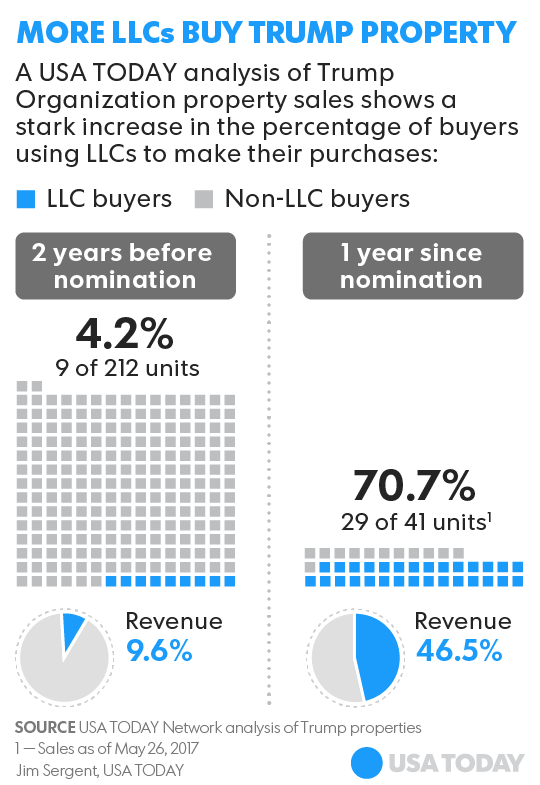


 R&R - Reachout and Rebuild