The Continued Tale of Mika and Joe

Hey GOP, Trump’s Misogyny and Obsession With Revenge Are Nothing New

Republicans who looked past his earlier behavior shouldn’t complain now.

Chuck Burden/ZUMA


It was no shock that Donald Trump set the political media world ablaze on Thursday morning when he tweet-blasted MSNBC morning co-hosts Joe Scarborough and Mika Brzezinski as “psycho” and “crazy,” focusing his fire on “low I.Q.” Brzezinski and claiming she had been “bleeding badly” from plastic surgery during a visit to his ritzy Mar-a-Lago estate. On cue, the indignation poured forth, with Republicans wringing their hands. GOP Senator Ben Sasse tweeted, “Please just stop. This isn’t normal and it’s beneath the dignity of your office.” His colleague Lindsey Graham bemoaned, “Mr. President, your tweet was beneath the office and represents what is wrong with American politics, not the greatness of America.” House Speaker Paul Ryan remarked, “Obviously, I don’t see that as an appropriate comment.”

But Trump was not acting in an exceptional manner; he was combining two of the driving forces of his personality, both of which were well documented before he was elected: misogyny and revenge. In fact, he was just following his personal code of conduct—as Melania Trump’s response to this tweetstorm made clear.

Reacting to a question about Trump’s extreme tweets, a spokeswoman for the first lady noted, “When her husband gets attacked, he will punch back 10 times harder.” This was Trump’s wife echoing one of Trump’s favorite mottos. As Mother Jonesreported in October, Trump has a long history of touting his love of revenge, and for years in speeches and public talks he has declared that a key to success is vengeance: “Get even with people. If they screw you, screw them back 10 times as hard. I really believe it.”

In fact, this was a catchphrase he deployed repeatedly when giving paid addresses on how to become rich and famous like him. In a 2007 speech, he explained his first rule of business:

It’s called “Get Even.” Get even. This isn’t your typical business speech. Get even. What this is a real business speech. You know in all fairness to Wharton, I love ’em, but they teach you some stuff that’s a lot of bullshit. When you’re in business, you get even with people that screw you. And you screw them 15 times harder. And the reason is, the reason is, the reason is, not only, not only, because of the person that you’re after, but other people watch what’s happening. Other people see you or see you or see and they see how you react.

Sometimes Trump said you should screw people back 10 times as much as they screwed you, sometimes he said 15 times. Melania Trump has adopted the more moderate position. But the point was always the same: Worship revenge. Trump once exclaimed, “I really believe in trashing your enemies.” And he summed up this lifelong philosophy in a 2013 tweet: “’Always get even. When you are in business, you need to get even with people who screw you.’—Think Big.” The following year, he tweeted this quote: “‘Revenge is sweet and not fattening.’—Alfred Hitchcock.”

Of course, the other constant in Trump’s life is his fondness for degrading women. His feud with actor Rosie O’Donnell is famous; he called her a “pig” and a “degenerate.” He has often derided women as “dogs.” In March 2016, I chronicled a long list of Trump’s misogyny eruptions. He once said Jennifer Lopez could not be on a list of the most beautiful women because her backside was too big. He noted that women were attracted to men who treated them badly. (“It’s sick, isn’t it?”) When radio shock jock Howard Stern asked him if he would still love Melania if she were disfigured in a horrible car accident, Trump replied, “How do the breasts look?” Other news outlets published similar lists of his boorish assertions. (See here and here.) In public, he bragged that he hired a woman just because she was “hot.” During the campaign, he claimed he had mocked women’s looks only “for the purpose of entertainment.” (One of Hillary Clinton’s best zingers of the campaign: “Donald looks at the Statue of Liberty and sees a 4….Maybe a 5, if she loses the torch and tablet and changes her hair.”)

Throughout the 2016 campaign, Trump repeatedly displayed his penchant for mixing misogyny with get-even wrath. He assailed Alicia Machado, the onetime Miss Universe whom he had previously fat-shamed. He derided Fox News host Megyn Kelly, who had dared to ask him about his history of sexist remarks, as a “bimbo” and referred to her blood as well. He attacked Carly Fiorina for her appearance. Much of his lock-her-up campaign against Clinton was laced with sexism. Oh yeah, and there was also that video of Trump bragging about committing sexual assault.

Trump certainly did not hide his misogyny or his obsession with revenge. He couldn’t. He placed both front and center during the campaign. (Some Trump associates have noted that his primary reason for running for president was revenge: to get back at President Barack Obama for having mocked him so effectively at the 2011 White House Correspondents Association Dinner.) As a candidate, Trump presided over a crusade fueled by hate. So it’s bit late for any Republican or pundit who did not declare Trump’s earlier behavior unacceptable to complain now or register surprise.

Responding to Trump’s anti-Joe-and-Mika tweets, Sen. James Lankford (R-Okla.) said, “The President’s tweets today don’t help our political or national discourse and it does not provide a positive role model for our national dialogue.” The same could be said for much of Trump’s presidential campaign, and yet Republicans supported him and thereby enabled his loathsome conduct. By backing Trump and overlooking his bigotry and profound flaws, they taught him—and the entire nation—this lesson: Misogyny and revenge indeed can work. That is, there is no need for this dog to learn any new tricks. His old ones work just fine.

Posted in Trump | Tagged , , , , , | Leave a comment

Presidential Commission Demands Massive Amounts of State Voter Data

nb.  This data will be made public, including Social Security numbers, if state databases contain it.  Privacy?  Who cares in the face of .000004% voter fraud?  Identity theft?  Not Kris Kobach’s problem.  Where is the leadership in this administration?

A commission created by President Donald Trump to enhance confidence in America’s elections has asked all 50 states for copies of their voter records which often include names, addresses and ages. The commission has said it intends to make the information widely available.
People cast their ballots in the 2016 presidential election at Freedom Academy Elementary School on November 8, 2016, in Provo, Utah. (George Frey/Getty Images)

On Wednesday, all 50 states were sent letters from Kris Kobach — vice chair for the Presidential Advisory Commission on Election Integrity — requesting information on voter fraud, election security and copies of every state’s voter roll data.

The letter asked state officials to deliver the data within two weeks, and says that all information turned over to the commission will be made public. The letter does not explain what the commission plans to do with voter roll data, which often includes the names, ages and addresses of registered voters. The commission also asked for information beyond what is typically contained in voter registration records, including Social Security numbers and military status, if the state election databases contain it.

President Donald Trump established the commission through an executive order on March 11. Its stated goal is to “promote fair and honest Federal elections” and it is chaired by Vice President Mike Pence. The commission plans to present a report to Trump that identifies vulnerabilities in the voting system that could lead to fraud and makes recommendations for enhancing voters’ confidence in election integrity. No deadline has been set for completion of the work.

A number of experts, as well as at least one state official, reacted with a mix of alarm and bafflement. Some saw political motivations behind the requests, while others said making such information public would create a national voter registration list, a move that could create new election problems.

“You’d think there would want to be a lot of thought behind security and access protocols for a national voter file, before you up and created one,” said Justin Levitt, a professor at Loyola University School of Law and former Department of Justice civil rights official. “This is asking to create a national voter file in two weeks.”

David Becker, the executive director of the Center for Election Innovation & Research, also expressed serious concerns about the request. “It’s probably a good idea not to make publicly available the name, address and military status of the people who are serving our armed forces to anyone who requests it,” he said.

Kobach, the secretary of state in Kansas, has been concerned about voter fraud for years. His signature piece of legislation was a law requiring Kansans to show proof of citizenship when they register to vote, which is currently ensnarled in a fraught court battle with the American Civil Liberties Union. He has written that he believes people vote twice with “alarming regularity,” and also that non-citizens frequently vote. Multiple studies have shown neither happens with any consistency.

Kobach also runs the Interstate Voter Registration Crosscheck Program, a proprietary piece of software started by Kansas Secretary of State Ron Thornburgh in 2005. Under the program, 30 states pool their voter information and attempt to identify people who are registered in more than one state.

Some expect the information Kobach has requested will be used to create a national system that would include data from all 50 states.

It is not uncommon for voters to be registered in more than one state. Many members of Trump’s inner circle — including his son-in-law Jared Kushner and daughter Tiffany Trump — were registered to vote in two states. Given the frequency with which voters move across state lines and re-register, the act of holding two registrations is not in itself fraud. There is no evidence to suggest that voting twice is a widespread problem, though experts say removing duplicate registrations are a good practice if done carefully.

“In theory, I don’t think we have a problem with that as an idea, but the devil is always in the details,” said Dale Ho, the director of the ACLU’s Voting Rights Project. While he believes voter registration list maintenance is important, he says Kobach’s Crosscheck program has been repeatedly shown to be ineffective and to produce false matches. A study by a group of political scientists at Stanford published earlier this year found that Crosscheck highlighted 200 false matches for every one true double vote.

“I have every reason to think that given the shoddy work that Mr. Kobach has done in this area in the past that this is going to be yet another boondoggle and a propaganda tool that tries to inflate the problem of double registration beyond what it actually is,” Ho said.

Some experts already see sloppy work in this request. On at least one occasion, the commission directed the letter to the incorrect entity. In North Carolina, it addressed and sent the letter to Secretary of State Elaine Marshall, who has no authority over elections or the voter rolls. In that state, the North Carolina Board of Elections manages both.

Charles Stewart, a professor at MIT and expert in election administration, said it was proof of “sloppy staff work,” and questioned the speed at which the letter was sent. “It seems to me that the data aren’t going anywhere. Doing database matching is hard work, and you need to plan it out carefully,” he said. “It’s a naïve first undertaking by the commission, and reflects that the commission may be getting ahead of itself.”

Connecticut Secretary of State Denise Merrill, who oversees voting in the state, said she was dismayed about the commission’s failure to be clearer about what its intentions are. In a statement, Merrill said her office would share publicly available information with the commission. But she said that “in the same spirit of transparency” her office would request the commission “share any memos, meeting minutes or additional information as state officials have not been told precisely what the Commission is looking for.”

“This lack of openness is all the more concerning, considering that the Vice Chair of the Commission, Kris Kobach, has a lengthy record of illegally disenfranchising eligible voters in Kansas,” she wrote.

Alabama’s Republican Secretary of State John Merrill (no relation) also indicated he had questions for Kobach regarding how much of the data would be made public and how Alabamans’ privacy would be protected, even while he expressed support for the commission. “Kobach is a close friend, and I have full confidence in him and his ability, but before we turn over data of this magnitude to anybody we’re going to make sure our questions are answered,” he said.

Colorado Secretary of State Republican Wayne Williams, for his part, said he was not concerned with what the commission planned to do with the data. “Just like when we get a [public-records] request, we don’t demand to know what they are going to do with the data,” he said. “There are important reasons why the voter roll is publicly available information.”

The extent to which voter roll data is public varies across the country. While some states, like North Carolina, make their voter rolls available for free download, other states charge high fees. Alabama, for example, charges one cent per voter in the roll for a total cost of more than $30,000. The state law provides a waiver for government entities, so Merrill said the commission would receive the data for free. Other states, like Virginia, do not make this information public beyond sharing it with formal campaigns and political candidates. When ProPublica tried to purchase Illinois’ voter roll, our request was denied because they only release it to government entities for privacy reasons. Illinois did not respond to a request regarding whether they would release this information to the PCEI, which — while a government entity — intends to make the information public.

The letter from the commission also asks quite broad questions of state elections officials.

“What changes, if any, to federal election laws would you recommend to enhance the integrity of federal elections?” asks the first question. The letter also asked for all information and convictions related to any instance of voter fraud or registration fraud, and it solicited recommendations “for preventing voter intimidation or disenfranchisement.”

“The equivalent is, ‘Hey, doctors, what changes would you suggest regarding healthcare? Let us know in two weeks,’” said Levitt, the Loyola professor. “If I were a state election official, I wouldn’t know what to do with this.”

While the commission is being chaired by Vice President Mike Pence, Kobach signed the letter alone. Jon Greenbaum, chief counsel for the Lawyers’ Committee for Civil Rights Under Law, said this is an indication that Kobach — not Pence — “will be running the show,” which he said should be a point of concern.

“As we know with Kobach, he’s obsessed with trying to identify voter fraud and finds it in a lot of places where it doesn’t exist,” he said.

Vanita Gupta, the former acting head of the Department of Justice’s civil rights division under President Barack Obama, said the commission’s letter was an indication the commission was “laying the groundwork” to carry out changes to the National Voter Registration Act that might seek to restrict access to the polls.

The National Voter Registration Act — sometimes called the Motor Voter Act — was enacted in 1993. It allows the DOJ the authority to ensure states to keep voter registration lists, or voter rolls, accurate and up-to-date. It also requires states to offer opportunities for voter registration at all offices that provide public assistance (like the DMV).

In November, Kobach was photographed holding a paper addressing national security issues and proposing changes to the voter registration law. It is not clear what these changes were. The ACLU is involved in a lawsuit against Kansas’ state law requiring people to show proof of citizenship in order to register to vote. As part of the suit, ACLU lawyers requested access to the document reflecting the changes Kobach proposed.

Originally Kobach told the court the document was beyond the scope of the lawsuit, but last week the court found the documents were relevant and that Kobach had intentionally misled the court. He was fined $1,000 for the offense and required him to turn the document over. It has not yet been made public.

Gupta said her concern about the future of the voter registration act was deepened by the fact that, on Thursday, the DOJ sent a letter to the 44 states covered by the act requesting information on the maintenance of their voter rolls. States were given 30 days to answer a set of detailed questions about their policies for list maintenance.

“The timing of the letters being issued on the same day is curious at the very least,” she said.

The White House and the DOJ all did not respond to requests for comment about the letters.

The letter did not ask about compliance with the portions of the act that require states to attempt to expand the voter base, such as by offering voter registration forms and information in public offices.

Danielle Lang, deputy director of voting rights for The Campaign Legal Center, said the focus on list maintenance troubled her. While she said this might point to a new direction in enforcement for the DOJ’s voting rights section, it was too early to tell how this information might be used.

Levitt said he did not recall a time when the DOJ has previously requested such broad information. While the information is public and not, on its face, troubling, Levitt said the only time he recalled requesting similar information was during targeted investigations when federal officials suspected a state was not complying with the law.

Posted in Civil Rights, Privacy, Trump, Voter Fraud | Tagged , , , , | Leave a comment

Politically Correct? You’re Damned Straight I Am!

Capture 3

Here’s the thing about folks who rail against the “Politically Correct.” Being politically correct is exactly that: being correct, or on the right side of a fact-based, or morally superior argument.

It is politically correct to be against racism and misogyny. It is politically correct to be against a government that is owned by corporate interests. It is politically correct to be against gerrymandering and voter suppression. It is politically correct to want to elevate the poor and the struggling so they can live with a little dignity. It is politically correct to want to invest in the best education we possibly can for our children. It is politically correct to understand that science is our friend.

To be politically correct is to stand by your principles and be willing to engage with opposing views using rational thought, logical inference and facts, an admittedly difficult thing to do in today’s environment of “alternative facts,” media bashing and claims of “fake news” from the anti-intellectuals on the far right, and yes, the far left.

People who don’t like “political correctness” are simply uninterested in facing facts. More importantly, they are demonstrating lack of empathy. They mock political correctness with smug condescension and expect that everyone will simply buy the bullshit they are selling. It is simply another way to package anti-intellectualism into bite-sized morsels that the ignorant can devour while feeling superior.

People who object to political correctness are really saying “I’m tired of having to defend my offensive beliefs and I don’t care about the people those beliefs offend.”

I’m happy to be politically correct. How about you?

Posted in Uncategorized | 1 Comment

Trump Just Did A Big Favor For Employers, Including His Own Family Business

HUFFINGTON POST

The president’s conservative nominees for the National Labor Relations Board could reverse a progressive era at the agency.

YURI GRIPAS / REUTERS


WASHINGTON ― When it comes to the power balance between workers and employers, President Donald Trump just tipped the scales in favor of guys like himself.

Over the past week, Trump chose a management attorney and a former GOP staffer to fill vacancies on the National Labor Relations Board. Their nominations could help reshape labor policy in favor of corporations, potentially reversing Obama-era decisions and further weakening the U.S. labor movement.

If confirmed as expected, Trump’s picks ― William Emanuel, who was named Tuesday, and Marvin Kaplan, who was named last week ― will occupy two seats on a five-member board that serves as referee between businesses and labor groups. The NLRB’s decisions help determine how easy or difficult it is for workers to unionize ― which, in turn, affects unions’ footprint in the U.S. economy, and how much bargaining power rank-and-file workers have with their employers.

That includes Trump’s own family hotel business, which has come before the NLRB several times over labor disputes.

After years of rulings friendly to unions in the Obama era, the labor board put in place by Trump will be far more likely to side with employers in contentious, policy-setting cases. With its new Republican majority, the board may undo notable decisions in recent years that helped more workers secure collective bargaining rights in the workplace.

Industry lobbies like the National Restaurant Association applauded Trump’s nominations, as did the anti-union Workforce Fairness Institute.

The NLRB is an independent federal agency, meaning its members are nominated by the president, but don’t answer to him. The five members serve staggered terms, traditionally with three members hailing from the president’s party. What is currently a 2-to-1 Democratic majority held over from the Obama years would become a 3-to-2 Republican majority if Trump’s nominees are confirmed.

Emanuel is a lawyer at the management-side firm Littler Mendelson. Kaplan served as a lawyer for Republicans on the House Committee on Education and the Workforce; he’s currently a commissioner at the Occupational Safety and Health Review Commission.

The confirmation of Trump’s picks will not be difficult, thanks to the “nuclear” rules change made by Democrats during a previous fight over the labor board. When the Republican minority stonewalled Obama’s NLRB picks and prevented the board from functioning, Democrats reformed the rules in 2013 so that nominees only require 51 votes to pass the Senate. Republicans now hold 52 seats.

The NLRB found itself at the center of political fights on Capitol Hill during the Obama years, with Republicans accusing it of “killing” jobs and catering to unions. Trump would have nominated Emanuel and Kaplan with heavy input from business lobbies and GOP lawmakers, seeking to change course from the board’s progressive direction.

If Emanuel and Kaplan are installed, the board could gradually flip some of the Obama-era rulings that helped workers organize in the workplace. Union membership is hovering near an all-time low in the U.S. ― just 6.4 percent of private-sector workers belong to unions now ― but labor groups hoped the board’s liberal rulings could help.

One such ruling, Specialty Healthcare, allowed workers to unionize in small groups, which employers claim put them at a disadvantage in union campaigns. Another case, Browning-Ferris, broadened the definition of who can be considered a “joint employer,”potentially dragging franchisors like McDonald’s into labor disputes involving their franchisees. Yet another, involving Columbia University, paved the way for graduate students at private universities to unionize.

Republicans in Washington held congressional hearings to blast rulings like those. But once Emanuel and Kaplan are confirmed ― probably after the Senate’s summer recess ― the pendulum is bound to swing back toward employers.

Posted in Labor, NLRB, Uncategorized | Tagged , | Leave a comment

Analysis: Mitch McConnell Plans To Hide Trumpcare’s Pain Until After Midterms

KAISER HEALTH NEWS — REPEAL & REPLACE WATCH

June 27, 2017

Senate Majority Leader Mitch McConnell (R-KY) speaks following a closed-door Senate GOP conference meeting on Capitol Hill on June 27, 2017. Senate Republicans announced they will delay a vote on their health care bill until after the July 4 recess. (Drew Angerer/Getty Images)

Senate Majority Leader Mitch McConnell is well aware of the political peril of taking health benefits away from millions of voters. He also knows the danger of reneging on the pledge that helped make him the majority leader: to repeal Obamacare.

Caught between those competing realities, McConnell’s bill offers a solution: go ahead and repeal Obamacare, but hide the pain for as long as possible. Some of the messaging on the bill seems nonsensical (see: the contention that $772 billion squeezed out of Medicaid isn’t a cut). But McConnell’s timetable makes perfect sense — if you are looking at the electoral calendar.

Here are a few key dates in McConnell’s “Better Care Reconciliation Act” (BCRA) that seem aimed more at providing cover for lawmakers than coverage for Americans:

2019: First major changes and cuts to the Affordable Care Act exchanges happen after the 2018 midterm cycle, allowing congressional Republicans to campaign on a “fixed” health system, even though Obamacare is still largely in place next year.

2019: States share $2 billion in grants to apply for waivers under a much looser process through this fiscal year. These waivers could allow insurers to sell skimpy plans that have low price tags but don’t take adequate care of people with preexisting conditions. None of those waivers has to go into effect, however, until after 26 Republican governors face re-election in 2018.

2020: Stabilization cash that makes the markets more predictable and fair for insurers flows through the congressional midterm cycle and the 2020 presidential cycle. Then it disappears. Medicaid expansion funds hold steady through this crucial political window, too.

2024: States enjoy their last few sips of Medicaid expansion cash at the end of 2023 — just as, perhaps, a second Republican presidential term is ending.

2025: The bill changes the formula for the entire Medicaid budget (not just the Obamacare expansion), dramatically reducing federal funding over time. That starts eight years and two presidential election cycles from now.

McConnell insists everything about the bill has been aboveboard and transparent.

“Nobody’s hiding the ball here. You’re free to ask anybody anything,” McConnell said on June 13.

But he and his working group did literally hide the bill from Democrats and most Republicans, crafting it behind closed doors until there was just a week left before his goal to secure a vote on it. (That timing was thrown off Tuesday with the announcement the vote was delayed, but the dealmaking is just beginning.)

Meanwhile, at least two policy details in the bill may obscure the effects for several years and make the health insurance markets look better almost immediately by giving insurers a more predictable, more lucrative market.

One is a stipulation that compels the federal government, for two years, to pay the cost-sharing reduction payments to insurance companies that President Donald Trump has threatened to end. The payments are part of the Affordable Care Act, and they flow to insurers on behalf of low-income marketplace customers to cover their out-of-pocket health expenses. Republicans had sued to stop the payments, adding considerable instability to ACA marketplaces next year. McConnell ends that uncertainty for two years.

On top of that cash infusion, the BCRA proposes a “Short-Term Stabilization Fund” that would also aim to help lower premium costs and could attract a few more insurers into counties that are sparsely covered now. It would dish out $50 billion to insurers — $15 billion per year in 2018 and 2019 and $10 billion per year in 2020 and 2021.

The money would make up for the billions that the Republican-led Congress has refused to appropriate for insurance companies under the ACA’s risk corridors program. Risk corridors aimed to offset losses for insurers whose costs were more than 103 percent of expected targets. Congress has so far paid only 12.6 cents on the dollar of those obligations and faces lawsuits from insurers that were stiffed.

In short, the two pots of money would go a long way toward addressing the instability in Obamacare created by the Republican-led Congress, but only through the next presidential cycle in 2020.

Beyond timing, the legislation’s features allow senators to make truthful arguments that disguise negative effects.

Perhaps the key claim is that the Senate bill would increase access to insurance. It might, in that insurance companies in states that waive standards would be free to offer much cheaper plans. But those plans would be cheaper because they wouldn’t cover essential health benefits or adequately cover preexisting conditions. Lower-income Americans might be able to buy a plan — possibly a $6,000 deductible for someone who makes less than $12,000 a year.

A spokesman for McConnell did not answer a request for comment. But Democrats are keenly aware of the electoral machinations in the bill.

“Everything about this legislation, from the process to the effective dates of many of the provisions, is driven by political expediency,” said Brian Fallon, a Democratic consultant and former lead spokesman for Hillary Clinton’s campaign. “Mitch McConnell only cares about getting the ‘win,’ not about the substance of the bill.”

Senate Democratic aides who spoke on background were not sure that the steps the bill takes to shore up markets for the next two elections would work when insurance companies can see what lies ahead. But they agreed the timing and short-term fixes might help McConnell twist the arms of reluctant Republican senators.

“I think it will be enormously helpful to McConnell in a room with a moderate Republican who wants to be told, ‘Hey, a lot of this stuff that’s going to happen in this bill that you’re hearing about, that’s worrisome is past your re-elect, it’s past 2018, it’s past 2020,’” one senior aide said. “‘Just vote for it, it’ll be fine, we’ll figure the rest out later.’”

Democrats said McConnell’s hide-the-ball strategy will not work with voters, and they want Republican senators to know that before they vote.

“The polling already shows that, based on the fact that they control every aspect of government, Trump and the Republicans own everything that happens from now on in the health care system,” Fallon said.

Sen. Patty Murray (D-Wash.), the top Democrat on the Health, Education, Labor and Pensions Committee who has the task of leading the arguments against the GOP bill, thinks senators will imperil their political futures if they buy McConnell’s arguments.

“Sen. McConnell is doing everything he can to persuade Senate Republicans that Trumpcare won’t be devastating for the people they serve, but the facts are that Trumpcare is going to cause families to pay more, gut Medicaid, and take coverage away from millions of people,” Murray said. “Any Senate Republican who votes for Trumpcare and believes patients and families won’t hold them accountable is being sold a bill of goods.”

Still, McConnell knows how to work a legislative calendar. Expect a July full of closed-door dealmaking with reluctant senators, leading up to maximum leverage before the August recess.

Kaiser Health News, a nonprofit health newsroom whose stories appear in news outlets nationwide, is an editorially independent part of the Kaiser Family Foundation.

Posted in Better Care Reconciliation Act, Health Care, Medicaid, Trump, trumpcare | Tagged , , , | 1 Comment

A Cruel Joke — 13 men are in charge of healthcare for all American women.

POSTED IN THE GUARDIAN

Lucia Graves

Wednesday 28 June 2017  


Regressive gender politics are resurgent in 2017, as demonstrated by a Republican bill that would be devastating to women’s health

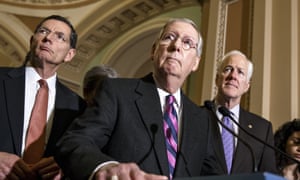
John Barrasso, Mitch McConnell, and John Cornyn: three of the men behind the Senate healthcare bill.
John Barrasso, Mitch McConnell, and John Cornyn: three of the men behind the Senate healthcare bill. Photograph: J Scott Applewhite/AP

A decade or two ago, the notion that 13 men would be plotting the fate of American women’s healthcare behind closed doors, that they would delight in defunding the women’s health organization Planned Parenthood and impeding healthcare access for millions of American women, would have felt like the politics of a bygone era.

Midway through 2017, it feels more like deja vu.

As Republicans prepare for their delayed vote on their updated measure to repeal and replace the Affordable Care Act, women’s groups and senators have vocally hit out against male dominance of the healthcare debate – exemplified by the GOP’s 13-man working group that crafted the Senate bill.

The Democratic senator Kamala Harris told the Guardian the bill “is terrible for women”, while her New York colleague Kirsten Gillibrand has described it as “a cruel joke” and a “blatantly partisan attack on women’s health”.

But for many, it’s more than the substance of the bill that rankles. Specifically, it feels like a return to a kind of regressive gender politics they hoped had passed in America: a politics in which men make the decisions about what happens to women’s bodies.

“It’s outrageous that the future of healthcare for millions of women lies in the hands of 13 men,” Cecile Richards, president of Planned Parenthood, said. “It’s clear they don’t care about our opinion or our lives – because if they had asked us what we thought, we’d all be in a very different position right now.”

The Senate healthcare bill would increase the number of uninsured people in the US by 22 million, according to the non-partisan Congressional Budget Office, and is opposed by the American Medical Association on the grounds that it violates the Hippocratic oath.

It would also be particularly devastating to women’s health, in a number of ways. Patty Murray, the top Democrat on the Senate’s health committee, called it “nothing less than an attack on women’s health and rights”.

Harris said: “It blocks millions of women on Medicaid from getting care at Planned Parenthood. It allows states to stop requiring insurance companies to cover essential health benefits – like maternity care and birth control. Women in this country will not be silenced on this issue. We will only get louder.”

Under the Republican bill, women could pay as much as $1,000 more per month for maternity care, Murray told reporters in a conference call on Friday, and millions would lose access to even the most basic preventive care services at Planned Parenthood.

As Dana Singiser of Planned Parenthood put it on the call: “If we listed all the cruel things this bill would do we’d be here all day.”

Often the men who tout defunding Planned Parenthood seem to have no idea what the organization actually does.

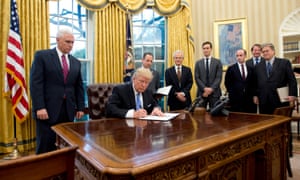
Donald Trump signs the global ‘gag rule’, surrounded by men.
Donald Trump signs the global ‘gag rule’, surrounded by men. Photograph: Ron Sachs / Pool/EPA

“Frankly, I am sick of coming down to the Senate floor to explain to Republicans what Planned Parenthood does,” Elizabeth Warren said in a recent statement posted to her Facebook page. “I am sick of explaining that it provides millions of women with birth control, cancer screenings, and STI tests every year. I am sick of pointing out again and again that federal dollars do not fund abortion services at Planned Parenthood or anywhere else.”

Because of the Hyde amendment, federal funding does not actually go toward abortion services, but to the other basic healthcare services Warren outlined, including life-saving cancer screenings and treatments.

It isn’t the first time in recent years she has had to explain to the men in charge of women’s healthcare how the largest US provider of reproductive healthcare operates. When the GOP mounted another effort to defund Planned Parenthood back in August 2015, she made a similar speech.

“Do you have any idea what year it is?” Warren asked at the time. “Did you fall down, hit your head, and think you woke up in the 1950s or the 1890s? Should we call for a doctor? Because I simply cannot believe that in the year 2015, the United States Senate would be spending its time trying to defund women’s healthcare centers.”

Perhaps she shouldn’t have been that surprised. For years, Republicans have worked to strip away women’s rights to make choices about their own bodies and more often than not, the efforts have been led by men. When Donald Trump signed the global “gag rule”, pulling US funding from any global organizations that so much as mention the word “abortion”, he did it flanked exclusively by white men in suits. A photo of President George W Bush signing a ban on a rare abortion procedure reveals yet another group of grinning, self-congratulatory men.

As Jill Filipovic, writing in the New York Times, has noted, in a way, men controlling women’s bodies is an election promise delivered. “At some point, we have to ask: Is this really a pattern of errors?” she writes. “Maybe these aren’t tone-deaf mistakes at all, but intentional messages to rightwing supporters.”

Warren seems to agree, at least with the notion that the bill is all about political messaging.

“Women come to the floor, we explain, we cite facts. But Republicans would rather base healthcare policy on politics than on facts,” she said recently, after the House speaker, Paul Ryan, called the bill “pro-life”. “Calling something pro-life won’t keep women from dying in back alley abortions; it won’t help women pay for the cancer screenings that could save their lives; it won’t help them take care of their families, have safe sex or afford their medical bills.”

Murray was even more sweeping in her assessment. “The moment we’re in right now is truly a pivotal one for women and women’s rights,” she told reporters Friday, adding that for every woman and everyone who cares about their access to healthcare, now is the time to fight back.

“Those 13 men cutting backroom deals about your healthcare access clearly didn’t want to hear from you, so make sure they do now,” she said.

Posted in AHCA, American Health Care Act, Birth Control, Family Issues, Family Planning, Health Care, Medicaid, Planned Parenthood, Pre-existing Conditions, Trump, trumpcare | Leave a comment

Let A Senator Know How You Feel About the BCRA

For those interested in pressuring senators to oppose the BCRA, here is a list of “No” and “Undecideds” compiled by Huffington Post.  A link to contact information appears at the bottom of the post.

Here’s a look at where McConnell’s conference stands on the legislation.

The Hill will be updating this list as Republican senators offer statements of support or opposition. Please send updates to mmali@thehill.com.


No (6)

Sen. Susan Collins (Maine) — The Maine centrist says she will not back a procedural motion on the bill after seeing the CBO score. “I cannot support a bill that’s going to make such deep cuts in Medicaid that it’s going to shift billions of dollars of costs to our state governments,” she said Sunday on ABC’s “This Week,” a day before the score came out.

Sen. Ted Cruz (Texas) — In a statement Thursday, the conservative former presidential candidate said he opposed the bill. Cruz said the bill did not do enough to lower health costs. He has floated an amendment that would let insurers sell plans that are not compliant with ObamaCare requirements.

Sen. Dean Heller (Nev.) — Heller said Friday he opposed the bill, raising concerns about the phaseout of the Medicaid expansion. “It’s going to be very difficult to get me to a yes,” he said. Heller is viewed as the most vulnerable GOP senator up for reelection next year, so his vote will be closely watched. Heller has indicated he would vote against taking up the bill in a procedural vote without changes.

Sen. Ron Johnson (Wis.) — Johnson on Thursday joined three of his colleagues in opposing the bill. He has expressed worries the bill doesn’t do enough to lower premium costs. On NBC’s “Meet The Press” Sunday, Johnson said “we should not be voting on this next week.” “I don’t have the feedback from constituencies who will not have had enough time to review the Senate bill.” He has also criticized GOP leaders for rushing the legislation and says he may not back a procedural motion unless the bill is changed.

Sen. Mike Lee (Utah) — The conservative joined Paul, Johnson and Cruz in a statement opposing the bill on Thursday. In a Friday blog post on Medium, he noted that conservatives have compromised on “every substantive question in the bill.” But added he hadn’t “closed the door” on voting for some version of it and would support it “if it allowed states and/or individuals to opt-out of the Obamacare system free-and-clear to experiment with different forms of insurance, benefits packages, and care provision options.”

Sen. Rand Paul (Ky.) — Paul is McConnell’s home-state fellow senator, but he may be a hard get. He also says he’ll oppose the procedural motion. “The current bill does not repeal Obamacare. It does not keep our promises to the American people. I will oppose it coming to the floor in its current form, but I remain open to negotiations,” Paul said in a statement Thursday.

Undecided/Unclear (20)

Sen. Bill Cassidy (La.) — Cassidy won headlines when he talked about how the bill needed to pass a “Jimmy Kimmel test” on whether it would prevent children with pre-existing conditions from getting coverage. Cassidy told CBS’s “Face the Nation” Sunday he needed more time to consider the bill. “Right now, I am undecided. There are things in this bill that adversely affect my state, that are peculiar to my state, but if those can be addressed, I will. If they can’t, I won’t,” Cassidy said about his vote.

Sen. Shelley Moore Capito (W.Va.) — Capito has been involved in talks about the phaseout of ObamaCare’s federal funding expanding Medicaid. She’s also worried about how Medicaid cuts could effect the opioid epidemic. Like other senators, she said she would be reviewing the draft. She did not mention any concerns, but said she wanted to access to affordable healthcare for those on Medicaid and those struggling with drug addiction.Sen. Bob Corker (Tenn.) — Asked if he would support the bill, Corker told reporters it would “irresponsible” for lawmakers to take a position already, adding that “this draft we’re looking at is not necessarily the draft that’s going to be entered into the record” and could undergo “significant amendments.”

Sen. Steve Daines (Mont.) — “I look forward to hearing directly from Montanans on this legislation,” Daines said in a statement Thursday.

Sen. Joni Ernst (Iowa) — Ernst, who has not yet taken a position on Senate Republicans’ ObamaCare repeal and replace plan, is polling her constituents to gauge their feelings on the bill.

Sen. Jeff Flake (Ariz.) — Flake, who is up for reelection in 2018, tweeted “just got my copy of the #healthcare bill and I’m going to take time to thoroughly read and review it.”

Sen. Cory Gardner (Colo.) — Gardner on Thursday said he was “carefully reviewing” the bill and called for more time. “If we can have opportunities to make the bill better, then by all means let’s take every chance and (all the) time we can,” he said, according to the Denver Post.

Sen. John Hoeven (N.D.)  — Hoeven said in a statement that he “will review this legislation to determine whether it meets this standard and we also want to see a CBO score on the bill.”

Sen. Johnny Isakson (Ga.) — Isakson said in a statement that “I am fully and thoroughly reviewing the draft of the Republican health care plan that was released today. The stark reality remains that if we do nothing, Obamacare will fail, and Americans will suffer.”

Sen. James Lankford (Okla.) — Lankford told CNN that he has found six areas where he has “problems and suggestions,” adding “none of them are showstoppers … but there are problems we need to fix before we get this into law.”

Sen. John McCain (Ariz.) — “I think it’s a good proposal overall. I’m going to have to look at it,” McCain told reporters Thursday.

Sen. Jerry Moran (Kan.) — Moran said in a statement that he is “awaiting the Congressional Budget Office score to gain a complete understanding of the impacts and consequences this bill would have on hardworking Kansans.”

Sen. Lisa Murkowski (Alaska) — Along with Collins, Murkowski has suggested she might not back a bill that defunds Planned Parenthood. The Senate bill would block funding for a year.

Sen. David Perdue (Ga.) — “I’m looking at this thing. I’m not ready to say yes or no on it because I want to read this in detail,” he said.

Sen. Rob Portman (Ohio) — “There are some promising changes to reduce premiums in the individual insurance market, but I continue to have real concerns about the Medicaid policies in this bill, especially those that impact drug treatment at a time when Ohio is facing an opioid epidemic,” he said in a statement Thursday. The opioid crisis is a huge problem in Ohio, and Portman has worked with Capito to seek support through the GOP bill on this issue.

Sen. Marco Rubio (Fla.) — Rubio’s office said in a statement that “Senator Rubio will decide how to vote on health care on the basis of how it impacts Florida. He has already spoken to Governor Scott, Senate President Negron and Speaker Corcoran about the first draft of this proposal.”

Sen. Ben Sasse (Neb.) — On Sunday at a Koch summit, Sasse said he is not committed to the GOP’s ObamaCare repeal bill. Sasse told conservative donors the bill was “largely a Medicaid reform package,” according to Vox. “This is not a full repeal or full replace piece of legislation, and that’s dictated by a whole bunch of circumstances. So we are having a conversation about something that’s much smaller than that.”

Sen. Dan Sullivan (Alaska) — In a statement Thursday, Sullivan said he “will read every word” of the bill, looking closely at stabilizing the state’s insurance market, cutting costs and “providing a sustainable and equitable path forward for Medicaid.”

Sen. Thom Tillis (N.C.) — Tillis said the Senate’s bill needs to be a “net improvement” over ObamaCare and “I look forward to carefully reviewing the draft legislation over the next several days.”

Sen. Todd Young (Ind.) — Young on Friday told a group in his home state of Indiana that he is in the undecided column, though he also repeated an earlier statement that “doing nothing is not an option.”

Contact information:  http://www.dailykos.com/stories/2017/6/12/1671161/-Republican-senators-say-their-phones-aren-t-ringing-to-save-the-ACA-so-here-s-the-contact-list?detail=emaildkre

Posted in AHCA, American Health Care Act, Better Care Reconciliation Act, Health Care, Trump, trumpcare | Leave a comment

I Would Short Tourism to the USA

I can personally confirm the unpopularity of DT and the USA in Switzerland where I am currently!

Apparently the sentiment is wide spread: http://www.reuters.com/article/us-usa-trump-image-survey-idUSKBN19I00F?utm_source=applenews

Image of the United States has plunged under Trump, survey shows

By Noah Barkin | BERLIN


The image of the United States has deteriorated sharply across the globe under President Donald Trump and an overwhelming majority of people in other countries have no confidence in his ability to lead, a survey from the Pew Research Center showed.

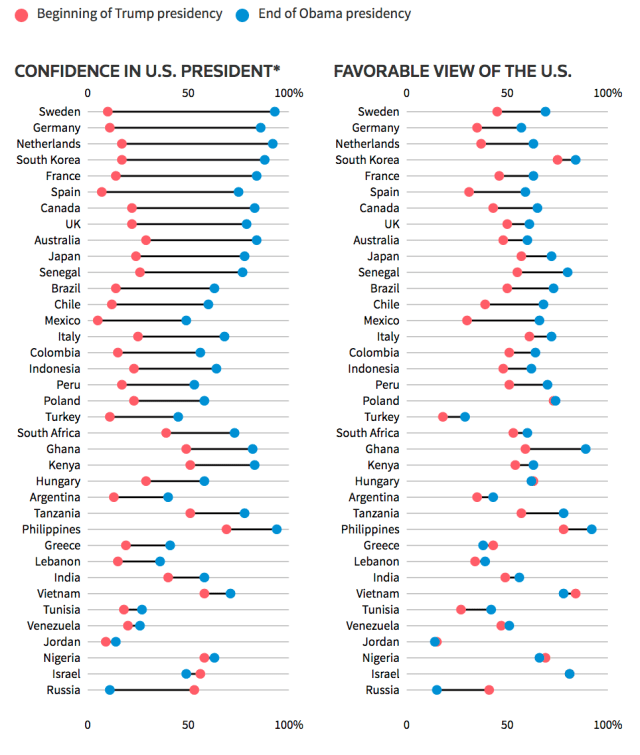
Five months into Trump’s presidency, the survey spanning 37 nations showed U.S. favorability ratings in the rest of the world slumping to 49 percent from 64 percent at the end of Barack Obama’s eight years in the White House.

But the falls were far steeper in some of America’s closest allies, including U.S. neighbors Mexico and Canada, and European partners like Germany and Spain.

Trump took office in January pledging to put “America First”. Since then he has pressed ahead with plans to build a wall along the U.S. border with Mexico, announced he will pull out of the Paris climate accord, and accused countries including Canada, Germany and China of unfair trade practices.

On his first foreign trip as president in early June, Trump received warm welcomes in Saudi Arabia and Israel, but a cool reception from European partners, with whom he clashed over NATO spending, climate and trade.

Just 30 percent of Mexicans now say they have a favorable view of the United States, down from 66 percent at the end of the Obama era. In Canada and Germany, favorability ratings slid by 22 points, to 43 percent and 35 percent, respectively

In many European countries, the ratings were comparable to those seen at the end of the presidency of George W. Bush, whose 2003 invasion of Iraq was deeply unpopular.

“The drop in favorability ratings for the United States is widespread,” the Pew report said. “The share of the public with a positive view of the U.S. has plummeted in a diverse set of countries from Latin America, North America, Europe, Asia and Africa”.

BELOW PUTIN AND XI

The survey, based on the responses of 40,447 people and conducted between Feb. 16 and May 8 this year, showed even deeper mistrust of Trump himself, with only 22 percent of those surveyed saying they had confidence he would do the right thing in world affairs, compared to 64 percent who trusted Obama.

Image of the United States plummets under Trump

The image of the United States in the world has been seriously damaged by President Donald Trump and an overwhelming majority of people in other countries have no confidence in his ability to manage world affairs, a Pew Research Center survey showed.

Screen Shot 2017-06-27 at 7.08.55 PM.png

The countries with the lowest confidence in Trump were Mexico, at 5 percent and Spain at 7 percent. The only two countries where ratings improved compared to Obama were Russia, where confidence in the U.S. president surged to 53 percent from 11 percent, and Israel, where it rose 7 points to 56 percent.

Globally, 75 percent of respondents described Trump as “arrogant”, 65 percent as “intolerant” and 62 percent as “dangerous”. A majority of 55 percent also described him as a “strong leader”.

The survey showed widespread disapproval of Trump’s signature policy proposals, with 76 percent unhappy with his plan to build the wall on the border with Mexico, 72 percent against his withdrawal from major trade agreements and 62 percent opposed to his plans to restrict travel to the U.S. from some majority-Muslim countries.

On the positive side, the survey showed that 58 percent of respondents had a positive view of Americans in general. And in many regions of the world, a majority or plurality of respondents said they expected relations with the United States to stay roughly the same in spite of Trump.


Posted in foreign policy, Trump, Uncategorized | Tagged , , , | 1 Comment

The Senate Health Reform Bill Slashes Medicaid Severely

Posted by AARP

The Better Care Reconciliation Act (BCRA) now under consideration in the Senate would drastically alter the Medicaid program. The proposed Senate bill would change the way the federal government currently funds Medicaid by limiting federal funding and shifting cost over time to both states and Medicaid enrollees. BCRA would subject older adults, adults with disabilities, expansion adults, and non-disabled children under age 19 to mandatory per enrollee caps beginning in 2020. State Medicaid programs would have the option to choose between block grants and per enrollee caps for non-elderly non-disabled non-expansion adults.

The Senate bill would start out using the medical care component of the Consumer Price Index (M-CPI)—a measure of the average out-of-pocket cost of medical care services used by an average consumer—as the growth rate for per enrollee caps.  However, beginning in 2025, it would slash the growth rate to the Consumer Price Index for all urban consumers (CPI-U)—a measure of general inflation that examines out-of-pocket household spending on goods and services used for everyday living. CPI-U does not tie closely to medical costs and will not reflect population growth or the impact of aging. To be clear, none of the proposed growth factors—M-CPI, M-CPI+1, and CPI-U— keep pace with the growth in Medicaid spending.

Although studies have examined the impact of Medicaid spending cuts in the House-passed healthcare bill over a 10 year period (e.g. [CBO] [CMS] [Urban Institute]) we know of none that examine the impacts over a longer time horizon. To fill this gap, the AARP Public Policy Institute has developed a model that looks out an additional decade to capture impacts on Medicaid spending between 2027 and 2036.

By dramatically reducing the per capita cap growth factor beginning in 2025, we project that the Senate bill would cut between $2.0 and $3.8 trillion from total (federal and state) Medicaid spending over the 20-year period between 2017 and 2036 for the four non-expansion Medicaid enrollment groups: older adults, adults with disabilities, children, and non-expansion adults (children with disabilities are excluded because BCRA does not subject them to capped funding). A cut of this magnitude threatens the viability of the program in unprecedented ways and will increase the number of people who no longer have access to essential healthcare services and critical supports.  The projections do not include the proposed cuts to the adult expansion population, which would also be considerable.

Previous analysis by the AARP Public Policy Institute discusses why capping Medicaid is flawed and would leave states and the poorest and sickest Americans holding the bag for the shortfalls that will most certainly occur.

Table 1 shows the cumulative 20-year cuts to Medicaid by eligibility group under the Senate health reform bill for three growth rate projections.  The bill would cap per enrollee cost growth using two measures of inflation (M-CPI and CPI-U), which are highly variable and uncertain, though well short of what is needed to maintain the integrity of the Medicaid program.  It is difficult to plan for such uncertain growth rates, and reasonable projections are far apart.

We present the high, middle, and low case for M-CPI/CPI-U growth rates based on the following:

  • Low Case. Based on historical growth rates. Over the last five years (2012-2016), the M-CPI growth rate has averaged 3.0% per year, and the CPI-U growth rate has averaged 1.32% per year.
  • Middle Case. Based on projections from the Congressional Budget Office. CBO projects M-CPI to grow by 3.7% per year, and CPI-U by 2.4% per year.
  • High Case. Based on projections from 2016 CMS Medicaid Actuarial Report.  From 2019 onward, this report projects M-CPI to grow by 4.2% per year, and CPI-U by 2.6% per year.


In short, the lower the cap growth rate, the more severe the Medicaid cuts will be.

The charts below demonstrate that for any projection of the bill’s cap growth rates, BCRA will lead to significant funding shortfalls for older adults, adults with disabilities, and non-disabled low-income children and adults. The end result is that states and beneficiaries will be left with severe funding shortages, and states will be forced to cut eligibility, provider rates, or covered services—or very likely all three.


Susan Reinhard is a senior vice president at AARP, directing its Public Policy Institute, the focal point for AARP’s public policy research and analysis. She also serves as the chief strategist for the Center to Champion Nursing in America, a resource center to ensure the nation has the nurses it needs.


Jean Accius is vice president of livable communities and long-term services and supports for the AARP Public Policy Institute. He works on Medicaid and long-term care issues.


Lynda Flowers is a Senior Strategic Policy Adviser with the AARP Public Policy Institute, specializing in Medicaid issues, health disparities and public health.


Ari Houser is a Senior Methods Adviser at AARP Public Policy Institute. His work focuses on demographics, disability, family caregiving, and long-term services and supports (LTSS).


Posted in AHCA, American Health Care Act, Better Care Reconciliation Act, Health Care, Medicaid, Trump, trumpcare | Tagged , , , | 1 Comment

Are you 64 and making $56,800 a year? Welcome to a $20,500 Trumpcare insurance premium

Posted on Daily Kos
SAN FRANCISCO, CA - JUNE 21:  Healthcare activists hold headstones as they stage a die-in while protesting the Trumpcare bill on June 21, 2017 in San Francisco, California. Dozens of healthcare activists and senior citizens staged a protest outside the San Francisco Federal Building to express their opposition of the American Heathcare Act bill that is being drafted behind closed doors by Republican senators.  (Photo by Justin Sullivan/Getty Images)

Popular vote loser Donald Trump freely admits he called the House version of Trumpcare “mean, mean, mean” and also claimed that he wanted a Senate bill that is “generous, kind, with heart.”  That’s not what he got with the Senate version of Trumpcare, the “Better Care Act.”  In fact, the Congressional Budget Office says it’s just as mean by the numbers, if not more so.

According to their estimates, 15 million people will lose their insurance next year, 2018. An election year.  By 2026, 22 million people who are now insured will have lost that insurance.  Compared to the Affordable Care Act, “an estimated 49 million people would be uninsured, compared with 28 million who would lack insurance that year under current law.”  The biggest hit, as in the House bill, lands on Medicaid.

The largest savings would come from reductions in outlays for Medicaid—spending on the program would decline in 2026 by 26 percent in comparison with what CBO projects under current law—and from changes to the Affordable Care Act’s (ACA’s) subsidies for nongroup health insurance.  Those savings would be partially offset by the effects of other changes to the ACA’s provisions dealing with insurance coverage: additional spending designed to reduce premiums and a reduction in revenues from repealing penalties on employers who do not offer insurance and on people who do not purchase insurance. […]In later years, other changes in the legislation—lower spending on Medicaid and substantially smaller average subsidies for coverage in the nongroup market—would also lead to increases in the number of people without health insurance.

Keep in mind that “later years” part.  This estimate doesn’t go beyond 2026; however the CBO doesn’t think that the so-called “flexibility” for Medicaid that block granting would be for states is all that.  Instead, it would be a burden.  “With less federal reimbursement for Medicaid, states would need to decide whether to commit more of their own resources to finance the program at current-law levels or to reduce spending by cutting payments to health care providers and health plans, eliminating optional services, restricting eligibility for enrollment through work requirements and other changes, or (to the extent feasible) arriving at more efficient methods for delivering services.”  It also projects that post-2026, Medicaid enrollments would continue to fall.

People with individual plans will see “substantial increases in out-of-pocket spending, even though benchmark premiums would decline, on average, in 2020 and later years.” That’s because insurance would pay for a smaller share of benefits. That’s going to be true for “close to half the population, CBO and JCT expect—living in states modifying the EHBs [essential health benefits] using waivers.  People who used services or benefits no longer included in the EHBs would experience substantial increases in supplemental premiums or out-of-pocket spending on health care, or would choose to forgo the services.”

In some areas of the country—particularly sparsely populated ones (are you listening Lisa Murkowski)—the CBO foresees a market collapse, the classic death spiral.  “Some sparsely populated areas might have no nongroup insurance offered because the reductions in subsidies would lead fewer people to decide to purchase insurance—and markets with few purchasers are less profitable for insurers.”

Yes, this bill is mean, mean, mean. But hey, it’s got lots of tax cuts for the very rich, so expect most Republicans to overlook the other parts.

Posted in AHCA, American Health Care Act, Better Care Reconciliation Act, Health Care, Medicaid, Trump, trumpcare | Tagged , , , , , | 2 Comments

Rural hospital association representative: ‘This bill will close hospitals. … People will die’

Posted on Daily Kos
US President Donald Trump shakes hands with Senate Majority Leader Mitch McConnell as he meets with Republican congressional leaders in the Roosevelt Room at the White House in Washington, DC, on June 6, 2017. / AFP PHOTO / NICHOLAS KAMM        (Photo credit should read NICHOLAS KAMM/AFP/Getty Images)

Trump and McConnell agree to make Americans die faster.

Every healthcare association, provider group, and patient advocacy group in the country is on red alert over Trumpcare, Senate Majority Leader Mitch McConnell’s effort to end healthcare in the U.S. as we know it.

“There has never been a rollback of basic services to Americans like this ever in U.S. history,” said Bruce Siegel, president of America’s Essential Hospitals, a coalition of about 300 hospitals that treat a large share of low-income patients. “Let’s not mince words. This bill will close hospitals. It will hammer rural hospitals, it will close nursing homes. It will lead to disabled children not getting services. . . . People will die.”

That National Association of Medicaid Directors—the people who administer the program in every state—agree, but in less blunt language:

Changes in the federal responsibility for financing the program must be accompanied by clearly articulated statutory changes to Medicaid to enable states to operate effectively under a cap. The Senate bill does not accomplish that. It would be a transfer of risk, responsibility, and cost to the states of historic proportions.While NAMD does not have consensus on the mandatory conversion of Medicaid financing to a per capita cap or block grant, the per capita cap growth rates for Medicaid in the Senate bill are insufficient and unworkable.

“Historic” cuts, “insufficient and unworkable” cuts—that’s a bureaucratic way of hitting the panic button. They have every reason to panic—they’re the ones who along with their states’ governors are going to have to make the decisions over who lives with Medicaid and who dies without it. All the while Republicans were screaming about death panels in Obamacare, they were actually plotting out the most cruel way to create them.

Posted in AHCA, American Health Care Act, Better Care Reconciliation Act, Health Care, Medicaid, Trump, trumpcare | 1 Comment

CONGRESS: KEEP AMERICANS COVERED

From The American Association of Medical Colleges

aamc-news-keep-coverage-article-header.jpg

When Congress began considering health care reform, including reforms to Medicaid, the AAMC outlined three key principles we hoped to see included in a reform bill, which we continue to stand behind:

  1. It should maintain or improve current levels of health care coverage.
  2. It should happen as part of a deliberate and thoughtful implementation process.
  3. It should strengthen Medicaid, not weaken it.

Unfortunately, the Senate bill doesn’t include any of these principles. Rather than stabilizing the health care marketplace, this legislation will upend it by crippling the Medicaid program while also placing untenable strain on states and providers.

The Issue

aamc-news-problem-inline.jpg

We are extremely disappointed by the Senate bill. Despite promises to the contrary, it will leave millions of people without health coverage, and others with only bare bones plans that will be insufficient to properly address their needs. As the nation’s medical schools and teaching hospitals see every day, people without sufficient coverage often delay getting the care they need. This can turn a manageable condition into a life-threatening and expensive emergency.

AAMC-member teaching hospitals represent only 5% of hospitals nationally, but we see a much larger percentage of patients on Medicaid and who don’t have insurance. We provide 24% of all Medicaid hospitalizations and 33% of all hospital charity care.
We know what so many people losing coverage will look like:
  • Patients will delay or forego necessary care, leading to more complex conditions, higher costs and overwhelmed emergency departments
  • Costs will increase for all patients due to an increased number of uninsured
  • Without corresponding support for the health care safety net, more uninsured individuals would cause a ripple effect on regional health care networks due to a lack of corresponding support
  • Teaching hospitals will be forced to limit investments in job creation, critical services, and training the next generation of all health professionals

The AAMC is not against health care reform, but, as medical professionals, we are against health care reform that leads to fewer people having coverage—and lower-quality coverage for people who are insured.


Posted in AHCA, American Health Care Act, Better Care Reconciliation Act, Health Care, Medicaid, Trump, trumpcare | 1 Comment

Summary of CBO Report on Better Care Reconciliation Act of 2017 (Senate Bill)

June 26, 2017
Cost Estimate
CBO and JCT estimate that enacting the Better Care Reconciliation Act of 2017 would reduce federal deficits by $321 billion over the coming decade and increase the number of people who are uninsured by 22 million in 2026 relative to current law.

Summary

An Amendment in the Nature of a Substitute [LYN17343] as Posted on the Website of the Senate Committee on the Budget on June 26, 2017

The Congressional Budget Office and the staff of the Joint Committee on Taxation (JCT) have completed an estimate of the direct spending and revenue effects of the Better Care Reconciliation Act of 2017, a Senate amendment in the nature of a substitute to H.R. 1628. CBO and JCT estimate that enacting this legislation would reduce the cumulative federal deficit over the 2017-2026 period by $321 billion. That amount is $202 billion more than the estimated net savings for the version of H.R. 1628 that was passed by the House of Representatives.

The Senate bill would increase the number of people who are uninsured by 22 million in 2026 relative to the number under current law, slightly fewer than the increase in the number of uninsured estimated for the House-passed legislation. By 2026, an estimated 49 million people would be uninsured, compared with 28 million who would lack insurance that year under current law.

Following the overview, this document provides details about the major provisions of this legislation, the estimated costs to the federal government, the basis for the estimate, and other related information, including a comparison with CBO’s estimate for the House-passed act.

Effects on the Federal Budget

CBO and JCT estimate that, over the 2017-2026 period, enacting this legislation would reduce direct spending by $1,022 billion and reduce revenues by $701 billion, for a net reduction of $321 billion in the deficit over that period (see Table 1, at the end of this document):

  • The largest savings would come from reductions in outlays for Medicaid—spending on the program would decline in 2026 by 26 percent in comparison with what CBO projects under current law—and from changes to the Affordable Care Act’s (ACA’s) subsidies for nongroup health insurance (see Figure 1). Those savings would be partially offset by the effects of other changes to the ACA’s provisions dealing with insurance coverage: additional spending designed to reduce premiums and a reduction in revenues from repealing penalties on employers who do not offer insurance and on people who do not purchase insurance.
  • The largest increases in deficits would come from repealing or modifying tax provisions in the ACA that are not directly related to health insurance coverage, including repealing a surtax on net investment income and repealing annual fees imposed on health insurers.

Pay-as-you-go procedures apply because enacting this legislation would affect direct spending and revenues. CBO and JCT estimate that enactment would not increase net direct spending or on-budget deficits in any of the four consecutive 10-year periods beginning in 2027. The agencies expect that savings, particularly from Medicaid, would continue to grow, while the costs would be smaller because a rescinded tax on employees’ health insurance premiums and health plan benefits would be reinstated in 2026. CBO has not completed an estimate of the potential impact of this legislation on discretionary spending, which would be subject to future appropriation action.

Effects on Health Insurance Coverage

CBO and JCT estimate that, in 2018, 15 million more people would be uninsured under this legislation than under current law—primarily because the penalty for not having insurance would be eliminated. The increase in the number of uninsured people relative to the number projected under current law would reach 19 million in 2020 and 22 million in 2026. In later years, other changes in the legislation—lower spending on Medicaid and substantially smaller average subsidies for coverage in the nongroup market—would also lead to increases in the number of people without health insurance. By 2026, among people under age 65, enrollment in Medicaid would fall by about 16 percent and an estimated 49 million people would be uninsured, compared with 28 million who would lack insurance that year under current law.

Stability of the Health Insurance Market

Decisions about offering and purchasing health insurance depend on the stability of the health insurance market—that is, on the proportion of people living in areas with participating insurers and on the likelihood of premiums’ not rising in an unsustainable spiral. The market for insurance purchased individually with premiums not based on one’s health status would be unstable if, for example, the people who wanted to buy coverage at any offered price would have average health care expenditures so high that offering the insurance would be unprofitable.

Under Current Law. Although premiums have been rising under current law, most subsidized enrollees purchasing health insurance coverage in the nongroup market are largely insulated from increases in premiums because their out-of-pocket payments for premiums are based on a percentage of their income; the government pays the difference between that percentage and the premiums for a reference plan (which is the second-lowest-cost plan in their area providing specified benefits). The subsidies to purchase coverage, combined with the effects of the individual mandate, which requires most individuals to obtain insurance or pay a penalty, are anticipated to cause sufficient demand for insurance by enough people, including people with low health care expenditures, for the market to be stable in most areas.

Nevertheless, a small number of people live in areas of the country that have limited participation by insurers in the nongroup market under current law. Several factors may lead insurers to withdraw from the market—including lack of profitability and substantial uncertainty about enforcement of the individual mandate and about future payments of the cost-sharing subsidies to reduce out-of-pocket payments for people who enroll in nongroup coverage through the marketplaces established by the ACA.

Under This Legislation. CBO and JCT anticipate that, under this legislation, nongroup insurance markets would continue to be stable in most parts of the country. Although substantial uncertainty about the effects of the new law could lead some insurers to withdraw from or not enter the nongroup market in some states, several factors would bring about market stability in most states before 2020. In the agencies’ view, those key factors include the following: subsidies to purchase insurance, which would maintain sufficient demand for insurance by people with low health care expenditures; the appropriation of funds for cost-sharing subsidies, which would provide certainty about the availability of those funds; and additional federal funding provided to states and insurers, which would lower premiums by reducing the costs to insurers of people with high health care expenditures.

The agencies expect that the nongroup market in most areas of the country would continue to be stable in 2020 and later years as well, including in some states that obtain waivers that would not have otherwise done so. (Under current law and this legislation, states can apply for Section 1332 waivers to change the structure of subsidies for nongroup coverage; the specifications for essential health benefits [EHBs], which set the minimum standards for the benefits that insurance in the nongroup and small-group markets must cover; and other related provisions of law.) Substantial federal funding to directly reduce premiums would be available through 2021. Premium tax credits would continue to provide insulation from changes in premiums through 2021 and in later years. Those factors would help attract enough relatively healthy people for the market in most areas of the country to be stable, CBO and JCT anticipate. That stability in most areas would occur even though the premium tax credits would be smaller in most cases than under current law and subsidies to reduce cost sharing—the amount that consumers are required to pay out of pocket when they use health care services—would be eliminated starting in 2020.

In the agencies’ assessment, a small fraction of the population resides in areas in which—because of this legislation, at least for some of the years after 2019—no insurers would participate in the nongroup market or insurance would be offered only with very high premiums. Some sparsely populated areas might have no nongroup insurance offered because the reductions in subsidies would lead fewer people to decide to purchase insurance—and markets with few purchasers are less profitable for insurers. Insurance covering certain services would become more expensive—in some cases, extremely expensive—in some areas because the scope of the EHBs would be narrowed through waivers affecting close to half the population, CBO and JCT expect. In addition, the agencies anticipate that all insurance in the nongroup market would become very expensive for at least a short period of time for a small fraction of the population residing in areas in which states’ implementation of waivers with major changes caused market disruption.

Effects on Premiums and Out-of-Pocket Payments

The legislation would increase average premiums in the nongroup market prior to 2020 and lower average premiums thereafter, relative to projections under current law, CBO and JCT estimate. To arrive at those estimates, the agencies examined how the legislation would affect the premiums charged if people purchased a benchmark plan in the nongroup market.

In 2018 and 2019, under current law and under the legislation, the benchmark plan has an actuarial value of 70 percent—that is, the insurance pays about 70 percent of the total cost of covered benefits, on average. In the marketplaces, such coverage is known as a silver plan.

Under the Senate bill, average premiums for benchmark plans for single individuals would be about 20 percent higher in 2018 than under current law, mainly because the penalty for not having insurance would be eliminated, inducing fewer comparatively healthy people to sign up. Those premiums would be about 10 percent higher than under current law in 2019—less than in 2018 in part because funding provided by the bill to reduce premiums would affect pricing and because changes in the limits on how premiums can vary by age would result in a larger number of younger people paying lower premiums to purchase policies.

In 2020, average premiums for benchmark plans for single individuals would be about 30 percent lower than under current law. A combination of factors would lead to that decrease—most important, the smaller share of benefits paid for by the benchmark plans and federal funds provided to directly reduce premiums.

That share of services covered by insurance would be smaller because the benchmark plan under this legislation would have an actuarial value of 58 percent beginning in 2020. That value is slightly below the actuarial value of 60 percent for “bronze” plans currently offered in the marketplaces. Because of the ACA’s limits on out-of-pocket spending and prohibitions on annual and lifetime limits on payments for services within the EHBs, all plans must pay for most of the cost of high-cost services. To design a plan with an actuarial value of 60 percent or less and pay for those high-cost services, insurers must set high deductibles—that is, the amounts that people pay out of pocket for most types of health care services before insurance makes any contribution. Under current law for a single policyholder in 2017, the average deductible (for medical and drug expenses combined) is about $6,000 for a bronze plan and $3,600 for a silver plan. CBO and JCT expect that the benchmark plans under this legislation would have high deductibles similar to those for the bronze plans offered under current law. Premiums for a plan with an actuarial value of 58 percent are lower than they are for a plan with an actuarial value of 70 percent (the value for the reference plan under current law) largely because the insurance pays for a smaller average share of health care costs.

Although the average benchmark premium directly affects the amount of premium tax credits and is a key element in CBO’s analysis of the budgetary effects of the bill, it does not represent the effect of this legislation on the average premiums for all plans purchased. The differences in the actuarial value of plans purchased under this legislation and under current law would be greater starting in 2020—when, for example, under this bill, some people would pay more than the benchmark premium to purchase a silver plan, whereas, under current law, others would pay less than the benchmark premium to purchase a bronze plan.

Under this legislation, starting in 2020, the premium for a silver plan would typically be a relatively high percentage of income for low-income people. The deductible for a plan with an actuarial value of 58 percent would be a significantly higher percentage of income—also making such a plan unattractive, but for a different reason. As a result, despite being eligible for premium tax credits, few low-income people would purchase any plan, CBO and JCT estimate.

By 2026, average premiums for benchmark plans for single individuals in most of the country under this legislation would be about 20 percent lower than under current law, CBO and JCT estimate—a smaller decrease than in 2020 largely because federal funding to reduce premiums would have lessened. The estimates for both of those years encompass effects in different areas of the country that would be substantially higher and substantially lower than the average effect nationally, in part because of the effects of state waivers. Some small fraction of the population is not included in those estimates. CBO and JCT expect that those people would be in states using waivers in such a way that no benchmark plan would be defined. Hence, a comparison of benchmark premiums is not possible in such areas.

Some people enrolled in nongroup insurance would experience substantial increases in what they would spend on health care even though benchmark premiums would decline, on average, in 2020 and later years. Because nongroup insurance would pay for a smaller average share of benefits under this legislation, most people purchasing it would have higher out-of-pocket spending on health care than under current law. Out-of-pocket spending would also be affected for the people—close to half the population, CBO and JCT expect—living in states modifying the EHBs using waivers. People who used services or benefits no longer included in the EHBs would experience substantial increases in supplemental premiums or out-of-pocket spending on health care, or would choose to forgo the services. Moreover, the ACA’s ban on annual and lifetime limits on covered benefits would no longer apply to health benefits not defined as essential in a state. As a result, for some benefits that might be removed from a state’s definition of EHBs but that might not be excluded from insurance coverage altogether, some enrollees could see large increases in out-of-pocket spending because annual or lifetime limits would be allowed.

Uncertainty Surrounding the Estimates

CBO and JCT have endeavored to develop budgetary estimates that are in the middle of the distribution of potential outcomes. Such estimates are inherently inexact because the ways in which federal agencies, states, insurers, employers, individuals, doctors, hospitals, and other affected parties would respond to the changes made by this legislation are all difficult to predict. In particular, predicting the overall effects of the myriad ways that states could implement waivers is especially difficult.

CBO and JCT’s projections under current law itself are also uncertain. For example, enrollment in the marketplaces under current law will probably be lower than was projected under the March 2016 baseline used in this analysis, which would tend to decrease the budgetary savings from this legislation. However, the average subsidy per enrollee under current law will probably be higher than was projected in March 2016, which would tend to increase the budgetary savings from this legislation. (For a related discussion, see the section on “Use of the March 2016 Baseline” on page 15.)

Despite the uncertainty, the direction of certain effects of this legislation is clear. For example, the amount of federal revenues collected and the amount of spending on Medicaid would almost surely both be lower than under current law. And the number of uninsured people under this legislation would almost surely be greater than under current law.

Intergovernmental and Private-Sector Mandates

CBO has reviewed the nontax provisions of the legislation and determined that they would impose intergovernmental mandates as defined in the Unfunded Mandates Reform Act (UMRA) by preempting state laws. Although the preemptions would limit the application of state laws, they would impose no duty on states that would result in additional spending or a loss of revenues. JCT has determined that the tax provisions of the legislation contain no intergovernmental mandates.

JCT and CBO have determined that the legislation would impose private-sector mandates as defined in UMRA. On the basis of information from JCT, CBO estimates that the aggregate cost of the mandates would exceed the annual threshold established in UMRA for private-sector mandates ($156 million in 2017, adjusted annually for inflation).

Posted in Better Care Reconciliation Act, Health Care, Medicaid, mental health, Opioid, Planned Parenthood, Pre-existing Conditions, Trump, trumpcare | Tagged , , | Leave a comment

Zeldin Gets It Wrong Again

The House just passed the Creating Hope and Opportunity for Investors, Consumers, and Entrepreneurs Act, otherwise known as the Financial CHOICE Act of 2017 (H.R. 10).  Lee Zeldin was a champion of the bill and just issued a press release touting its supposed benefits.  As has been his wont, Zeldin (like his puppet master Trump) can’t find anything to commend in legislation enacted by the Obama administration.

For example, in his press release, Mr. Zeldin harshly criticizes the Consumer Financial Protection Bureau:

“Dodd-Frank also created the Consumer Financial Protection Bureau (CFPB), a highly unconstitutional and unaccountable fourth branch of government exercising immense power over the financial sector that has harmed too many of the middle income Americans it was supposedly created to help. As a result of this agency’s undue influence, auto loans have become far more expensive and bank fees have increased for so many Americans. To make matters worse, small businesses have found that their sources of credit have been dramatically reduced, cutting their access to capital and limiting their potential for growth and job creation.”

Recently, Scott Stringer, the NYC Comptroller, released a report of the results of the actions by the CFPB and the benefits conferred upon New Yorkers.  It puts the lie to Zeldin’s false statements.  Here is an excerpt (a link to the entire report is at the bottom of this post):

Executive Summary

The Consumer Financial Protection Bureau (CFPB) is a federal agency charged with protecting American consumers as they navigate our nation’s complex landscape of financial products, ranging from credit cards and payday loans to mortgages and student loans. Created by the Dodd-Frank Wall Street Reform and Consumer Protection Act in 2008, the CFPB monitors both traditional financial service providers like banks and credit unions, as well as other providers of consumer financial services like auto lenders, debt collectors and others. In addition, the agency works to educate consumers about financial services products and, through its Office of Consumer Response, helps consumers resolve individual disputes or concerns.

Through its work, the CFPB has returned almost $12 billion to 29 million American consumers and has helped guard hundreds of thousands more against unfair, deceptive, or abusive products and services. And yet numerous proposals in Congress as well as recent legal actions could severely hamper the agency’s ability to serve as a fair and impartial advocate for consumers. Specifically, pending legislation would all but decimate the agency, including legislation that would dismantle the agency, replace the independent director with a five member commission, or change its funding structure to require annual appropriations from Congress.[1]

This report from New York City Comptroller Scott M. Stringer focuses on how the CFPB has helped protect consumers in the nation’s financial capital, New York City. Drawing on data from the agency’s Consumer Complaints Database, this report highlights the tangible assistance the CFPB has delivered to New Yorkers struggling with financial companies or products. The Database comprises nearly one million consumer complaints dating back to July 2011 and provides a rich set of data about the challenges facing consumers.

Some key facts and trends include:

  • New York City residents lodged more than 23,700 complaints between December 1, 2011 and January 13, 2017, dealing with a full spectrum of financial issues.
  • As the database has expanded to include more types of products, the number of complaints from New York City residents has risen from about 2,400 complaints per year in 2012, to almost 7,000 per year in 2016.
  • Almost 22 percent of New York City complaints focus on mortgages, 19 percent concern credit reporting, and 17 percent pertain to bank accounts, credit cards, and debt collections.
  • Over 90 percent of New York City consumers who submitted a complaint to the CFPB received a response from the target of their complaint, receiving either an explanation, a resolution to their issue, or monetary relief.
  • Reflective of the differences in New York City’s neighborhoods (Chart I), there is variation in the types of complaints based on borough. While mortgages were the issue most frequently raised by residents of Brooklyn, Queens, and Staten Island, the most frequent complaint from the Bronx concerned credit reporting. The most frequent complaint from Manhattan concerned credit cards.

Chart I: Select Complaints by Product by Borough

The increasing number of complaints and CFPB’s effectiveness at helping to resolve them demonstrates the important role that the agency plays in protecting New York City consumers. Proposals to scale back the scope and independence of the CFPB are misguided and should be rejected so that New Yorkers and all Americans can continue to enjoy the benefits of having a strong financial services regulator working to protect consumers every day.


Here is the link to the report: https://comptroller.nyc.gov/reports/cfpb-and-nyc-how-the-consumer-financial-protection-bureau-empowers-and-protects-new-yorkers/

Posted in CFPB, GOP, Student Debt, Student Loans, Tax Reform, Trump | Tagged , , | 1 Comment

Block a disastrous health care vote in the U.S Senate

From:  Mike Anthony

The Republican leadership in the U.S. Senate is about to unveil a bill that, with a few tweaks and camouflage, is pretty much just like the House-passed bill eviscerating Obamacare. The Senate bill is so bad that they’ve had 13 white guys drafting it secretly behind closed doors. The Leadership plans to pressure Republicans into voting for the bill in the Senate next week.


We can stop this train wreck if three or more Republican senators vote “no” on the bill or oppose having the Senate vote at all on such a major bill affecting every American family and one sixth of the U.S. economy – a bill that has been contrived in secret without the usual open and deliberative process of committee hearings, public input, and transparent consideration.


It appears there are four undecided Senators who are the most promising prospects to oppose if persuaded by public pressure from constituents and other concerned citizens and four more Senators who for various reasons might oppose. But the reality is that Majority Leader Mitch McConnell is making all kinds of backroom deals to get undecided Republicans on board. Unless public opposition from our side is overwhelming there’s a good chance McConnell will succeed in getting an up-or-down vote and winning that vote.


I urge you to call the offices of the following eight Senators asking that they oppose voting on this or any other major health bill unless there first are a transparent process, real committee hearings, public input, and careful deliberation and refinement – or whatever message and words feel most natural to you.


Shelley Moore Capito (WV)    202-224-6472

Susan Collins (ME)      202-244-2523

Lisa Murkowski (AK)   202-224-6665

Bill Cassidy (LA)          202-224-5824


Tom Cotton (AR)         202-224-2353

Jeff Flake (AZ)            202-224-4521

Dean Heller (NV)        202-224-6244

Marco Rubio (FL)        202-224-3041


Resist!

Posted in AHCA, American Health Care Act, Congress, Health Care, Trump, trumpcare | Tagged | Leave a comment

Winners And Losers: 40 Is Old In Senate GOP Health Plan’s Subsidy Structure

KAISER HEALTH NEWS — REPEAL & REPLACE WATCH
June 22, 2017

People getting subsidies to help buy health insurance would see at least three sharp changes — tied to both age and income — that could dramatically affect how much they pay for coverage if the Senate Republican health plan becomes law.

The Senate bill released Thursday would reduce the income thresholds that determine eligibility, change the amount people who receive help pay toward their insurance premiums and peg subsidies to less generous coverage.

About 85 percent of the nearly 10 million consumers who enrolled in coverage last year through federal and state marketplaces received tax credit subsidies and other types of financial assistance. Under the Senate plan, some could pay less in premium costs, but many, particularly older Americans, could see their share of payments go up. And let’s be clear — you’re old at about 40.

Incomes Eligible For Help Fall To 350 Percent Of Poverty

The Affordable Care Act provides tax credit subsidies on a sliding scale for people earning up to 400 percent of the federal poverty level — an amount that equals about $47,520 this year for individuals. Starting in 2020, the Senate bill would drop that to 350 percent, which is now an annual income of about $41,580. As a result, fewer people would qualify. To be sure, some enrollees who exceed that new income limit might lose only a small subsidy because of the way the current law is structured, but older enrollees could lose substantial amounts. The Center on Budget and Policy Priorities estimated Thursday that a 60-year-old earning just above the cutoff would lose at least $3,000 annually in subsidies.

Age Matters

Tax credits are just one part of the picture. Under the ACA, subsidy-eligible enrollees must pay a percentage of their annual household income toward premiums, ranging from about 2 percent to just over 9.5 percent for those with higher incomes. Those amounts go up over time. The Senate bill would adjust those percentages based on age, keeping the lower limit at around 2 percent, but exceeding 16.2 percent at the highest income and age group. So if you are 39 or younger, you generally would pay smaller percentages of your income when compared with what you pay under the ACA, ranging from about 2 percent to 8.9 percent.

But once you hit 40, things change. Let’s say you earn $41,580 — 350 percent of poverty — you would pay more than 12.5 percent of your income, or $5,197, under the Senate plan. That compares with $4,029, or 9.69 percent currently under the ACA. At that same income level, percentages rise to 15.8 for those ages 50 to 59 and up to 16.2 percent of income for those 60 and up.

Aiming For Bronze: Subsidies Tied To Less Generous Coverage

The Senate would link the subsidies to plans with less generous coverage than the ACA. Subsidies under current law are pegged to a benchmark “silver” plan, which covers an average of about 70 percent of medical expenses. The Senate would peg the subsidy to the median price of a policy that covers about 58 percent of health costs, roughly equivalent to today’s “bronze” plans. Consumers pay the rest of the cost, usually through deductibles and copayments. This year, average deductibles for bronze plans were more than $6,000, while silver plans averaged $3,500, according to consumer website HealthPocket. People could still use subsidies to buy more generous plans, but the premiums would be higher.

Christopher Condeluci, who served as tax and benefit counsel to the Senate Finance Committee when the ACA was drafted, said the changes might prompt more people to buy insurance, noting that subsidies will be available to those who are under the federal poverty level, which they aren’t under current law. Younger people also might benefit by paying less toward coverage, helping boost their enrollment.

To make that happen, however, he said, the formula had to be adjusted so older people at the higher-income end of subsidy eligibility pay more.

“The current ACA discourages younger people from getting in,” said Condeluci, who expects “the older-age lobby will continue to criticize this type of proposal.”

While getting people under the poverty level covered by insurance would be a good thing, it should be done by expanding Medicaid, said Sabrina Corlette, who studies the individual insurance market as research professor at Georgetown University’s Health Policy Institute.

“It’s much more expensive for the federal government to subsidize private insurance than provide a Medicaid benefit,” said Corlette, who also doubts that many people earning less than $12,000 a year have enough saved to cover the cost of a deductible in the types of plans the Senate proposal would subsidize.

In total, the changes proposed in the Senate bill mean, Corlette said, “the subsidy buys you less and the older you are, the more you will be asked to pay.”

Kaiser Health News, a nonprofit health newsroom whose stories appear in news outlets nationwide, is an editorially independent part of the Kaiser Family Foundation.

Posted in ACA, AHCA, American Health Care Act, Health Care, Medicaid, mental health, Pre-existing Conditions, Trump, trumpcare | Leave a comment

Promises Made To Protect Preexisting Conditions Prove Hollow

KAISER HEALTH NEWS — REPEAL & REPLACE WATCH

June 23, 2017

Congressional Democrats joined activists on May 4 for a rally to urge not to replace the Affordable Care Act. (Alex Wong/Getty Images)

Senate Republicans praised the Affordable Care Act replacement bill they presented Thursday as preserving coverage for people with cancer, mental illness and other chronic illness.

But the legislation may do no such thing, according to health law experts who have read it closely.

Built into the bill are loopholes for states to bypass those protections and erode coverage for preexisting conditions. That could lead to perverse situations in which insurers are required to cover chronically ill people but not the diseases they suffer from.

Depending on what states and governors do, plans sold to individuals might exclude coverage for prescription drugs, mental health, addiction and other expensive benefits, lawyers said. Maternity coverage might also be dropped.

Somebody with cancer might be able to buy insurance but find it doesn’t cover expensive chemotherapy. A plan might pay for opioids to control pain but not recovery if a patient became addicted. People planning families might find it hard to get childbirth coverage.

“The protection your insurance provides could depend a lot on where you live,” said Sabrina Corlette, a research professor at Georgetown University’s Health Policy Institute. In some states, “over time, [patients with chronic illness] might find it increasingly difficult to find insurance companies that will offer plans that cover their needs.”

The Senate provisions aren’t expected to affect job-based health plans or Medicare for seniors. They would mainly affect the kind of insurance sold to individuals through the Affordable Care Act’s online exchanges, which cover about 10 million people.

Obamacare overhauls in both the House and Senate would also limit spending on Medicaid for low-income people, which analysts say would cause coverage losses for millions.

The Senate legislation, expected to be voted on next week, follows a widely criticized House bill that would also overhaul the Affordable Care Act, in its case giving states the option of denying coverage or raising premiums for those with preexisting illness.

On Thursday Republican Senators touted their bill as avoiding those features.

“I feel comfortable that no one is going to be denied coverage because they’ve been sick before,” said Sen. Lindsey Graham (R-S.C.) The bill “doesn’t change [protections for] preexisting illnesses, which is good,” he said.

Not explicitly. But it still gives insurers a potential way to shrink coverage for the chronically ill, albeit less obviously, said health law scholars.

“There’s nothing in the Senate bill that specifically would allow withdrawal of coverage for a person with a preexisting condition,” said Timothy Jost, emeritus law professor at Washington and Lee University in Virginia and an expert on health reform. “What it does do is allow states to get waivers” allowing exceptions to rules requiring comprehensive coverage, he said.

The Affordable Care Act required carriers to offer “essential health benefits” covering a wide range of services including hospitalization, maternity, prescription drugs and mental health.

Both the Republican House bill and the Senate bill would let states change that rule. Under those measures, states could set their own standards that might not be as generous, allowing insurers to exclude benefits for those with preexisting illness.

“The Senate bill guarantees people with preexisting conditions access to insurance at the same rate as healthy people, but there is not a guarantee that the benefits they need will be covered by insurance,” said Larry Levitt, a senior vice president at the Kaiser Family Foundation. (Kaiser Health News is an editorially independent program of the foundation.)

Obamacare, too, allows states to make exceptions for essential health benefits — but with strict limits. Coverage must be at least as comprehensive as the federal standard, for one thing. The Senate bill contains no such safeguard.

“As long as they can show that it’s budget neutral, states would have a lot of latitude” to cut essential benefits, said Christopher Koller, president of the Milbank Memorial Fund and a former Rhode Island insurance commissioner.

Insurance plans for individuals might again start to look as they did in the days before Obamacare, when they typically excluded coverage for maternity, mental health and substance abuse, health policy experts said.

That’s especially true because the Senate bill would allow governors to lower coverage standards by executive certification — without approval from legislatures, Corlette said. The measure would also permit governors to raise or eliminate Obamacare’s caps on what patients pay annually out of pocket before insurance kicks in. That could make care for preexisting conditions unaffordable even if it’s covered by the plan.

For their part, insurers may heavily pressure states to make such changes, analysts said.

Unlike the Affordable Care Act and the House bill, the Senate bill contains no incentives or inducements for healthy people to maintain medical coverage. That could result in a disproportionately sick group of people buying individual insurance, driving up carriers’ costs and prompting them to seek ways to trim coverage and cut claims.

“If the only people motivated to buy insurance are going to be the ones who really need it, insurers are really going to have a strong incentive to use their benefit design to deter enrollment for the sickest people,” said Corlette.


Kaiser Health News, a nonprofit health newsroom whose stories appear in news outlets nationwide, is an editorially independent part of the Kaiser Family Foundation.

Posted in AHCA, American Health Care Act, Congress, Health Care, Medicaid, Pre-existing Conditions, Uncategorized | Tagged , , | Leave a comment

Some Of Trump’s New Election Investigators Don’t Seem To Have Much Election Experience

Sometimes I think that I’m on the set of a “Dukes of Hazard” episode — BAC

Posted on HuffPost

“I’m just a very small old country boy from Arkansas in this bigger commission with Vice President Pence, and I’m just going to do the best I can, to be honest.”

X

President Donald Trump quietly announced Wednesday evening he intended to appoint three more people to a commission to investigate voter fraud, but two of the people he wants to appoint don’t seem to have any expertise in voting issues or elections.

The three officials named were Luis Borunda, the deputy secretary of state of Maryland; David Dunn, a former Arkansas Democratic state lawmaker; and Mark Rhodes, a county clerk in West Virginia.

Dunn, who served in the Arkansas legislature from 2005 to 2011 and now runs a government relations firm, said he was eating dinner with his children when the White House sent out a press release announcing the president intended to appoint him to the commission. Arkansas Secretary of State Mark Martin (R), an old friend of Dunn’s from the legislature, recommended him to the commission, Dunn said. He said he also spoke with Kris Kobach, the Kansas secretary of state and the commission’s vice chair, just once about his interest in the role, but didn’t expect much to come of it until he saw the White House’s press release.

The commission, which will be led by Kobach and Vice President Mike Pence, is charged with examining election systems to study the issues that undermine and affect confidence in them.

In a Thursday interview, Dunn sounded openly stunned he was chosen for the role and admitted he did not have any expertise in elections or voting issues.

“I don’t know why this has fallen on my shoulders,” he told HuffPost, adding that he was concerned about voters’ access to the polls, particularly in rural areas of the state. “I’m just a very small old country boy from Arkansas in this bigger commission with Vice President Pence, and I’m just going to do the best I can, to be honest.”

I don’t know why this has fallen on my shoulders.”David Dunn, former Arkansas state representative.

Critics are closely watching the probe and say it is an unnecessary effort to try to justify Trump’s unsubstantiated claim that millions voted illegally in the 2016 election. Several studies and investigations have shown voter fraud is not a widespread problem. Many have been particularly alarmed by Trump’s decision to tap Kobach to lead the commission, since Kobach has pushed some of the most restrictive voting laws in the country in his state and has a history of exaggerating voter fraud. Kobach is now also running for governor of Kansas.

Dunn said he didn’t believe millions voted illegally in 2016, and he said Kobach told him he wasn’t looking for people who would just go along with what the commission wanted. Dunn also said he didn’t think the commission would look into Russia’s interference in the 2016 election, even though two of its members told The Boston Globe they thought the hacking should be part of the committee’s inquiry.

Borunda, the Maryland deputy secretary of state, didn’t return a request for comment. An online biography detailing his portfolio doesn’t make any mention of work on voting or elections. He formed a Hispanic commission to support the campaign of Maryland Gov. Bob Ehrlich (R) in 2003 and has served on the Maryland Economic Development Commission and the Baltimore Board of Education. His biography notes he’s responsible for handling the operations of the secretary of state’s office.

Jennifer Bevan-Dangel, executive director of Common Cause Maryland, called Borunda’s appointment “bizarre” because elections in Maryland are administered by the state Board of Elections, not the secretary of state’s office. Bevan-Dangel noted Borunda’s LinkedIn page lists an expertise in “non-profit, start up organization, visionary, branding & graphic design,” but not voting.

“Maryland is a great state to draw on expertise from. We have a state board that has really been paving the way working with other states ensuring that voter rolls are up to date and developing ways for interstate cooperation,” she said. “There was an incredible opportunity to tap into that expertise and instead we’ve tapped into someone, I’m not sure what expertise he can bring to the table.”

Kobach’s office did not return a request for comment on the appointments.

Of the three new people Trump intends to appoint, the only one with deep election experience is Mark Rhodes, the county clerk in Wood County, West Virginia. Rhodes said he spoke with Kobach after West Virginia Secretary of State Mac Warner (R) recommended him for the position a month ago. While he found out he had passed a background check for the position, he wasn’t formally notified of Trump’s intention to nominate him until he saw the White House’s press release.

As someone with experience administering elections, Rhodes said, he could offer the commission an on-the-ground perspective. He oversees elections for 56,000 registered voters in a county with a population of 82,000 people, and said his office went through death certificates and obituaries every day to make sure its voter rolls were accurate and up to date.

Rhodes, who won a 2014 election by just five votes, said he had seen no evidence of voter fraud in his county, but was open to the commission investigating it. He dismissed the concern the commission was intent on finding evidence of voter fraud.

“It’s not gonna hurt. If the commission would improve the voters’ or the people’s security, that their vote is counted and counted correctly, then it’s gonna help,” he said. “I have a preconceived notion that there is no election fraud, and that’s here in Wood County, West Virginia.”

The other Democratic members of the commission are Maine Secretary of State Matt Dunlap and New Hampshire Secretary of State Bill Gardner. The Republicans are Kobach, Indiana Secretary of State Connie Lawson and former Ohio Secretary of State Ken Blackwell. Christy McCormick, a commissioner on the Election Assistance Commission, is also serving.

This article has been updated with comment from Bevan-Dangel.

Posted in Trump, Voter Fraud | Tagged , | 1 Comment

Trump Wants to Charge Retailers to Accept SNAP Benefits (Food Stamps)

When is the GOP’s cruel assault on the most vulnerable going to end?

From Modern Farmer

You’ve probably heard about the White House’s proposed overhaul of the Supplemental Nutrition Assistance Program (SNAP) program, formerly known as food stamps—the program would see deep cuts if President Donald Trump’s budget goes forward. But you may not be familiar with another proposal that could also affect the 43 million Americans who rely on SNAP, as well as the grocers who accept these benefits from their customers.

Trump wants to charge grocery stores and other retailers a fee for accepting SNAP benefits to the tune of more than $2 billion over 10 years, with businesses from corner stores to Walmart bearing the cost. Currently, retailers don’t pay a fee to get authorized to accept SNAP benefits, but they are required to register with the Department of Agriculture, the agency responsible for overseeing the program.

As outlined in the White House’s Major Savings and Reforms—which makes up the budget plan and also A New Foundation for American Greatness—the fees would be on a sliding scale, and would be charged when a retailer first signs up to participate and again when they renew their application every five years. Small businesses, like convenience stores, would pay somewhere in the range of $250 while large supermarket chains would have to shell out as much as $20,000. It’s unclear what type of fee farmers markets and CSAs—many of which now accept SNAP benefits–would be responsible for under the proposal.

According to The Office of Management and Budget (OMB), which is responsible for producing the president’s budget plan, the current system “fails to recognize the Federal costs of application processing and oversight of retailers, and the significant portion of a retailer’s revenue that SNAP can represent.”

 Also:  Check out what Food & Wine has to say:  http://www.foodandwine.com/news/trump-charges-stores-for-accepting-food-stamps
Posted in budget, Congress, Family Issues, Politics, Trump | Tagged , , , , | Leave a comment

EPA completes purge of scientists from its scientific advisory board

Posted On Daily Kos

WASHINGTON, DC - JUNE 02:  Environmental Protection Agency Administrator Scott Pruitt answers reporters' questions during a briefing at the White House June 2, 2017 in Washington, DC. Pruitt faced a barrage of questions related to President Donald Trump's decision to withdraw the United States from the Paris climate agreement.  (Photo by Chip Somodevilla/Getty Images)

Keep your demon science away from my agency.

Scott Pruitt had already moved to replace much of the scientific review boards at the EPA with industry lobbyists. 

The Environmental Protection Agency has dismissed at least five members of a major scientific review board, the latest signal of what critics call a campaign by the Trump administration to shrink the agency’s regulatory reach by reducing the role of academic research.

And with that minor test run over, Pruitt has moved on to a wholesale purge of scientists from his supposedly scientific agency.

The Environmental Protection Agency has given notice to dozens of scientists that they will not be renewed in their roles in advising the agency, continuing a scientific shake-up that has already triggered resignations and charges from some researchers that the administration is politicizing the agency.

With climate change data hidden or destroyed, Pruitt directly working to raise funds for Republicans, and actions that go beyond accepting climate change to denying basic science, it’s no doubt inconvenient to have people around who know what the hell they’re doing. So that is being remedied. Pronto. And just in case any of those scientists were thinking about saying something Pruitt wouldn’t like, he made sure that wouldn’t happen—at least not on EPA grounds.

None of the subcommittees will have a chair or vice chair, and all committee meetings scheduled for late summer and fall have been cancelled.

Pruitt’s actions completely wipes out the existing Board of Scientific Counselors. It means the whole board can now be reappointed, filled with industry lobbyists and science deniers, and the EPA can then go forward on the basis that “its scientific advisers” tell it that carbon dioxide is good for plants, only God can change the climate, and Donald Trump is nature’s bestie.

President Trump has directed Mr. Pruitt to radically remake the E.P.A., pushing for deep cuts in its budget — including a 40 percent reduction for its main scientific branch — and instructing him to roll back major Obama-era regulations on climate change and clean water protection.

No clean water. No clean air. Certainly no scientists.

It seems pretty clear that neither Trump nor Pruitt understand what “protection” means. They certainly don’t understand “environmental.”

Posted in Air Pollution, climate change, Environment, EPA, science, Trump | Leave a comment